


Voices
Standing in the open

It has been a week in which the South African Jewish community has stood in full view of the country, in the courts, on the street, and around the Shabbat table. Looking over last week’s events, what struck me most wasn’t any single story but the pattern running beneath all of them: a community increasingly comfortable being seen.
In Cape Town, the South African Jewish Board of Deputies’ Equality Court case against Turkish-born politician Mehmet Vefa Dag returned to the headlines. Dag was true to form in court, blustering, accusing the judge of bias, and, at one point, mistaking her for someone else entirely. The matter has been postponed after Dag failed to appear with legal representation. This isn’t the outcome we wanted, but the postponement itself doesn’t diminish what the case represents. Our Cape Council has pioneered a legal strategy taking proactive strong stances against antisemites and those who would threaten our communal safety.
In Durban, a diplomatic Shabbat, planned around a visit from the premier of KwaZulu-Natal, Thami Ntuli, had to be reimagined at short notice when he cancelled. What could have been a disappointment turned into something better: a Shabbat dinner for the community’s own leadership, with no agenda beyond being together. By most accounts it is the first time an evening like this has taken place in recent memory, and those who were there described a rare, unforced sense of unity. There was such warmth around that table that talk has already turned to making it an annual fixture.
Another event that was covered in last week’s SA Jewish Report was the rugby walk, in which more than 60 religious community members walked from Glenhazel to Ellis Park, stopping at the iconic Lions Shul for Mincha before the rugby Test match. This forms part of a greater initiative by our community to reclaim spaces and to be visibly, unselfconsciously Jewish in public. It’s easy to underestimate what an afternoon like that means. But every step of it was a quiet argument, that our safety is not best served by making ourselves smaller, but by walking through our own city in the open, on our way to Mincha and then to the rugby, exactly as we are.
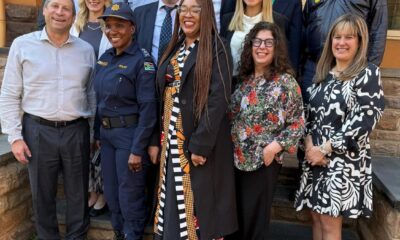
Finally, and less visibly than any of the above, leadership from our Johannesburg, Cape Town, and Durban councils met last week with senior representatives of the South African Police Service. The meeting was an opportunity to discuss our relationship and to show our appreciation to the various departments of the security services and their steadfast role in protecting our way of life in South Africa. The meeting also allowed us to discuss high-profile incidents, and to ensure that our lines of communication remain open.
Put together, these events point to a robust, proud, and visible community around the country. We work to ensure that our rights are protected through engagement with relevant authorities, we make sure that those who would abuse us are properly dealt with, and we express our identity in the open.
None of this happens by accident, and none of it happens quickly. Legal strategies take years to build. Trust with police leadership is earned meeting by meeting. Even a Shabbat dinner that seemed to come together on its own was, in truth, the product of a community secure enough to gather itself at a moment’s notice and make something meaningful. We are no longer choosing between being safe and being visible because we have learnt that the two reinforce one another. A community that shows up, in court, at the table, and in the street, is a community that is harder to intimidate and easier to protect. That is worth holding onto, long after this particular week has folded into the next one.