





News
UCT case shows it put Gaza before South Africa

When Professor Adam Mendelsohn took the University of Cape Town (UCT) to court over two resolutions it adopted in June 2024, he did so out of a deep concern for the institution, its students, staff, and ordinary South Africans. This was made apparent in the arguments of his legal team, led by Advocate Eduard Fagan SC, when the case was heard in the Cape Town High Court on 23 and 24 October.
However, Advocate Tembeka Ngcukaitobi SC, representing UCT, repeated multiple times that UCT had adopted the resolutions “for Palestine”, knowing that it would give up funding that would have benefited its constituents and ordinary South Africans, and that it would curtail academic freedom. Their supporters reinforced this in court.
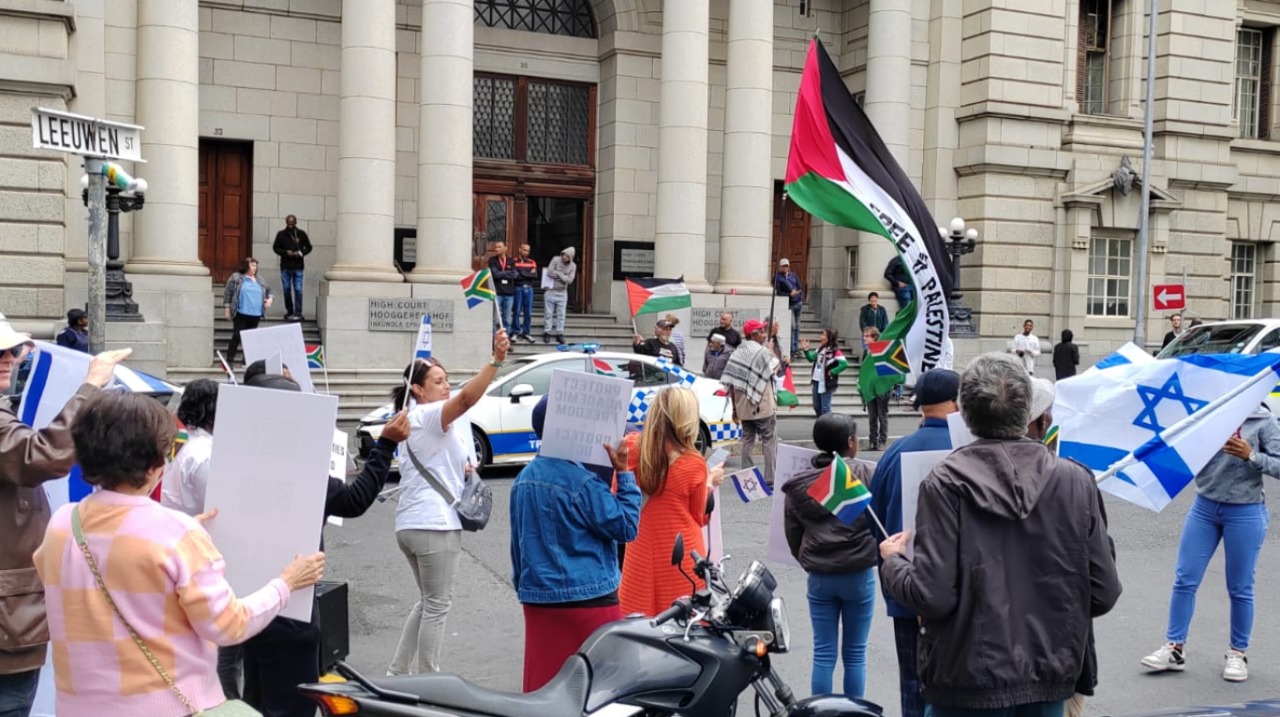
Outside court, anti-Israel extremists hurled abuse at anyone who supported Mendelsohn’s concern for UCT and the South Africans who would have benefited from donations. “Look at these disgusting Zios,” said Professor Usuf Chikte, the co-ordinator of the Palestine Solidarity Campaign, telling the media that “the Zionists are prioritising Jewish supremacy over everybody else”.
“One settler, one bullet. One Zionist, one bullet,” stated one female protester. Others yelled, “Long live the resistance!” and “There is only one solution: intifada resolution.” Mendelsohn’s supporters held signs saying, “Let ideas compete, not identities,” and “Universities should teach, not preach.”
The case was heard before Judges Robert Henney, Tandazwa Ndita, and Mark Sher. Mendelsohn, the director of the Kaplan Centre for Jewish Studies at UCT, was also head of UCT’s history department until he was suspended because colleagues expressed opposition to his legal application. He has since been cleared of any wrongdoing, but UCT hasn’t reinstated him.
Mendelsohn is calling on the court to order UCT to review or set aside two resolutions that its highest decision-making body, its Council, adopted in June 2024. He says UCT didn’t follow its own processes when adopting the resolutions, which curtail academic freedom and research.
The first resolution “resolves to reject the International Holocaust Remembrance Alliance’s [IHRA] definition of antisemitism” because of the IHRA’s “conflation of critique of Zionism and Israel’s policies as antisemitism”. However, Sher stated that this was “just an interpretation” of the definition.
Fagan noted that Mendelsohn’s application raised no issue with the other points of this resolution, such as calling for a ceasefire. It demonstrates that Mendelsohn’s case isn’t against those who want human rights for Palestinians, it’s about the legality of UCT’s actions.
That includes his allegation that the UCT Executive (Exco) hid from Council members that the university was in breach of a contract with the Donald Gordon Foundation (DGF) if it rejected the IHRA definition, meaning that the DGF would pull millions of rands of funding, including the donation of a hospital and R200 million towards UCT’s Neuroscience Institute.
Ngcukaitobi argued that because there was no explicit statement in correspondence from donors saying they would cancel funding, there was no need to warn Council. However, he ignored the fact that there were also verbal discussions and a contract that UCT signed which bound it to adopt the IHRA definition. Henney pointed out that this clause was drafted by UCT itself.
But court papers show that both the DGF and the Dell Foundation, which also removed funding in light of Hamas support on campus and the resolutions, tried to salvage the relationship with UCT. The fact that UCT had ongoing engagements to “resolve their concerns” suggests that there was a real risk of losing the donations, Fagan said.
Fagan also pointed out that universities aren’t for profit, so the narrative of UCT being “strong-armed” by donors is nonsensical. Donations are given only to help the university thrive and to benefit the disadvantaged, he argued, which is why UCT owed its constituents a thorough process.
All three judges showed discomfort with the fact that UCT didn’t reveal the full risk to Council. Sher compared this to a pharmaceutical company rushing to release a new drug and stating that there were related “health concerns”, but not elaborating, leading to a consumer having an allergic reaction. The judges also questioned the actions of Council chairperson, Advocate Norman Arendse SC, as Mendelsohn and the DGF both allege that he lied in his answering affidavit.
A major point of contention was whether UCT should have consulted with stakeholders before adopting the resolutions. As amicus curiae (friend of the court), the South African Jewish Board of Deputies’ (SAJBD’s) legal counsel, Advocate Mushahida Adhikari, argued that deciding on a definition of antisemitism without engaging with Jews is like “a group of men deciding on a definition of sexism without talking to women”.
But Ngcukaitobi argued that there was sufficient representation on Senate and Council.
Arguing for South African Jews for a Free Palestine (SAJFP) as amicus curiae, Advocate Geoff Budlender SC said it was “absurd” to ask the university to consult. When Henney pointed out that “those who experience antisemitism are Jews”, so maybe they should be consulted, Budlender responded that “those who are accused of antisemitism” should also be consulted. The SAJBD later said this was like “asking the Afrikaner Weerstandsbeweging [AWB] to be consulted on racism”.
The second resolution states that “no UCT academic may enter into relations with, or continue relations with, any research group or network whose author affiliations are with the Israel Defense Forces [IDF] or the broader Israeli military establishment”.
The judges asked what was meant by “enter into relations”; “network”; and “broader Israeli military establishment”. They questioned whether the resolution hindered academic freedom and human rights, for example, by ending a research project on tuberculosis between a South African and Israeli academic.
Ngcukaitobi said, “We don’t want our academics affiliated with the army of Israel”, and stated that “broader military establishment” meant auxiliary organs that “support the children they send to kill other people”.
He argued that the resolutions still needed to be refined into policy, so the way they were adopted and how they should be interpreted didn’t matter. He ignored the fact that Israeli academics were forced to sign statements declaring that they weren’t part of the IDF when attending a recent UCT conference.
He also said that the resolutions were put before Council twice after June 2024, with more information, and both times, it voted not to rescind them. Therefore, he said, it did nothing wrong in adopting them.
SAJBD National Director Wendy Kahn said the SAJBD joined the case to demonstrate “the hostile environment in which these resolutions were adopted, and their impact on Jewish students and academics at UCT.
“We need to ensure that diversity is respected [at UCT], where no individual is targeted based on their identity, including being Jewish and Zionist,” she said.
Kahn emphasised that this was a watershed case, the outcome of which extended beyond UCT, with implications for Jewish communities locally and internationally. It would help determine whether Jewish South Africans could “continue to rely on constitutional protections when their dignity and safety was at risk in public institutions”.
South African Zionist Federation spokesperson Rolene Marks said the case revealed “grave governance failures” and “how a faction within council has wilfully undermined the institution through its obsessive campaign against the Jewish state”.
Academic freedom “has been curtailed, Jewish students and academics no longer feel safe on campus, and a chilling effect has taken hold over engagement with Israeli academia”, Marks said. “It’s a travesty that ideological activism has been allowed to eclipse good governance, integrity, and the university’s duty to its students and staff.”
Sara Gon, the director of the Free Speech Union of South Africa, said Council “serves the provision of education to every person at the university, irrespective of their views on the most contentious issues”.
This is why many universities had decided that “political issues must not be expressed by the ultimate managerial body,” Gon said. Debate and controversy “are the lifeblood of a university, but not of the administration”.
The case continues on 30 October.




Jessica
October 31, 2025 at 10:24 am
Jihadis, all. Goes to show that “moderate Islam” is merely a front for the Jihad.
Alan Berger
November 7, 2025 at 12:20 pm
This is disgusting, that UCT, has chosen Palestine side. All those implicated should be expelled and never allowed to study again. Where is the UCT Rector, Managers and staff.
Hope all funding to UCT gets stopped for good.
You disgust me.