Lifestyle/Community
Honouring the dead and those living through war

A father describing his children running to shelters, a soldier’s final act of bravery, and a toddler shaped by war formed the heart of the Yom Hazikaron ceremony in Cape Town this week.
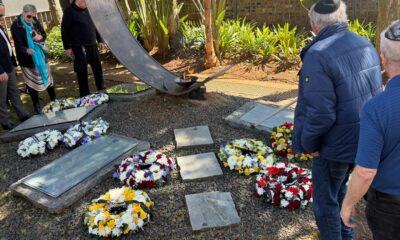
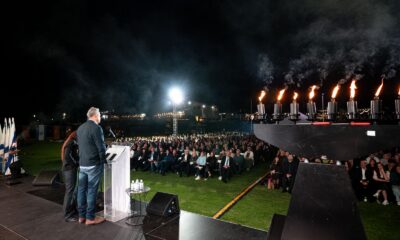
While the evening at the Cape Town Holocaust & Genocide Centre had the traditional elements of remembrance, the most moving moments came through personal stories.
One recalled Danny, who was killed in a terrorist attack in his home in 1995. He was described as someone who had embraced life and community. In his final moments, he fought the attacker, allowing his wife and children to escape. His actions were presented as a reflection of instinctive courage, shaped by deep commitment to family and identity.
Roy, a soldier who died during the Second Lebanon War in 2006, had been academically gifted, creative, and deeply engaged in life. His final act, jumping on a grenade to protect others in his unit, was framed not as a single moment of bravery, but as the result of values built over time. “These were the same values that defined his life,” said Eitan Frei, a bochurim to Cape Town.
Joshua Schewitz, executive director of the South African Zionist Federation Cape Council, brought the lived experience of Israelis today into sharp focus. “As a father, you just focus on protecting your kids,” he said, describing moments of rushing to shelters during missile sirens. He said even young children internalise this reality.
Schewitz shared a conversation at home in which one of his daughters spoke about wanting to become an air force pilot, while another expressed a desire to guide military targets. He said such conversations are not unusual in Israel, but reflect a childhood shaped by conflict.
Schewitz described the fear often felt only after the immediate danger of a missile has passed. His account highlighted how families continue to function despite ongoing uncertainty.
His wife, Daphna, offered the perspective of someone who grew up in Israel. She described military service as a given part of life, influenced by generations who served before. Her father fought in multiple wars, and she spoke about the continuity of that experience across families.
Standing on stage with their two-year-old son, she explained that his entire life so far has taken place during conflict. This has shaped his behaviour, including a reluctance to being separated from her.
At one stage during her address, Joshua walked with their son to the back of the room to allow Daphna to speak uninterrupted, and the boy sobbed, shouting, “Ima! Ima! Ima!”, calling for his mother. A tangible demonstration of the effects of growing up in conflict.
Another reflection on daily life came through a written piece titled “The messy middle”, which first appeared on a WhatsApp group, and was read with permission from the author. It described the emotional strain of moving between crisis and routine. It captured the uncertainty of the ceasefire. “A ceasefire is not peace,” the text said.
The reading described the tension between relief and ongoing anxiety, and the challenge of resuming normal activities while still processing trauma. It emphasised that recovery is not immediate, and that emotional responses often lag behind events.
While the ceremony included traditional elements such as prayers and candle lighting, they supported rather than defined the evening. The lighting of candles by youth representatives and community members symbolised continuity, but the focus remained on the stories behind the names.
The presence of Sam Zinn, a 101-year-old veteran of the 1948 War of Independence, added a historical dimension. His participation connected past and present, reinforcing the long history of sacrifice that Yom Hazikaron represents.
Opening remarks by Mia Briner, chairperson of the Zionist Youth Council, set the tone by linking remembrance to both grief and gratitude. She referred to the lasting impact of 7 October, saying it continues to shape collective memory. “Each life lost, an entire world destroyed,” she said.
Her words echoed throughout the evening, with each story providing a different lens on loss, courage, and resilience.
The ceremony underscored that remembrance is not only about honouring those who have died, but about understanding the lives they lived and the realities of those they left behind. As the community gathered in Cape Town, far from Israel, these stories created a shared space of reflection that bridged distance through personal experience.