





News
Zille stands firm on Joburg focus amid anti-Israel storm

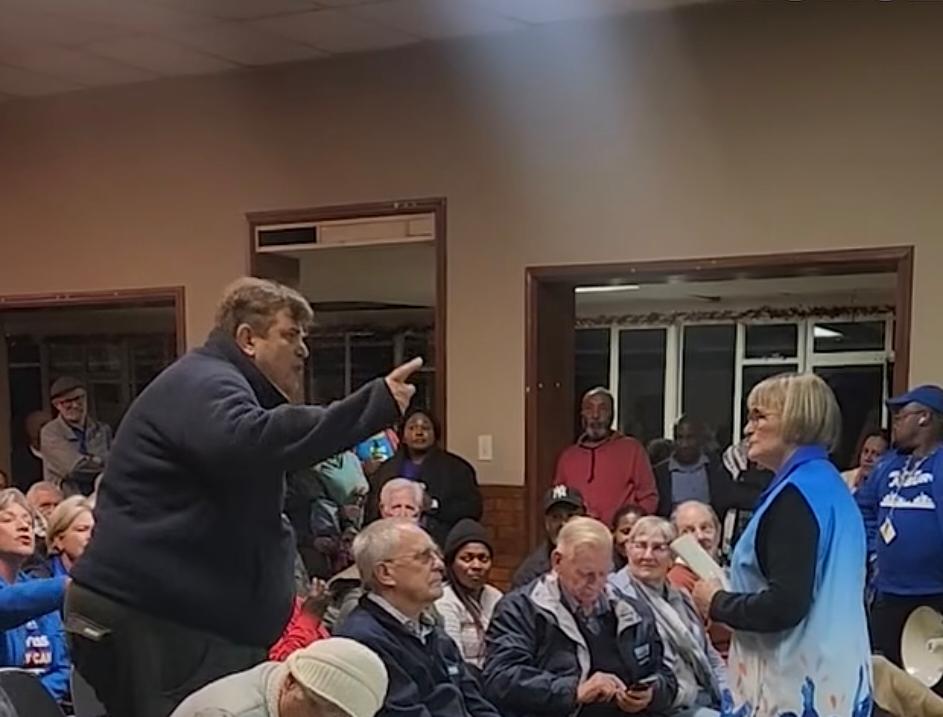
An Israel-hating pastor confronted Helen Zille about the Democratic Alliance’s (DA’s) supposed stance on Gaza, at a DA campaign event in Johannesburg recently.
Nigel Branken challenged the mayoral contender in front of a packed audience at the Kensington Club.
“You continue to deny there is a genocide,” he shouted from the audience. “Where is your morality? How many more children must die? How many people must starve, Helen Zille?”
This was recorded and widely shared online, prompting debate about the role of international issues in local elections.
Political commentator and former Sunday Times editor Ray Hartley said the incident reflected broader concerns about how emotionally charged issues are being brought into local campaigns.
“Divisive, emotional sloganeering delivered in a threatening manner has no place in our discourse, let alone in a local government election, which ought to be about saving Joburg from disaster, not single-issue radicalism,” he said.
Zille calmly addressed attendees at the meeting, saying, “There are terrible and serious things happening all over the world. And believe me, I take a great deal of interest in that, and I read a lot about it. And if you know anything about my history, you’ll know that I know a little bit about genocide too.”
But she said her focus is on building South Africa and cultivating unity at home. “South Africa has a different project. And that is taking people from extraordinarily diverse backgrounds, cultures, religions, races, ethnicities, and levels of development. And our project is to make it work for everyone.
“Our project is to show the world, including the Middle East, that Muslims and Jews, and Christians and agnostics and atheists can live together in one country by respecting each other’s rights and defending each other’s rights,” she said.
Zille claimed to be unscathed by Branken’s attack. “I am not bothered by criticism, wherever it comes from. I don’t want to make this election about the Middle East, so I’m not going to discuss it. Nothing that I can say is going to have any impact on the situation there, but just make it very difficult for us to win Joburg, which we are trying to do,” she said.
Zille accused critics of trying to shift the campaign agenda. “People like Nigel Branken are trying to drag us onto this field. I am not going to follow.”
Her remarks reflect a deliberate campaign focus on local governance. Johannesburg continues to face serious challenges, including unreliable electricity supply, water disruptions, and financial instability. The DA has framed its campaign around improving service delivery and restoring administrative capacity.
According to experts, the incident at the Kensington Club shows how the Israel-Palestinian conflict is used to sway political opinion in unrelated areas.
Darren Bergman, DA spokesperson for planning, monitoring, and evaluation in the Office of the Presidency, defended Zille’s handling of the situation, saying her response was appropriate in the context of a local campaign.
He argued that public reaction had focused too heavily on the confrontation itself. “I am disappointed that many have spread the challenge but few have been generous and fair in sharing her response,” he said. “People need to be very clear that Helen is here to save Johannesburg, that is her aim and objective. She cannot solve Middle East issues too.”
DA Member of Parliament (MP) Michael Bagraim agreed. “Helen is quite right to explain that we have more than enough troubles of our own,” he said, adding that focusing on an external issue beyond South Africa’s influence was “disingenuous”.
Despite these defences, criticism of the DA continues. Opponents argue that political parties cannot avoid taking positions on major global issues, particularly those involving human rights. They say that even in local elections, voters expect clarity on matters of international concern.
The DA’s perceived stance on Israel has become a focal point in this debate. Critics say the party’s position differs from that of the South African government, which has been outspoken in its support for the Palestinians.
The controversy has also drawn in voices from other political parties. Steve Swart, an MP from the African Christian Democratic Party, criticised what he described as selective outrage in public responses to the conflict. “It is disgraceful how pro-Palestinian activists not only ignore the horrific Hamas attacks on Israel on 7 October, but also twist the truth to suit their purposes,” he said.
Swart also addressed claims about legal findings on the conflict. “The International Court of Justice has made no finding that Israel committed genocide in Gaza. That is still to be decided when the merits of the case are heard,” he said.
He went further, questioning the focus of international activism. “It is equally disgraceful that nothing is said about human rights abuses elsewhere,” he said, referring to reports of large numbers of protesters killed in Iran. “Why do we not see protests in the capitals of the world against this and similar atrocious human rights abuses elsewhere, while Israel is continually singled out? It is clearly a case of double standards being applied.”
Sara Gon, a fellow at the SA Institute of Race Relations, said Zille had been put in a difficult situation. “Zille faced the ultimate challenge, which is a nightmare to face, in that to answer the accusations would be impossible particularly in the context of a public meeting,” she said.
Gon said Zille handled the confrontation well. “I think she did well in the heat of the moment. I do, however, think that the issue of confronting these accusations, particularly when debate is impossible, needs to be debated by the DA because it is going to be faced with this repeatedly in the run-up to the elections.”
Gon added that broader input may be needed. “It might be an appropriate issue for the Jewish community to contribute to and help craft suitable responses to meet a slew of accusations that cannot be dealt with in the context,” she said.
Responses from political figures, analysts, and activists reflect differing expectations of what leadership should address in local elections. As campaigning continues, the extent to which parties engage or resist such issues may shape both voter perceptions and the direction of the race for control of Johannesburg.




yitzchak
April 28, 2026 at 6:04 am
HZ has made a video of the state of Joburg,s civic centre. Getting anything done there is a nightmare.
But cronies have bought buildings in Braamfontein where the JBG City offices have moved to and the landlords now receive rent from the citycouncil whose own offices are a shambles.Those landlords have an interest therefore that the civic centre not reopen.
I wish the DA well in Gauteng. But the DA has a constituency problem. With semigration and emigration the voter base has been truncated since those votes are elsewhere. And that might make the difference in the vote. Gon with the wind, so to speak.