Featured Item
Art of a lifetime: Albie Sachs’ rebellious art collection

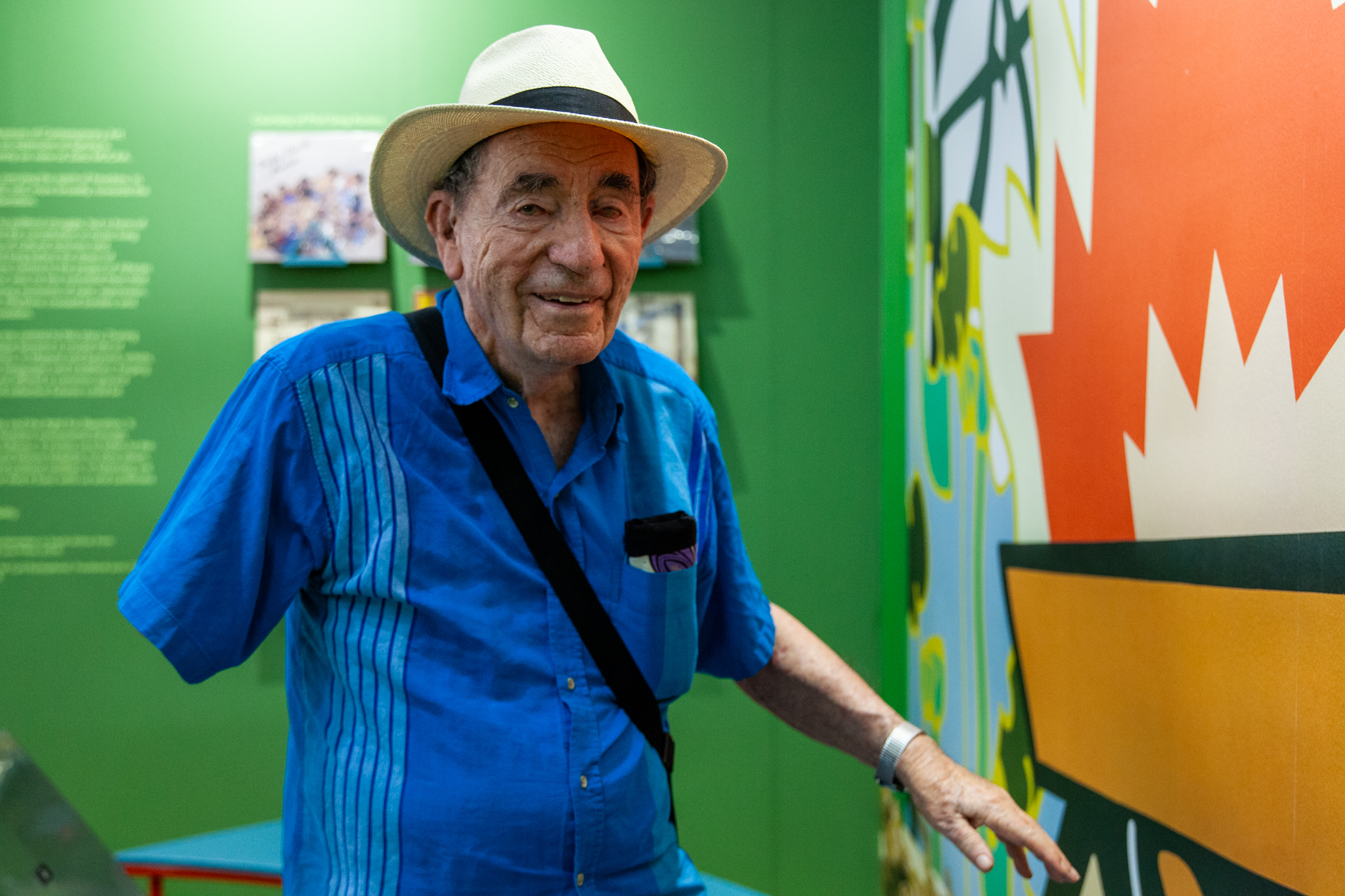
From exile and injury to the drafting of South Africa’s Constitution, South African activist, writer, and former Constitutional Court Judge Albie Sachs’ life reads like a chronicle of the nation’s turbulent journey to democracy. In Spring Is Rebellious, now on show at the Zeitz MOCAA Museum in Cape Town, that journey is explored through art, memory, and reflection, revealing the human spirit behind the public figure.
The year-long exhibition is based on Sachs’ experiences in the independent art world in Mozambique; his friendships with South African artists while in exile; and finally, his work in the Constitutional Court as a judge and in building the court’s art collection.
Sachs told the SA Jewish Report that the title of the exhibition Spring Is Rebellious came from a paper he wrote in 1989 while still in exile. “The paper said preparing ourselves for freedom and going to go back home soon, are we ready for freedom? One of the aspects of freedom is that we’ve got to open our minds to a new country. And when it comes to art and culture and expressions of who we are, we’ve got to get out of the very narrow framework of simply saying art is a weapon of struggle. We will see art as something much richer, much broader. It’s part of the struggle, but it’s much more than that.”
Sachs said this paper caused much controversy and commentary, and those commentaries were put into a book titled Spring is Rebellious, published in 1990. “It was a time of change in South Africa, and exiles were coming back. The curators at the Zeitz MOCAA Museum decided to use that as the title of the exhibition,” he said.
As well as being at the Zeitz MOCAA Museum until August 2026, the exhibition was shown at the Investec Cape Town Art Fair on 22 February.
Sachs said that when he visits the Zeitz MOCAA Museum and the exhibition is full of people, he feels a sense of pride. However, when he was at the Investec Cape Town Art Fair, he felt a certain electricity particularly because people were there from the whole of Cape Town, and the booth wasn’t a sterile place but full of the energy of his younger years.
“It’s a small space. It’s not an exhibition space,” he said. “They’ve taken some of the murals that are in the art gallery in the Zeitz MOCAA Museum and replicated them on the walls, very bright, vibrant. And then they’ve got an old-fashioned gramophone with music from the time when I was younger, with the covers of Hugh Masekela way back, and they play the music. And my son, who is 19, said he loved that music, he loved hearing it, he loved being in that ambience, so they didn’t make the booth into a miniature gallery, it wouldn’t have worked. They made it evocative of the sounds of the time when I was involved in struggle, and people came away smiling and had their pictures taken inside it. It was lovely to be there.”
The exhibition is made up of the art from Sachs’ personal collection. “It’s art that’s been part of my life. And it’s art in Mozambique. I was close to the artists. They did extraordinary, very rich art. I’ve donated what I acquired to the University of the Western Cape,” he said. “It’s art that influenced me while I was in exile – Dumile Feni’s work. And it’s art that’s in the Constitutional Court Artworks Collection. It’s the only top court in the world that has an expansive art collection. Many courts have pictures of usually dead white male judges. We’ve got tapestries, sculptures, paintings, art of many different forms that represent the diversity, the variety of people in this country, of emotions and configurations.”
Sachs was initially worried when approached to do this exhibition. “I was worried it would be a boring thing about this important man, and abstract stuff about the importance of art in society, and so on. Instead, it’s light. It’s provocative,” he said.
The exhibition has timelines including South Africa from apartheid to democracy; a timeline of Sachs’ life, including his practice as an advocate, going to jail, being in exile, being blown up, coming back, and becoming a judge on the Constitutional Court. The last timeline reflects the story of Mozambique from colonial possession of Portugal to an independent country which gave support to the freedom struggle in South Africa.
“These timelines have illustrated sections, and you can see the young me, the older – and I’d like to think wiser – me. It’s light, it’s attractive. The theme of art comes in because at different phases, different times in different locations, the artwork had a different character. So it’s not a long essay about me illustrated with nice pictures – ‘and he was a collector’. I never saw myself as a collector. I acquired art, and gave most of it away. Most of the art I acquired is in the Constitutional Court collection or at the University of the Western Cape.”
Sachs said that what he loves about the exhibition is the diversity of the pieces in the collection.
“Resonance comes not only from the particular work, but how it contrasts with the other work,” he said. “But the work I spend the most time with is a carving that was done in Mozambique in 1988 by an artist known as Govane, and it’s a long piece. Normally, carvings show that they’re made from a trunk, so they show upright figures. This was made from the roots, and it shows bodies lying down during a time of war. An agonised man, very, very weak, is using his last bit of strength to cradle another man who is dying. It’s tender, exquisite, beautiful. Dealing with such a harsh situation. If I do a walkabout, I start there.”