



OpEds
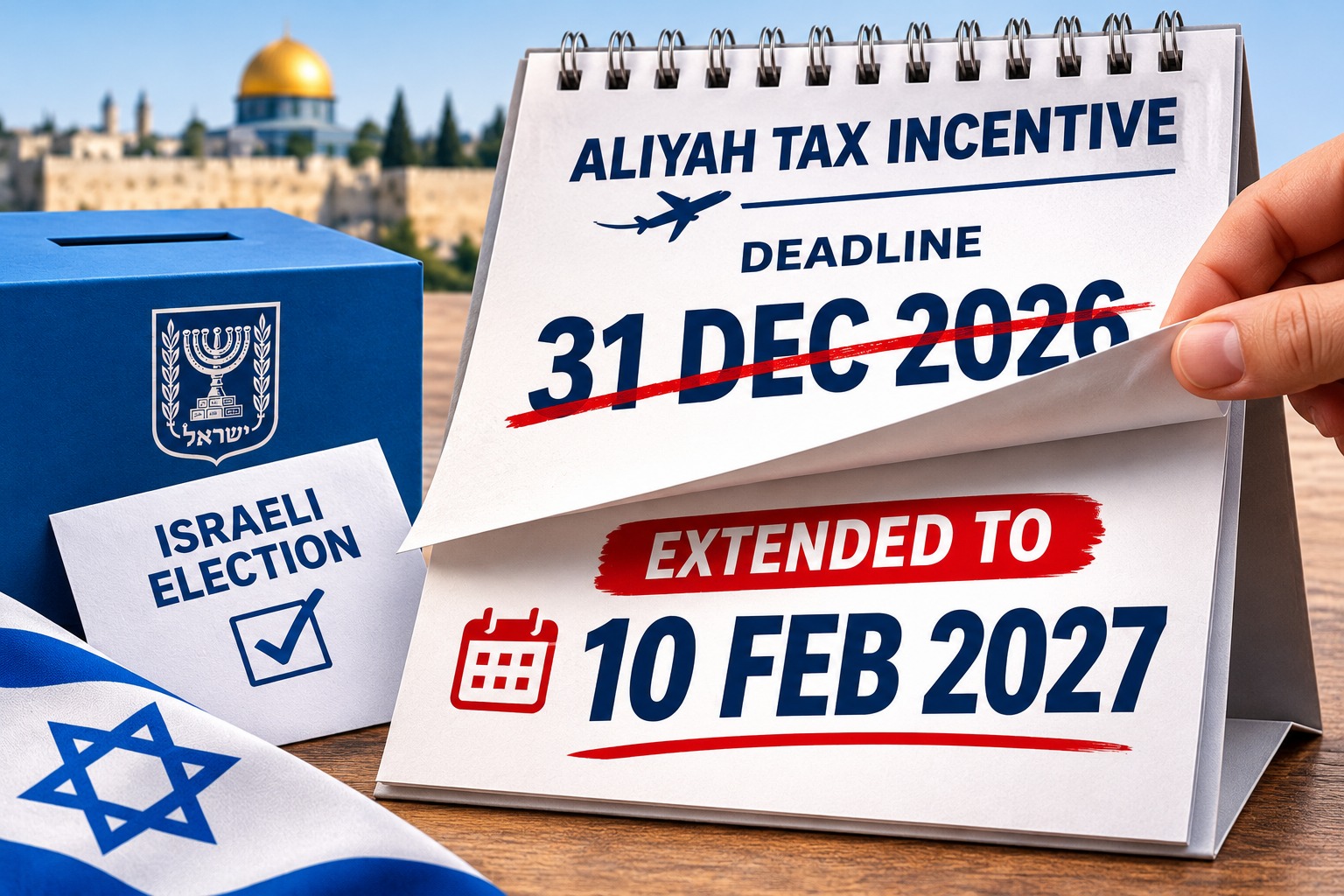
Israel’s election deadlock a gift for would-be olim

Last week’s inconclusive election may have left Israel without a clear path to a new government. But for South Africans considering aliya, it has delivered an unexpected bonus: six more weeks to qualify for one of the most generous tax incentives Israel has ever offered new immigrants.
Earlier this year, the Israeli government introduced a temporary tax exemption on income earned from working in Israel, designed to encourage skilled professionals, entrepreneurs, and business owners to make aliya.
The catch was that the incentive was available only to those who became Israeli tax residents by 31 December 2026.
That deadline has now been extended to 10 February 2027.
And, somewhat unusually, we have the Israeli election to thank.
Under Israel’s Basic Law, certain legislative provisions due to expire during the first three months of a newly elected Knesset are automatically extended until the end of that period. Following the 27 October election, this provision has extended the qualifying period for the tax incentive. The Israel Tax Authority has already confirmed the extension and updated its official application system.
The incentive remains substantial. Qualifying new immigrants and long-term returning residents can earn up to NIS 1 million (R5.3 million) a year in Israeli-source employment or business income free of Israeli income tax, in both 2027 and 2028. The exemption then drops to NIS 350 000 (R1.8 million) in 2029 and NIS 150 000 (R793 870) in 2030.
This is particularly attractive for professionals who can continue working remotely for their South African employers after relocating to Israel. Because employment income is generally sourced where the work is physically performed, such income may qualify for the Israeli exemption, subject to certain conditions.
Take, for example, a South African actuary earning R2.6 million annually who moves to Israel with his family before the 10 February 2027 deadline. He continues working remotely for his South African employer, but now performs his duties from Israel.
At that salary, he would ordinarily pay close to R1 million a year in South African income tax. By genuinely relocating to Israel, ceasing South African tax residency, and qualifying for the Israeli exemption, he could potentially save this amount in 2027 and 2028.
This temporary incentive complements Israel’s long-standing 10-year exemption on qualifying foreign-source income, including foreign capital gains, dividends, interest, and rental income. Together, these incentives can significantly ease the financial cost of making aliya.
But there is an important catch. The deadline is not simply about getting on a plane to Israel. It’s about genuinely moving your centre of life there.
Israeli tax residency depends on where you actually live and where your personal, family, and economic interests lie. The authorities will consider where your permanent home is, where your spouse and children live, where your children attend school, where you work, and where you spend your time.
Obtaining a Teudat Oleh (new immigrant certificate) or arriving in Israel shortly before the deadline does not, on its own, establish Israeli tax residency. The move must be genuine and supported by the facts.
Becoming an Israeli tax resident does not automatically mean that you have ceased to be a South African tax resident.
South Africa taxes its residents on their worldwide income. To avoid remaining liable for South African tax on income earned while working in Israel, it is essential to properly establish your cessation of South African tax residency and declare the change to the South African Revenue Service.
There can also be a sting in the tail. Ceasing South African tax residency can trigger a deemed disposal of certain assets for capital gains tax purposes, commonly referred to as “exit tax”. Moving money and assets abroad also requires careful consideration of South Africa’s exchange control rules.
Getting the timing and structuring wrong can be expensive and requires pre-aliya planning.
For prospective olim who hoped to relocate before the end of December but were struggling to finalise their arrangements, the extension is welcome news.
It provides some breathing space to obtain those elusive police clearances and unabridged birth certificates, organise housing and schooling, and restructure financial affairs to minimise the tax consequences of leaving South Africa.
But six weeks can disappear remarkably quickly when you’re trying to uproot a family and establish a new life in another country.
Anyone hoping to take advantage of this opportunity needs to start making concrete arrangements now.
The potential tax savings could run into millions of rands over the coming years. It would be a great pity to lose this opportunity simply because the practical arrangements were left too late.
Israel’s election may not have delivered the political certainty many had hoped for. But it has given would-be olim an unexpected reprieve.
The new deadline is 10 February 2027. Prospective olim shouldn’t count on another extension.
- Michael Kransdorff is chief executive of the Institute for International Tax and Finance.