Israel
Life under fire for South African olim in northern Israel

The call between oleh Kenny Struwig and the SA Jewish Report begins like any other interview. A greeting, a check on the sound, a polite apology. Then, in the background, a low boom rolls across the line. It won’t be the last.
For South African olim like Struwig living in northern Israel, war is not an abstract headline. It’s the sound that interrupts a sentence, the room you move to without thinking, and the silence that follows an explosion.
Struwig lives on Kfar Giladi, a kibbutz a few kilometres from Kiryat Shmona, one of the most heavily targeted areas in the north. “It’s pretty much all day, every day,” he says. “Rockets going over, aircraft infiltrations with drones.”
His children, aged 13 and 16, no longer attend regular school. “They’re doing a lot of Zoom training,” he says. “They’re pretty much in the house most of the day.” When the siren sounds, there is no debate. “You just go into one of the safe rooms and wait,” he says. “Two minutes, maybe 10 minutes. Then you go back to what you were doing.”
That routine, repeated dozens of times, has reshaped daily life. What once felt urgent now feels ordinary. “It’s become very normalised,” Struwig says. “You just carry on as if nothing is wrong.” That normalisation becomes clear during the interview. A siren sounds in the distance. He pauses, listens, then continues speaking. Moments later, another noise cuts through.
“That’s a rocket going over now,” he says. There is a brief silence. Then a distant boom. “You’ll hear the explosion,” he adds. The conversation continues.
Struwig explains how the threat isn’t only from incoming rockets, but also from outgoing fire. Tanks and artillery stationed nearby fire into southern Lebanon throughout the day and night. “The whole house shakes,” he says. “Windows have already been broken.”
Sleep is fragmented. Silence is temporary. The body keeps score. “My ears are sore all the time,” he says. Despite this, he still goes to work at an essential factory about 30 minutes away. The roads are quieter than usual. “I choose to go in sometimes,” he says. “But it’s unsafe.”
The danger isn’t theoretical. Rockets aren’t always intercepted. “One fell about 100 metres from me,” he says, recalling the time he was driving when a siren went off, he had to quickly pull over, and the nearest place was a cemetery, where he hid until it was safe to leave.
He speaks about shrapnel scattered across the kibbutz after interceptions. “We go around and pick it up,” he says. Nearby towns have been hit. A young woman from his kibbutz was killed when a rocket struck near her. Another man died in a separate incident. “Everyone knew them,” Struwig says.
Loss sits close, even when unseen. “You don’t believe it could actually happen,” he says. The emotional impact is harder to measure. “There’s a lot of hidden trauma,” he says. “People are more impatient. More argumentative.”
Family life is affected in quiet ways. “I’m more overprotective,” he says, describing differences between himself and his Israeli-born wife. Their daughter, now in the army, returns home on weekends when she can. She is training as a helicopter technician and her routine involves long, uncertain journeys across a country at war.
Yet, despite everything, Struwig doesn’t speak about leaving. His reasons are layered. His children have grown up in Israel. Their lives are rooted there. He also speaks about what he has seen the country do for its citizens. “They relocated tens of thousands of people from the north,” he says.
As the interview continues, more sirens sound in surrounding areas. The rhythm of attack and interception continues in the background. “This is what you’re hearing all the time now,” he says.
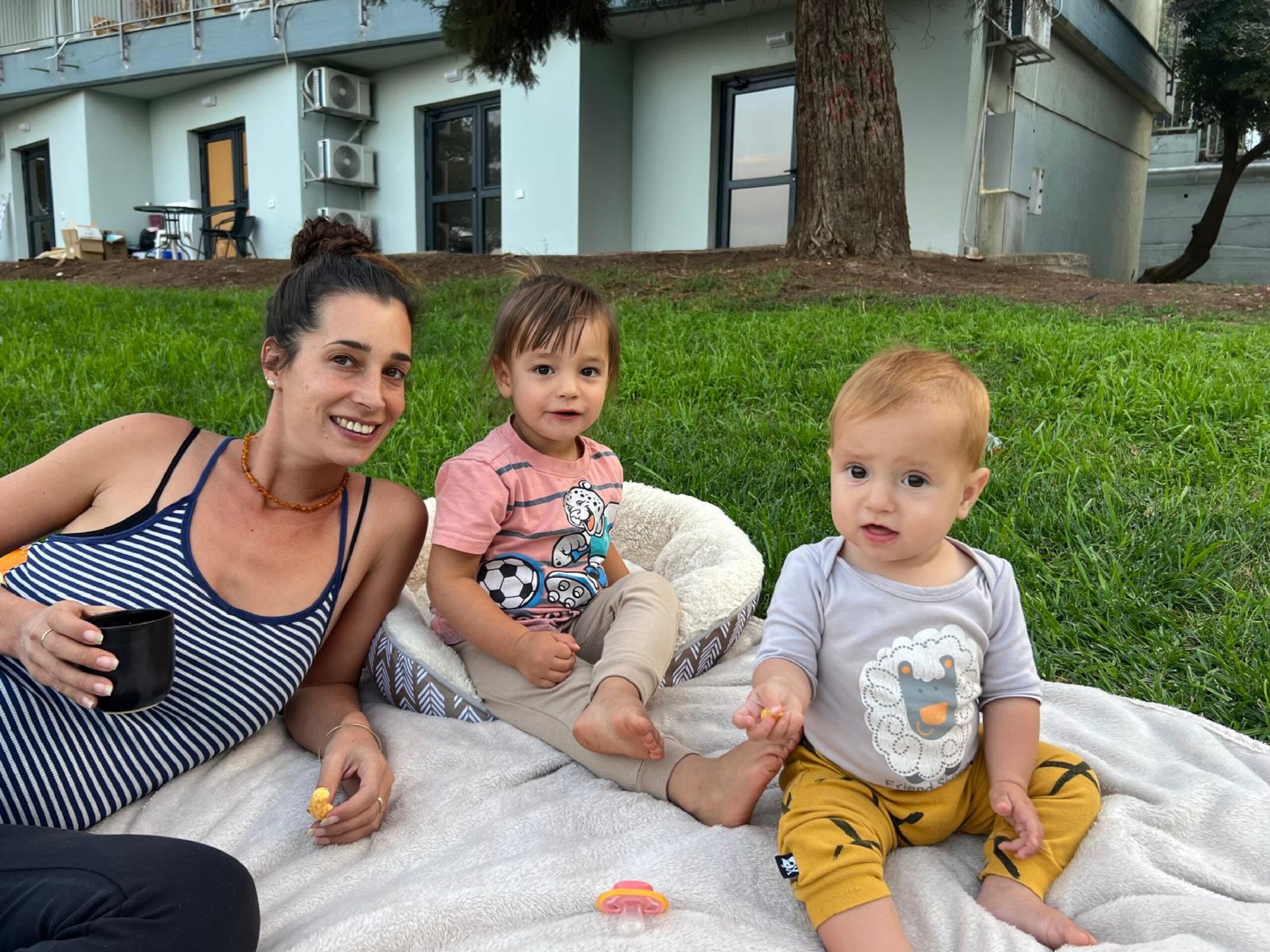
Further north, Moran Kurland Vasebali describes a different but connected reality. She lives on Kibbutz Manara, on the border with Lebanon, where she was raised by her South African-born parents. “I grew up with rockets over my head,” she says. “But it’s never been as tough as it is now, especially as a mom.”
She has two young children. Michael is nearly three, Tamara just over a year old. Her family’s life has been repeatedly disrupted. After the war in Gaza began, they were evacuated for more than a year. “That’s something that’s never happened here,” she says.
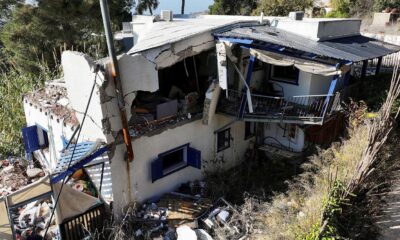
When they returned, much of the kibbutz was destroyed. “Seventy-five percent of the buildings were hit,” she says. Public spaces were damaged. Infrastructure was gone. Many residents didn’t return. “Only 60% came back,” she says.
Her own extended family was deeply affected. The homes of her sister, parents, and brother were all hit. Despite this, she chose to return. “Something told me in my heart this is my home,” she says.
That choice requires constant adjustment. Her husband is part of the kibbutz first response team. She often manages alone with the children. They have created emergency plans for different scenarios. “If something happens, I know exactly what to do with the kids,” she says.
These plans include coded messages, prepared bags, and decisions about when to hide or flee. At the same time, daily life continues in unexpected ways. She describes sitting with her son and watching an interception in the sky. He thought it was a star. When she explained it was a rocket, he became curious. “He asks me to show him rockets,” she says.
Childhood adapts to its environment. There are moments of loss that are harder to explain. When her mother’s home was destroyed, there was little left to recover. “Everything was burnt,” she says. Her young son has never seen the house where she grew up.
Still, she speaks about community with warmth. “It’s like a big family,” she says of the kibbutz. Support has come from outside as well, particularly from South African Jewish organisations. She describes this connection as a second family.
There is also frustration. She expresses disappointment with the government’s response and the slow pace of rebuilding. But her outlook remains forward-facing. She speaks about peace, about raising her children where she was raised, and about not letting fear dictate life.
“It’s a choice,” she says. “The choice is not to let fear take over our decisions.”
Back on the call with Struwig, the sounds of war continue. More distant booms. More pauses. “This was actually quiet,” he says. For those living it, this is what quiet now sounds like.
-
Telfed has been providing support and assistance to SA Olim in the north, and arranged for the interviewees to speak to the SAJR.