





Israel
The song of soldiers

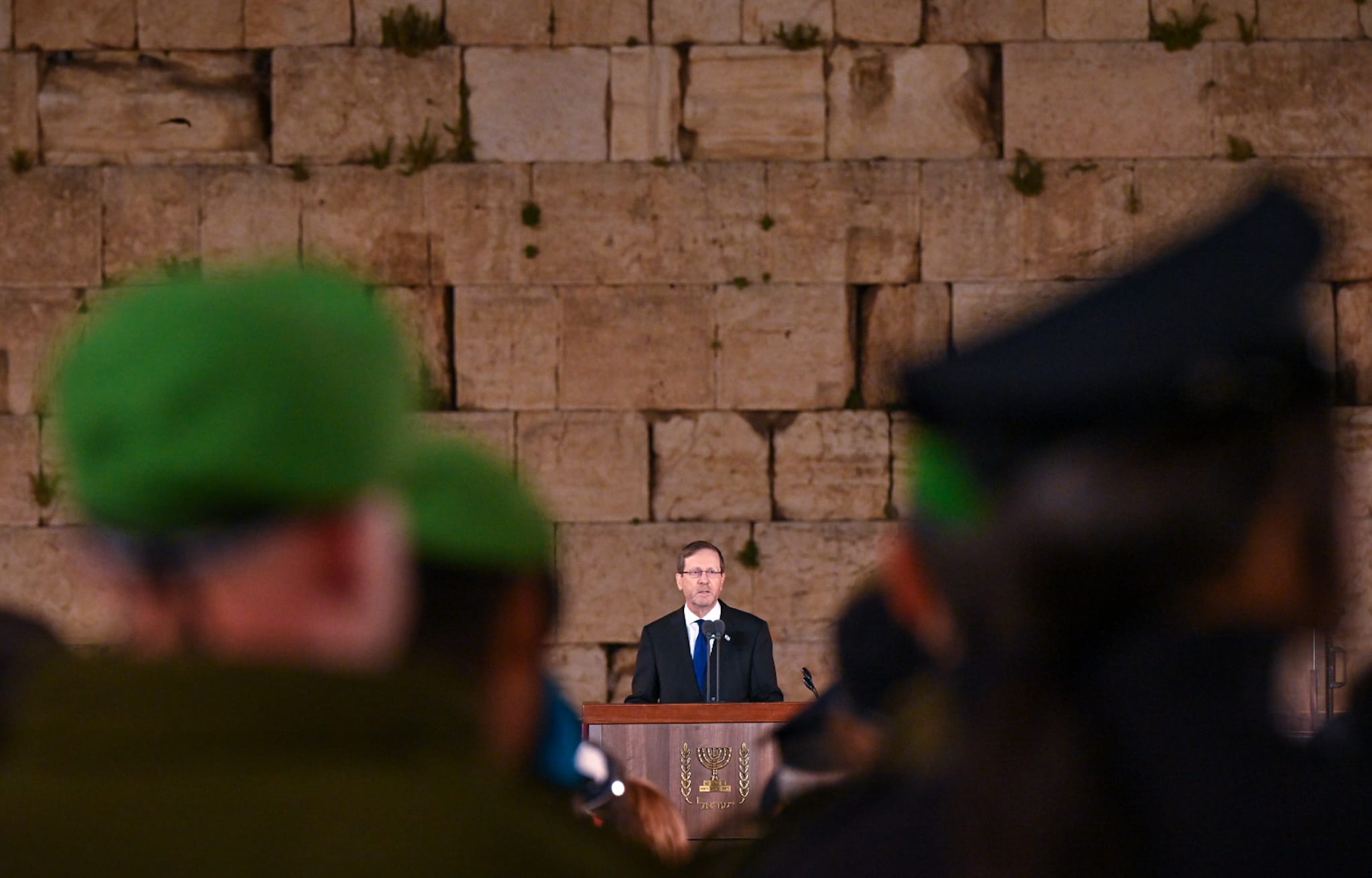
Israeli President Isaac Herzog spoke at the Official State Ceremony for Yom Hazikaron at the Western Wall in Jerusalem on Monday evening, 20 April. These are his words:
Major Dr Eitan Menachem Neeman was a beloved doctor in the Paediatric Intensive Care Unit at Soroka Medical Center in Be’er Sheva, who devoted his days to saving lives and caring for children from across the Negev. On the morning of 7 October, Eitan rushed to the hospital, stood between the wounded, and fought for their lives. The next day, he was called up for reserve duty ‒ a call to serve that he insisted on answering, despite his important role at the hospital.
On 9 October, while scanning the outskirts of the city of Sderot, Eitan’s team encountered terrorists in the area. Eitan chose, as he always did, to charge forward. He fought heroically until he fell in battle, alongside his comrades Captain Yuval Halivni and Master Sergeant Avihay Amsalem, may their memory be a blessing.
Two years later, at the Barmitzvah celebration of Eitan’s son, here at the Western Wall, when his family happened upon the rabbi who had tended to Eitan’s body, his family learned of another chapter in the story of his heroism. They learned that Eitan died while gripping in his hand a live grenade that the terrorists had thrown towards his unit ‒ a grenade that Eitan caught, but did not have time to throw back. Eitan, aged 45 when he fell in battle, was survived by his wife, Yael, and their seven children, his mother, Hadassah, his five sisters, and a multitude of people who owe him their lives.
This year, Eitan’s cousin Professor Shulamit Elizur published in his memory an ancient liturgical poem that she recovered from the Cairo Geniza. This liturgical poem was composed by Rabbi Natan ben Yeshua, rabbi of the ancient city of Gaza and a bereaved father, upon the death of his son nearly 1 000 years ago. A thousand years separate Rabbi Natan from Eitan, yet between them runs a thread of the generations ‒ a thread of pain, a thread of song and of creation. Personal memory and private grief, interwoven into the memory of the nation.
“Weeping, I weep,” writes Rabbi Natan in his moving words: “Weeping, I weep, and my spirit is shrouded, over a cluster plucked from the vine; over its new wine, tears shall my eye drip, before I could even drink of it ‒ it was snatched from me.”
As we enter this sacred day, I wish to offer a prayer for our warriors and all Israel Defense Forces (IDF) soldiers and security forces, in regular service and reserves, wherever they may be. An entire nation stands behind them. We are still in the midst of the campaign. In recent days, to our deep sorrow, more precious and beloved sons have been added to the list of the fallen.
War is a fateful time, a national test, and as a nation we are meeting it with extraordinary strength, and will continue to meet it with determination and resolve, through all the unbearable pain. I wish to thank all those who serve in the security forces, emergency services, rescue teams, and supporting organisations, and to wish a full and speedy recovery to all those wounded in body and soul, in this campaign and in all of Israel’s wars. I embrace them and their families.
When the battles cease, silence descends. Like the sacred moment after the siren that tears through the sky. But there is no rest in this silence; it is a heavy silence, a silence that leaves a void. The silence in which a mother leafs through an album and sears each memory into her eyes. The silence of a beloved, thinking of his partner as she managed to type a message, but did not have time to send it. The silence of a little girl and boy, for whom an embrace by a father or mother is but a meaningless word. The silence of a grandson who promised to visit but never came. The silence of a granddaughter who planned to call, but whose voice will no longer be heard. The silence that has no language, and offers no comfort. And within this silence, we understand that here too, before the Wailing Wall, words come to a halt, and stillness remains.
On this occasion, I stand before you, bereaved families, in sacred awe at the threshold of your home, and on behalf of the entire nation, I ask your permission to enter, to sit with you, to be with you, to weep with you, to feel together the pain of the void in which there is no air to breathe. To remember all of your loved ones.
Over the past two and a half years, our land has been filled with their images. At every street corner, innocent and beautiful faces smile at us, and beside them, a short line of text, a greeting from a hero that reads like a final wish on every corner. Fallen women and men, a name, a picture. And beside each face, a sentence, a quote, or a request: “Don’t stop dancing”, “With a smile!”, “Be good, be the very best!”, “Oh the strength we have!”. Words that join together into one great song, sounds of remembrance on stickers, our generation’s “sticker song” ‒ the song of the departed soldiers, the song of a remarkable generation. This is a song of soldiers, of warriors ‒ women and men ‒ who fought and fell for the right to sing the song of our people, for our collective right to carry the song of life.
Captain Be’eri Hazak wrote in his notebook of poems: “G-d Almighty ‒ please enhance the power of Your signals.” Be’eri, of Kibbutz Afikim, fell in the Yom Kippur War, in the battle west of the Suez Canal. In Weeping Shall You Reap Me is the title of the book of poems he left behind, and within it the immortal words set to music and sung by Berry Sakharof, in which Be’eri, whose name is so symbolic, calls to himself, calls to his fellow warrior, calls to the nation, calls to the Master of the Universe: “Please enhance the power of Your signals.”
“And if ever I should die, before my time has come,” wrote Staff Sergeant Adi Odeya Baruch in one of her poems, “I want you to celebrate life, and not mourn my death.” Adi Odeya, a gifted photographer who particularly loved photographing weddings, was looking forward to building her home with her partner, Nevo. On 7 October, she insisted on reporting for reserve duty. Five days later, Adi Odeya was killed in a rocket attack while defending the city of Sderot. Her Song of Life has been set to many melodies and widely performed, including the words engraved on her headstone: “See a beautiful world for me … I will always be there, I will be there among the clouds.”
The “Song of Soldiers” is also the creation of Master Sergeant Zechariah Pesach Haber. Zechariah, a Torah scholar and doctoral student in biology, fell in battle in the Gaza Strip in January 2024, leaving behind his wife, Talia, and their three children. His research was brilliant and innovative, and his family received his doctorate in life sciences after his death. A comprehensive Torah encyclopaedia that he had written was unexpectedly discovered after he fell, and a liturgical poem he composed, entitled A New Offering, which speaks entirely of renewal and growth, was set to music and performed as a communal song.
The “Song of Soldiers” is also the song of life and mission of Sergeant First Class Maher Khatar. Maher, a member of the Druze community, worked in agricultural development and loved music and dance. At 33, he was among the first in the village of Majdal Shams in the Golan to enlist in the IDF. “I must do my part,” he used to say. As a combat soldier in the Combat Engineering Corps, Maher paved a path of enlistment to the military that stemmed from a belief in our shared destiny. A month and a half ago, during Operation Roaring Lion, Maher fell in Lebanon, in the battle to defend northern Israel, alongside Staff Sergeant Or Demry. When I went to pay my respects at his home, his widow, Yasmin, told me that Maher had volunteered for this mission wholeheartedly. Thanks to Yasmin’s determination, Maher was laid to rest in a military funeral in Majdal Shams, and for the first time, a military section was established in the cemetery in the village.
Eitan, Maher, Be’eri, Zechariah, and Adi Odeya represent thousands of fallen women and men. Believe me, I would want to speak about each and every one of them. At this sacred moment, I would want to speak about their deeds, their creations, their songs, their writings, and their thoughts. I would speak of the thousands of soldiers, women and men, who courageously went to war, to protect our lives here, and to secure a life of song and creativity for all of us. They left a void in our hearts that will never be filled. But they also left us their spiritual treasures: notebooks, poems, video clips, written journals, WhatsApp messages and letters, works of art, or kind and worthy deeds, in every field, that express the power of their spirit, the great song that pulsed inside of them and inside of us.
For we do not live by our sword, but alongside it. We will grasp it in times of need, such as now, with one hand, and the sword will be sharp and resolute. But the spirit will always be, and must be, mighty and rooted in our other hand. The spirit, yes, the spirit, which dreams, which wills good. The spirit that yearns for peace, for freedom, and for dignity. The spirit that is full of faith, of love for humanity, for the nation, and for the land. This is the spirit that can face up to every challenge. This is the spirit through which we rise from the pain. This is the spirit that we wish for the wounded ‒ that with it they may return to their own path of life. This is the spirit that stands at the foundation of all songs. A spirit of a nation, through which it reaches astonishing achievements. This spirit is the spirit that we fight for. The sword is a tool in our hands, but the spirit is the purpose that guides us.
There are songs that are written once, and there are songs, ancient and old, that are rewritten in every generation. Arik Einstein expressed this in a song composed by Shem Tov Levi, titled A Song After a War: “An old, ancient song, a song of soldiers who return after battle ‒ a song of a beloved, waiting for you ‒ someone has sung this before.” It is an enormous privilege to be part of a nation whose greatest warriors are also its greatest poets. And when we listen to the wills of the fallen, and when we behold the power of their lives, we hear that same “song of soldiers”, and we know that “someone has sung this before”. We know that we are continuing the tradition of our people, passed from generation to generation.
From the days of Deborah the Prophetess and King David, composer of the Psalms, through the fighters of the pre-state underground movements and down to our generation, our warriors have always fought for a life of strong, resonant song, full of vision and consolation. “This is a song after a war; it always reminds me of hope.” And now it is the turn of this generation, this incredible generation of warriors, women and men, who have proven that this generation’s spirit is no less than the generations that came before. It is now the turn of this generation of war to dare and to dream of the day after, to write the song that comes after the war. It deserves a song of hope.
My sisters and brothers, if we listen to that A Song of Soldiers, if we glance again at the memorial stickers, at the legacies and songs of the fallen, if we look directly into those faces, we will see Israeli women and men, of every faith, opinion, and background.
Lieutenant Ivri Dickshtein, a platoon commander in the Golani Brigade, from the community of Eli, who fell in Lebanon, wrote the following, which was later published in a book: “When the order is given, ‘forward, charge’ ‒ we shall rise together: one from Herzliya, one from Kiryat Arba, one from New York, and one from Netivot … We all have one land … We all have beautiful faces.” Our fallen had beautiful faces, and in different ways, they left behind many words and one “command to live”‒ that we were meant to live here together.
Our nation has one song, a song of many voices. In the holy temple, on the mountain situated above the sacred place where we now stand, they once sang together the song of the Levites. One rhythm, in different voices. Beyond the walls, there always stood those who waited for us to stop singing together. And when we stopped, our house was destroyed. The history of our people teaches, again and again: when voices silence one another, the danger grows. When voices sing together, the nation rises.
In this place, where generations of warriors have been sworn in to the IDF, let us all vow never to forget the fallen; and from the pain and the difficulty, and from the great achievements, we vow to continue to sing the song of life. We shall forever carry their memory in the heart of the nation, and in their name we shall yet sing, all of us together, the song that comes after the war.
May the memory of the fallen soldiers be a blessing, and may the song of their lives be bound in our hearts, our souls, and our spirits for all eternity, and may their souls be bound in the bond of eternal life.




Martin
April 26, 2026 at 11:51 am
What a spiteful lawsuit this would be.