





News
SA’s protection of Albanese ‘profound moral failure’

South Africa’s Department of International Relations and Cooperation (Dirco) has thrown its weight behind United Nations (UN) Special Rapporteur on the Palestinian Territories, Francesca Albanese, placing the country in opposition to several European nations that recently called for her dismissal, as well as the United States, which sanctioned her in 2025.
David May, a senior research analyst at US-based think tank, the Foundation for Defense of Democracies, says Albanese has grown increasingly bold in her attacks on Israel. “Encouraged by supporters who seek Israel’s destruction, Albanese has blurred the line between criticising Israel and promoting antisemitic tropes of power and malice.”
Though some Western countries have pushed back against Albanese’s inflammatory rhetoric, “the South African government has doubled down in its support of her”, he says. “After all, the ANC-led government has played a key role, alongside Albanese, in turning Israel and its supporters – the Jews – into pariahs, thereby justifying anti-Israel and antisemitic violence and discrimination.”
He says Albanese’s “antisemitic and eliminationist rhetoric against Israel is a symptom of a UN system irredeemably biased against Israel”, which should encourage Western countries to “eliminate the special rapporteur position focusing on Israel and the many other manifestations of anti-Israel bias within the UN”.
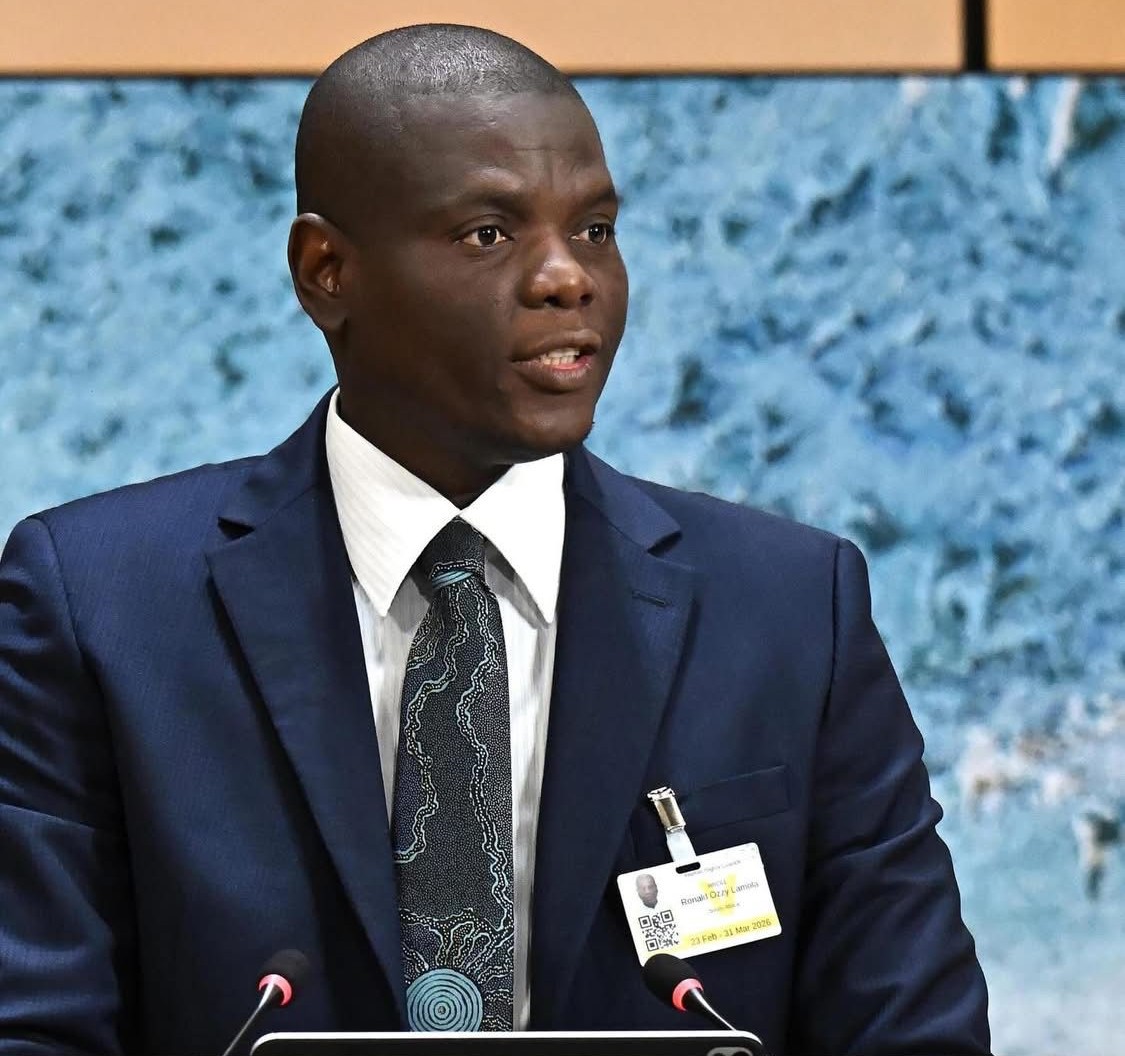
South Africa’s Minister of International Relations, Ronald Lamola, said on 23 February that “South Africa is concerned about attacks on special procedures mandate holders in general, and Ms Francesca Albanese in particular. Special procedures mandate holders play a key role promoting and protecting human rights, and they must be protected.”
Dirco spokesperson Chrispin Phiri highlighted Lamola’s statement about Albanese by posting it on X. Responding to Phiri’s tweet, Hillel Neuer, the executive director of UN Watch, asked, “Why is South Africa’s ANC government joining the murderous Islamic Republic of Iran and terrorist Hamas to back the first UN official in history condemned by France, Germany, Canada, and the Netherlands, for antisemitism, Holocaust inversion, and violating the UN code of conduct?”
Lamola was giving a national statement at the 61st Session of the UN Human Rights Council in Switzerland. He made the comment about Albanese on the same day that Washington’s new envoy to Pretoria, Leo Brent Bozell III, was formally accredited as US ambassador to South Africa. When US Secretary of State Marco Rubio sanctioned Albanese in July 2025, Rubio said that it was because she had “spewed unabashed antisemitism; expressed support for terrorism; and [had] open contempt for the US, Israel, and the West”.
Senior research consultant on US foreign policy, Michael Walsh, says Lamola’s support of Albanese could damage the relationship between South Africa and the US. “Even though the comment is phrased in moderate terms, I doubt that will matter to the Trump administration. It will take offence.”
The foreign ministers of France, Germany, Austria, the Czech Republic, and Albanese’s own country, Italy, called for Albanese’s resignation or dismissal after her comments at the recent Al-Jazeera Forum in Doha, where she suggested that Israel was “a common enemy” for all.
South African Zionist Federation (SAZF) spokesperson Rolene Marks says Lamola’s remarks “signal to South Africa’s Jewish community that this government prioritises ideological hostility towards Israel over its constitutional commitment to combat racism and uphold human dignity”.
It’s a “national disgrace” that a senior minister would publicly intercede on behalf of an individual “whose resignation is being demanded by credible voices globally due to her documented record of antisemitic rhetoric, Hamas apologism, and the wilful denial of documented atrocities,” Marks said. She called on President Cyril Ramaphosa to “disavow these remarks, and withdraw South Africa’s support for Albanese.”
The SAZF also called on parties in the Government of National Unity to “state unequivocally that Minister Lamola doesn’t speak for them, and that they reject any alignment with those who traffic in antisemitism or apologise for terrorism.”
Professor Karen Milner, the national chairperson of the South African Jewish Board of Deputies, lamented that “Albanese, whose role it is to advocate for Palestinian rights, has in no way engaged in helpful ways to address their plight, but rather traffics in antisemitic, hate-filled rhetoric.”
Instead of defending her uncritically, “South Africa should be helping her to undertake her role in a way that doesn’t propagate hatred,” says Milner.
Bafana Modise, spokesperson for the South African Friends of Israel, says Lamola’s statement demonstrates what his organisation has been saying for some time, namely that Dirco “is no longer pro-South Africa, it no longer speaks for South Africans, it speaks for foreign agendas”.
“Iran is burning, and Dirco is silent,” Modise says. “It’s silent on continental issues. South Africa needs to wake up and realise that our foreign policy is hypocritical, it’s inconsistent, and it serves foreign agendas and not South Africans.”
Benji Shulman, the director of the Middle East Africa Research Institute, says Lamola’s statement is part of a “long line of public demonstrations in favour of Hamas and other actors shielding Palestinian entities from accountability”. He says it should be seen as “part of Albanese’s current international campaign, where she has done media appearances to shore up support for her office after calls for her resignation.”
Political researcher Samuel Hyde says South Africa’s diplomatic posture appears “increasingly comfortable with undermining its own standing on the international stage”.
From “repeatedly shielding Putin’s war of aggression against Ukraine at the UN, to conducting joint military drills with the Iranian regime while it was brutally murdering its own citizens, South Africa has charted a troubling course that only worsens by the day”.
Add to this its “expansive lawfare campaign against Israel built around the genocide libel”, and the pattern becomes “difficult to ignore”, says Hyde. “It therefore comes as little surprise that, in what seems little more than a reflexive declaration of opposition to the West, its representatives would find it within themselves to defend an antisemite before the international community.”
In his speech, Lamola repeated South Africa’s stance that Israel’s war on Hamas was a genocide, stating, “We call on all member states to recognise Palestinian statehood and act in solidarity with its people. We continue to appeal for an end to Israel’s unlawful occupation, an end to the ongoing genocide, together with efforts to permanently displace the Palestinian people in Gaza and the West Bank.”
But columnist William Saunderson-Meyer, who writes critically about the ANC, says, “Lamola’s statement comes from an ANC leadership that has long since squandered any credibility it had in opining on human rights matters. It’s the usual scrambled egg verbiage about the virtuous Palestinians, the iniquitous Israelis, and, on this occasion, with a seasoning of ‘concern’ over long-overdue moves to dump Albanese.”
For Saunderson-Meyer, “the only significance of the statement – for it will have little or no influence in international forums – is that it shows that South Africa’s Government of National Unity unfortunately remains totally committed to its damaging anti-Western, anti-Israeli policies.”
Marks concludes that Lamola’s support of Albanese is a “profound moral failure”.
“Dirco has chosen, with disturbing enthusiasm, to align South Africa with distortion, hatred, and the whitewashing of terrorism,” she says. “The minister owes this country and its Jewish community an immediate retraction and apology.”




Ian levinson
February 26, 2026 at 3:56 pm
South Africa’s defense of Francesca Albanese is not a principled stand for human rights—it is a profound moral failure. Albanese has been condemned by France, Germany, Canada, the Netherlands, and even sanctioned by the United States for antisemitism, Holocaust inversion, and apologism for terrorism. To shield her is to legitimize hatred.