OpEds
South Africa silent while Iran’s embassy mocks death

South Africans should be outraged that a hosted foreign embassy thinks it prudent to turn mass deaths into a meme.
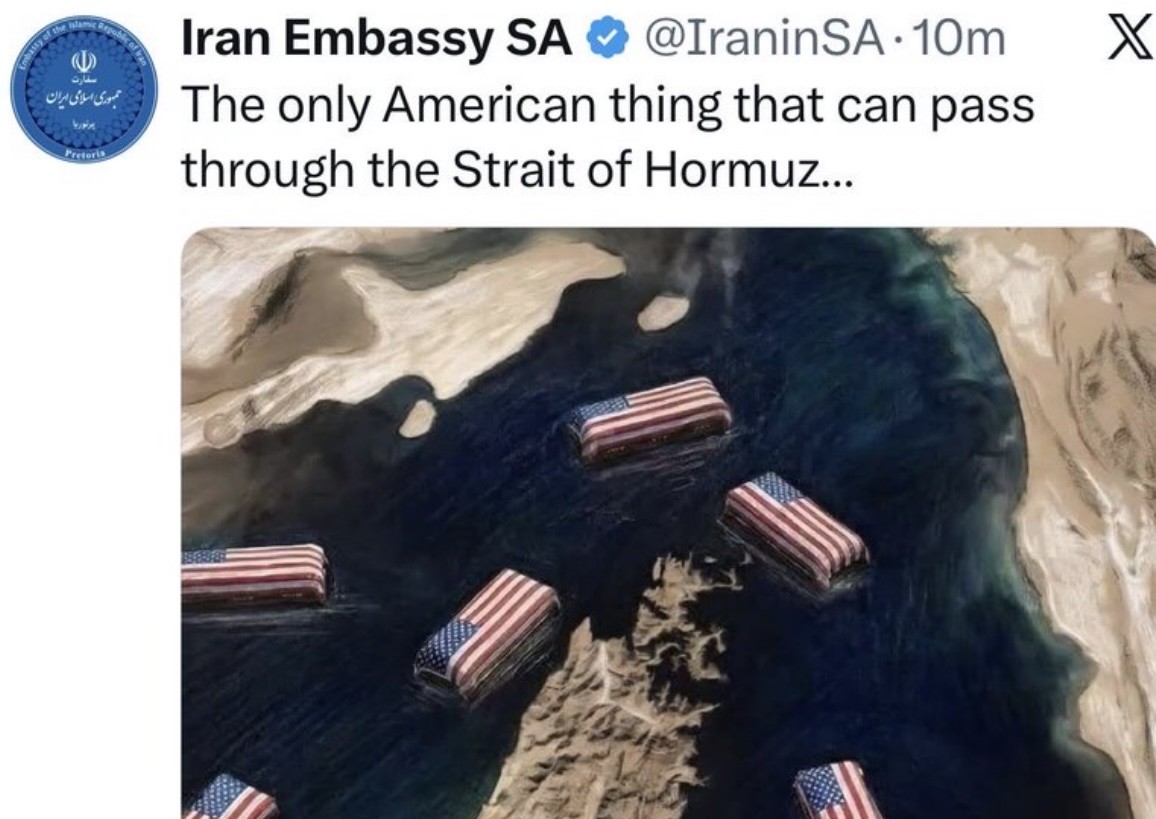
The Iranian embassy in Pretoria posted an image, on X, showing the Strait of Hormuz filled with coffins draped in the American flag, captioned, “The only American thing that can pass through the Strait of Hormuz.” This is not a mistranslation or a clumsy attempt at satire. It’s a deliberate fantasy about Americans entering a vital shipping lane only as corpses, published not by an anonymous account, but by an official diplomatic mission accredited to the Republic of South Africa.
Embassies exist to protect lives, assist citizens, and manage conflict. They are meant to be the last open door when all other channels close. When a mission that enjoys diplomatic immunity uses that privilege to revel in the idea of body bags floating through an international chokepoint, it drags diplomacy down to the level of an online troll farm.
Earlier, the same embassy had to “clarify” another controversial social media post that mocked Thai crew from a Thaiflagged cargo ship attacked near the Strait of Hormuz, comparing them to children scared to face their father after crashing the car.
That ship, the Mayuree Naree, was hit by projectiles in or near the Strait on 11 March. Twenty Thai sailors were rescued, but three crew members went missing and are believed to have been trapped in the engine room. Thailand’s foreign ministry protested, ordered its vessels to avoid the area, and continued searching for the missing men.
In response to the backlash, the Iranian embassy in South Africa insisted that its post about the Thai crew was merely “humour” and that it never meant to insult Thais. That its intention was only to reinforce Iran’s warning not to transit the Strait without coordinating with Tehran.
That defence already felt thin; the new coffin meme exposes it as completely disingenuous. The mission isn’t to unintentionally offend any nationality. It is systematically using real fear and real deaths at sea as raw material for edgy content.
If this is the public face of Iran’s embassy in South Africa, what does it say about Tehran’s attitude to human life in a region already on edge from escalating attacks on shipping and open talk of “opening” the Strait of Hormuz by force?
And why should South Africans quietly accept that such messaging is being pumped out from a building flying a foreign flag in our diplomatic quarter?
Our name is on the door. This is where Pretoria’s responsibility begins.
South Africa often presents itself as a principled champion of human rights and international law. From its case against Israel at the International Court of Justice to repeated statements calling for the protection of civilians in conflict zones, the government has claimed the moral high ground.
Yet on its own territory, under the protection of the Vienna Convention and our hospitality, a friendly state is now posting images celebrating the imagined deaths of people of another nation. Is this compatible with the values that underpin our “progressive internationalism” and our calls for deescalation in the Gulf?
Only last week, a deputy minister of international relations told Parliament that South Africa “will continue to monitor heads of missions that are based here, in line with the Vienna Convention”. If that promise is to mean anything, why has there been no public démarche, no summoning of the Iranian ambassador, no clear statement that this type of communication is unacceptable on South African soil?
The Department of International Relations and Cooperation (Dirco) doesn’t hesitate to issue sharply worded statements against Western governments when they overstep. Why the deafening silence when a friendly mission celebrates death from within our borders?
The government insists that South Africa’s stance on the US-Iran confrontation is one of “strategic non-alignment”. Non-alignment, however, doesn’t mean moral emptiness. It doesn’t require us to smile politely while an ally revels in the prospect of dead Americans, any more than it asks us to applaud when US or Israeli officials speak casually about using overwhelming force in the Gulf.
Our country has already paid a price for being perceived as too close to Tehran, from threats in the US Congress to concerns about investment and trade. Allowing an Iranian mission here to degrade itself into a cruel meme factory only deepens the impression that South Africa is willing to look away from the ugliest behaviour of its friends.
We don’t have to choose between defending Iran’s legitimate legal rights and condemning grotesque celebrations of death. In fact, our claim to principled non-alignment is stronger when we demand that all parties – Washington, Tehran, Tel Aviv, and others – uphold basic standards of dignity.
Put the shoe on the other foot. If the US or Israeli embassy in Pretoria posted an image of Iranian coffins bobbing in the Persian Gulf under the caption “the only Iranian thing that can pass through”, would we dismiss it as harmless humour?
Of course not. There would be outraged press conferences, marches, even calls for the ambassador’s expulsion. Why then should this Iranian meme be treated differently simply because its target is America, a country many South Africans understandably resent for its own history of violence abroad? If we believe in the equal worth of all human life, we cannot reserve our outrage only for the deaths of those we like. Either human beings are not props for memes, or they are. We must choose.
No embassy in South Africa should be able to post this kind of content without consequence. At minimum, three steps are warranted: a formal protest from Dirco, a public retraction and apology from the Iranian mission, and internal discipline by Tehran for the officials responsible.
The core question South Africans must ask is uncomfortable but unavoidable: Do we want a world in which embassies compete to see who can post the most gleeful fantasy of the other side’s dead, and do we want that contest hosted from our own capital?
If the answer is no, then our government – and we as citizens – must say so, clearly, and publicly.
- Nkateko Muloiwa is a political researcher with an interest in international and local affairs. He provides political commentary on issues ranging from the Middle East to rural South Africa. He recently completed his master’s degree in political studies and an MSc in Science Communication at the University of the Witwatersrand. He also has interests in the geopolitical significance of Israel in the Middle East.