World
Do Jews have a future in Europe? A historian of antisemitism has her doubts

JTA – Over the last two months, there have been more than a dozen attacks on Jewish institutions across Europe. Two of the highest-profile attacks were in London, where two people were stabbed last month, in the same Jewish neighbourhood where arsonists torched four Jewish-run ambulances in March.
There have also been attacks in the Netherlands, Belgium, France, and Germany.
Claiming responsibility for many of the incidents is a shadowy group calling itself Harakat Ashab al-Yamin al-Islamiyya, which counterterrorism officials say may have ties to Iran.
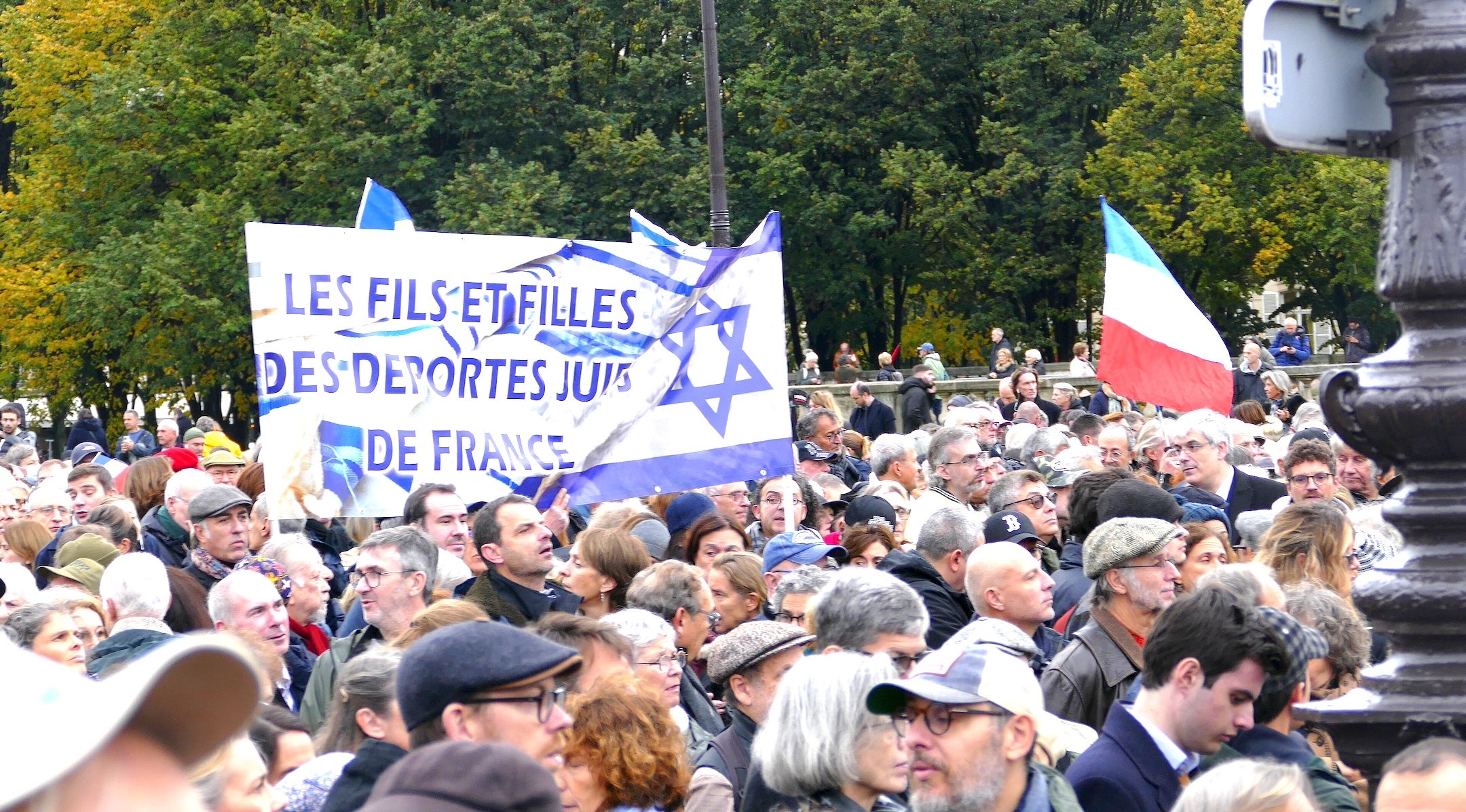
But even if the attacks are part of an Iranian plot to destabilise the West, they seem to many of Europe’s Jews as just the latest chapter in a long and all-too-familiar story. Long before American Jews began to fortify their institutions, European synagogues resembled heavily guarded embassies in hostile countries. In France, which has seen some of the deadliest attacks on Europe’s Jews, Jews have been asking if they should stay or go for years. Many have left.
That’s the context in which I interviewed Brandeis University historian Flora Cassen about her new book, Stained Glass: A Reflective History of Antisemitism. In an unusual combination of history and memoir, Cassen looks at Jewish life in today’s Western Europe through the lens of her academic specialty: medieval Jewry and antisemitism.
Drawing on her own childhood in Belgium, she describes Jewish communities that are tight-knit but insecure, and constantly aware that their citizenship and prosperity don’t guarantee their acceptance or safety. Too often, she writes, governments and the media treat attacks on their Jewish communities as a front in the Israeli-Palestinian conflict, not as an attack on their own citizens. Meanwhile, a wave of Holocaust remembrance and atonement, she writes, is receding, replaced by a nationalist fervour to move on from a troubled past.
It was during another wave of antisemitic attacks in Europe, in 2014 and 2015, that Cassen, by then living in the United States for more than a decade, began asking if Jews had a future in Europe.
“Despite everything, I had always loved Europe,” she writes. “I wanted nothing else more than for Jews to count as true Europeans. The realisation that I was possibly seeing the end of a community and that I was among those who had left was crushing.”
Cassen, 49, directs the Brandeis Center for Jewish Studies and its Sarnat Center for the Study of Anti-Jewishness. She is also a senior fellow at the Shalom Hartman Institute.
On Tuesday, we talked about whether Jewish life in Europe has a future amid rising antisemitism, the unsettling parallel she draws between Jewish life today and during the Middle Ages, and how Israel has shaped both antisemitism and Jewish identity in the Diaspora. She spoke to me from St Louis, Missouri, where she joins her family when she isn’t teaching in the Boston area.
The interview was edited for length and clarity.
Let me start with the genre of your book, because it’s a little unusual. It’s not a scholarly study, it’s not a history book; it’s part memoir. Each of the very short chapters is like a snapshot ‒ of family history, of the history of European antisemitism, of your Jewish childhood in Antwerp and your last two decades or so in the United States. Is this the first time you’ve tried something outside of your usual lane?
It was the first time. And it took me a while to get there. I think I worked on this book for five years. I wrote my first book on the Jewish badge in Renaissance Italy, and that’s a very traditional scholarly monograph. And I’m proud of it. But then I realised I think I sold something like 200 books, which is normal for scholarly books.
So for this book, I wanted to do something different. A number of different things came together: the resurgence of antisemitism, first in Europe and in Belgium in a very visible way that was very troubling to me; my grandmother died in 2019; and then the pandemic started in the spring of 2020.
Until last summer the book still had a very traditional structure. I had an introduction, six or seven chapters, each focused on a period of history, in which I inserted some personal stories or family stories. And then I did what was the boldest move for this book. I just separated it into something like 70 small chapters. And I was very worried. I sent it to my editor. I said, “I think I did something crazy”, but she loved it.
One of the central dilemmas in your book is one that is very much in the air, with a wave of antisemitic attacks in Europe: Should Jews stay, or should they go? It’s a question that has prompted reactions like the plays Prayer for the French Republic by Joshua Harmon and Tom Stoppard’s Leopoldstadt. Is there a future for Jewish life in Europe?
I can’t answer the “should” question. People need to make decisions for themselves. But certainly it is one of the animating questions.
At some point I realised every summer, when I went back to see my family, I had fewer friends in the Jewish community. People had left. I realised that I was one of them, even though I didn’t realise it at the moment when I left [in 1999 to start an MA programme].
Thinking back, if it was possible to do Jewish studies in Belgium at the same level as in the US, I probably wouldn’t have left. But I was told there’s no way you can do it there.
And then I remember reading this book by Danny Trom [France Without Jews, 2019] where he says he’s been hearing the same conversations in France. And he said very powerfully: Not everybody’s going to leave. There will always be Jews in Europe. But so many people are asking themselves the question that you have to start imagining it, and you have to start grappling with what it means that, in a continent that has been a home for Jewish life since probably before the Roman Republic, it cannot sustain Jewish life today.
To me, it’s an enormous embarrassment and shame for Europe. But they don’t seem to think about it or care about it very much. And to me, it’s incredibly sad, because I feel so European. I love Europe. It’s where I grew up. I love going back. And at the same time, I can’t feel at home.
Part of the diagnosis is also that Europeans have to start thinking of Jews as Europeans. And I think that still hasn’t happened.
In the book you worry about the number of people in Eastern and Central Europe, and perhaps a growing number in Western Europe, who believe that Jews still talk too much about the Holocaust.
It cuts both ways. On the left, people say, what about all the other suffering Europeans caused? Why do we always talk about Jews and not about that? And on the right, there’s a sense that this is a history of shame. “We should be proud of our nations, and we’ve talked about the Holocaust enough.”
The Holocaust became central to the construction of the European Union ‒ building the EU so this will never happen again, and every country that joins the EU has to acknowledge it. But the EU has become an institution that nobody really likes in Europe.
It’s always been hard. It’s not until the 1990s that countries started reckoning with collaboration. Until then, it was always, “It’s the Germans.”
Finally, there’s a dynamic around reparations. Many countries have paid reparations to survivors, and it started because of American pressure. And of course it was fair and just. But as you can imagine, it also generates backlash, because people feel, why should my tax money go to this two generations later?
And it plays into that old stereotype of Jews and money. It becomes a trope — Jews use the Holocaust to get more money.
One of your more startling assertions is that the conditions of today’s Jewish communities, in the United States and Europe resemble those of the Jews in the Middle Ages. What do you mean by that?
We want to use history to understand the present, but the question is, which history? If you only think about Jewry today in the context of the Holocaust, you can’t understand the combination of persecution and privilege that we are seeing today. Antisemitism is rising, whether it’s on the streets of London or on a beach in Australia. At the same time, by and large, Jewish individuals and Jewish communities still can have a good life, can buy houses in the neighbourhoods where they want to live, send their kids to good schools. So how do you understand that duality?
I study the Middle Ages, where you had Jewish communities who sometimes had a fairly privileged status because they worked closely with the authorities and were protected by them. But every once in a while, popular hostility could explode, and then that protection would fail, and the Jews would suffer terribly, before they would recover and rebuild. That combination of protection and hostility is something we see today, and not the all-encompassing war against the Jews we saw in the Holocaust.
You also cite the 20th-century historian Salo Baron in describing a dilemma, which is the choice between aligning with or voting for illiberal politicians and autocrats in exchange for their , or throwing in with liberal democracies that have been known to elect parties that are antisemitic, or, increasingly, hostile to Israel.
Yes, that is the dilemma. I love democracy, and I would fight for it. But after the transition to democracy in Europe, Jews had it the worst. The Holocaust happened in that context.
Jews have often done best in multicultural empires. Democracy is a numbers game, and we’re a small minority.
Baron also provides you with a framework for suggesting how Jews can thrive despite persistent hostility. Baron rejected the “lachrymose” version of Jewish history, which sees Jewish history as a series of disasters punctuated by brief moments of reprieve. The “non-lachrymose” version of Jewish history, you write, acknowledges that “there was life, joy, creativity and resilience”.
There is a remarkable European Jewish history, and I am sad that it is ending. But if we look at it this way, when we’re thinking about how to react, we have many more options, like communities that suffered incredibly hard times but built successful communities and cultures.
I want to ask about that resilience, but first I want to hear your thoughts on antisemitism. In writing about today’s versions of antisemitism, you distinguish between “replacement” and “eliminationist” antisemitism. Can you explain the difference?
The “replacement” argument, heard mostly on the right, is very similar to the traditional right-wing, even Nazi argument that Jews are plotting to destroy Western civilisation and the white race through immigration. That was the reason the Pittsburgh shooter targeted the [Tree of Life] synagogue in Pittsburgh, because they were helping immigrants.
The “eliminationist” argument is that the State of Israel is so evidently flawed that it should disappear. We’re not having a debate anymore about how the state could be better. Instead, there is no improvement possible, there is no redemption.
Criticism is fine, but when you argue that a state should cease to exist, that crosses a line.
I think you are saying that antizionism becomes antisemitism when it doesn’t feel like a protest against a government, but instead targets Jewish institutions and Jewish people.
Yes. Why are synagogues being firebombed in London and Belgium and the Netherlands? These are places of worship for Jewish citizens of those countries.
And once you start expressing it in the language of these old tropes, once you start hearing that all Israelis are “baby-killers” then we’re back in the Middle Ages.
What do you make of the argument, aired by Thomas Friedman, Michael A Cohen, and others, that Jews in Europe and the rest of the Diaspora are paying the price for Israeli actions beyond their control? That is sort of the corollary of the European officials you write about in the book who say they don’t have an antisemitism problem, but say they are caught in the crossfire of a Mideast conflict.
I reject it as illegitimate. I know people on the left will say, “If only Israel behaved better, then Jews would be fine in America.” And people on the right will say, “Well, if only Israel was even stronger, then Jews would be fine in America.” I buy neither argument. We need to take responsibility for how we treat people in our own societies, and we can’t wait for countries on the other side of the world to do things differently. The whole principle of pluralistic society is that people from different backgrounds, religions, and ethnicities can live together.
I think it is absolutely fine to be angry at what the State of Israel does, but we still have to uphold the norms that make life in pluralistic societies possible.
What has Israel meant for European Jewry? In the 20th and early 21st centuries, American Jews felt the creation of the State of Israel as a great source of ethnic pride and a repudiation of the Holocaust. Few chose to live there, but it gave them a sort of secular religion expressed in financial and political support that bound Jews together as they were becoming less religious. What did Israel mean to you and your community in Belgium?
I think it did the same, but for many European Jews it felt like a place that gave Jews back their dignity after the Holocaust. So many people had lost everything and their passports and they belonged nowhere, and the creation of the State of Israel gave them back that passport and that dignity.
In my book I compare how rooted American Jews are here, and I’ve always wondered why that rootedness was so much weaker in Europe. Part of it is knowing there is a country for the Jews elsewhere. Part of it is the difficulty of trusting society after [the Holocaust]. I’ve often felt growing up that the messages I was getting were very ambivalent. On the one hand, I was told, “You’re Belgian, and you belong here, and it’s a great place to live.” And on the other hand, I also heard “We don’t trust them, and we don’t trust the police, and we don’t trust the government, and we don’t trust our neighbours.” There’s that duality there I did not notice in the United States.
Tell me more about the differences you experienced between growing up in Antwerp and coming to the United States, first as a student at Brandeis, and later at New York University.
I did not expect how different the Jewish community would be, and I’ve sort of been in awe of the American Jewish community ever since: that confidence, that size, that diversity, that sort of creativity. I heard people say to me, “We used to go to this shul, and then we didn’t like it so much anymore, and so we created our own minyan, and then it grew into another shul.” I wish people would realise what they built here, like Brandeis, which was a Jewish-founded university that became an R1 [top-tier research] school.
And even in the past few years, when younger people have created antizionist synagogues and groups, I may not agree with all their politics, but there’s something to the fact that they’re saying, “We don’t like our parents’ Judaism, so we’re going to do it in a different way.” I never saw that in Europe growing up, and that’s maybe the measure of [the Holocaust’s devastation]: that the willingness to build in a place is just not there in the same way.
I also found fascinating your analysis that antisemitism in Europe may not be a consequence of Jews’ separateness, but their attempts at assimilation. It is as if Europeans tolerated the Jews when they lived in ghettoes, but were threatened when they tried to enter European society on equal terms.
What we call modern antisemitism was racial antisemitism, and a reaction to emancipation and assimilation. Racial in the sense that Jews could live and marry and even worship like Christians, but they were still regarded as a race apart.
Yes. You read it in those pamphlets from the late 1800s where people say “we used to know who they are, and now that they’ve been made citizens and equal, and they dress like us and they look like us, we don’t see them anymore.” But I also see it in Antwerp, where there used to be two communities, a more secular, assimilated one that I belonged to, and then a very Orthodox one. And it’s the people who belong to that secular, assimilated community that have left, and today, in Antwerp, you still have a large ultra-Orthodox Chassidic community, and it’s growing. Maybe because they are not trying to assimilate, that protects them from that feeling of not belonging.
This is also in the context of nationalism, which sees the Jew as what you describe as Europe’s “unifying other”. I am thinking of your chapter on European soccer fans who disparage their rival teams as “Jews” even if they have no Jewish history or players.
That goes back to my earlier point that, historically, it was in multiethnic empires that Jews did best. Europe has tried, through the project of the EU, to be that kind of multiethnic society, but European nationalism is still very strong, and growing stronger. Jews became attached to these sort of post-national, international environments, where they do well, whereas people in Europe tended to split into these more tribal groups.
I didn’t want to end our conversation without talking about some of your family’s story, especially one that goes to the heart of the dilemma you just described. Your grandparents, Pola and Henri, fled Nazi-occupied Europe for safety in the Belgian Congo, where Henri was offered a military posting. It’s a story about a couple who are reviled as a second-class race in Europe, but because they’re white, when they arrive in Congo, they’re part of the colonial class. I found it fascinating that their whiteness didn’t count for anything in Europe, but it meant everything in Africa.
I think in some ways it speaks to our time, because it forces us to confront these ambivalences and complexities at a time when we are more polarised. Their story forces you to stay in the complicated and the complex and the muddy.
It’s also a parable for what Jews are going through today. Even if Jews are seen as white, it doesn’t mean they’re not sometimes vulnerable.
Did writing your book leave you more or less hopeful about the Jewish future in Europe and the Diaspora in general?
Historians are very bad at making predictions. Still, I am hopeful about Jewish life in America, as long as I see the will to fight and dynamism I described. I’m less hopeful about Europe. I remember growing up thinking, “We’re the generation that’s going to rebuild”, and that didn’t work so well. So I’m less optimistic about Europe, and I’m frankly heartbroken about that. But by and large, I think the Jewish people have responded to so many challenging times in their history, and I think they will respond this time too.
- The views and opinions expressed in this article are those of the author and do not necessarily reflect the views of SA Jewish Report, JTA, or its parent company, 70 Faces Media.