





OpEds
Bellville bakery held a dark secret

Growing up in South Africa, the Holocaust was always a subject just outside the door, waiting to step in. There were stories of survivors, books that slowly filled library shelves, horrific images hidden in many homes for fear of traumatising the children.
Growing up in Bellville, about 20km outside Cape Town, in a Jewish community of about 100 families, was mainly comfortable and predictable. Most of the children attended local government schools, learned a smattering of Hebrew in cheder, and usually joined a Jewish youth movement, which enhanced the feeling of connecting to our history. Who would have thought that the Holocaust was much closer to home than we realised?
C’est Si Bon, a pastry shop, might have been one of the only reasons to put Bellville on the map in the 1960s. The custard slices, chocolate brandy balls, cream cakes with strawberries or other fruit, chocolate eclairs and petit fours, marzipan, German cheesecake, apple doughnuts, Swiss roll, sausage rolls, and breads became favourites of not only the locals, but also crossed the gap of the national road to the city and served as a terrific destination for Sunday drives.
The couple who ran the bakery had come from Europe in 1960. Andre Pouliart and his wife, Wanda.
He was Belgian and she German. Andre’s father had been a pastry chef in Brussels and it was from him that his son filled Voortrekker Road in Bellville, a town of 40 000 residents, with the delightful aromas that tempted so many.
One particular rainy Sunday in winter, at about mid-morning, a customer in his late 40s walked into the shop with his wife. It was their first visit. Within minutes of entering the konditorei, Issy felt the ground shaking under his feet. His head throbbed with the sudden realisation of what he saw behind the counter. He let out an agonised scream, instantly stifling the chatter of the other customers.
Pointing his shaking finger at the owner and almost choking, he shouted in a thick European accent, “You, you killed my family, you Nazi! It’s you! I remember you from the camps!” There was silence in the bakery. The owner’s face revealed nothing. He continued cashing money at the till.
The Holocaust survivor left the bakery immediately, barely making it to the door, his wife supporting his arm as they turned towards the car.
Within a short while, the story passed through the community. There were those who boycotted the bakery, but besides this symbolic action, there were no inquiries or investigations regarding the background of the owner.
Apartheid South Africa protected anyone with secrets such as these.
Decades later, with the advent of social media, and Facebook in particular, I joined a group of Bellville nostalgia, where the topic of the bakery was mentioned several times. Besides the posts on the legendary pastries, I corresponded privately with someone who knew the Pouliarts well.
He confirmed that Andre, by his own admission, had been an SS officer.
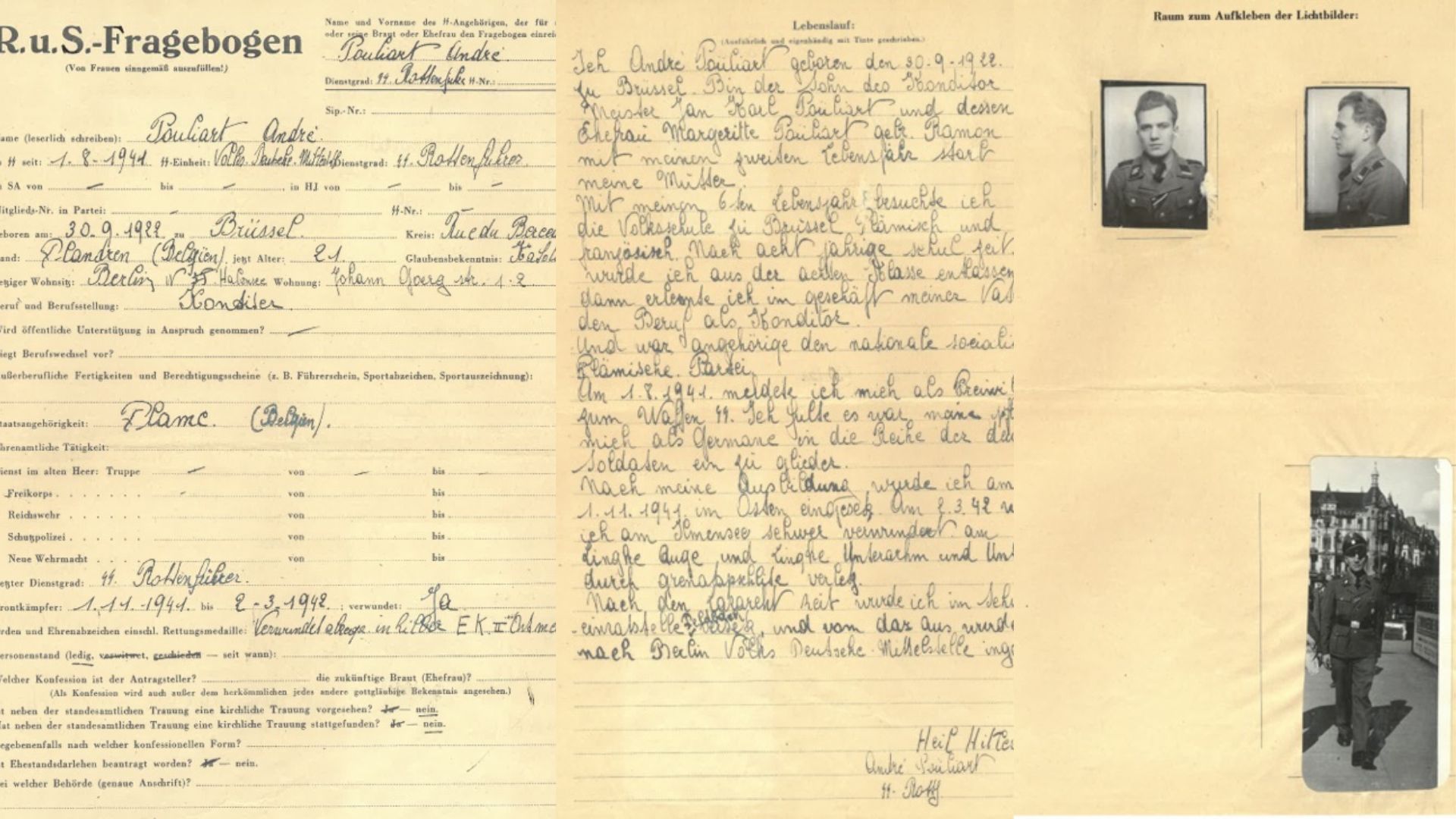
It took me time and the lonely COVID-19 epidemic to write to the German Archives (Bundesarchiv) inquiring about Pouliart. I was truly bowled over to learn that in a file on record were documents and photos of no other than the Waffen SS officer!
In 1941, he had volunteered for the Waffen SS. After training, he was deployed to the Eastern Front with the German army. Wounded in 1943, he was transferred to Berlin. In 1960, he and his wife travelled to South Africa, setting up home in Cape Town.
A thorough search of the internet revealed that Nazi criminals had made their way out of Germany and fled to havens using the “ratlines” created to assist them in their escape. They were supported by the Catholic Church. South America was a popular destination, as were the United States, Australia, Switzerland, and Spain.
South Africa was not reported as one of the havens and yet we know today that there certainly was support of the Nazis by groups such as the Ossewabrandwag, an Afrikaner Nationalist organisation.
So, what became of the bakery and its owners? We really have nothing to go on except that soon after they were exposed, they moved 45km north along the national road, to just where it turned off to the seaside resort of the Strand. To all accounts, the bakery enjoyed similar success thereafter.
After the death of the owner, his wife and son relocated to Palma de Mallorca, a Spanish resort popular with Germans and asylum for Nazis after World War II.
And Issy? I have no idea. I can only imagine the heartache he must have felt, the frustration at not being able to do anything about his discovery in the country he now called his home, the nightmare of his loss and reality. Whom could he tell? How did that visit to the renowned bakery in Bellville really affect him?
I imagine him sharing the story with his friends during the coffee break at cards evenings and see their incredulous faces, at a loss for words of comfort. After all, World War II happened “overseas” and remained intangible.
In today’s world, this story is even more poignant and sad. This story begged to be told and now that it has been, I feel a sense of relief. I only wish I could have shared this with Issy.
- Gail Loon Lustig was born in Cape Town, educated in Bellville, and qualified with a medical degree at the University of Cape Town in 1976 before making aliya. She worked as a general practitioner and raised her family in Israel. She now teaches and writes in her retirement.







Pia de Vos
July 17, 2026 at 5:39 pm
With a name like Andre Pouliart and coming from Belgium, there was quite a bit to hide behind. Interesting that he upped and left after being recognized…
And then the story becomes vague, but you were able to establish that the wife and son emigrated to Spain? There must have been some evidence to go on, after all? It would be good to follow up the clues and take the story further.