


OpEds
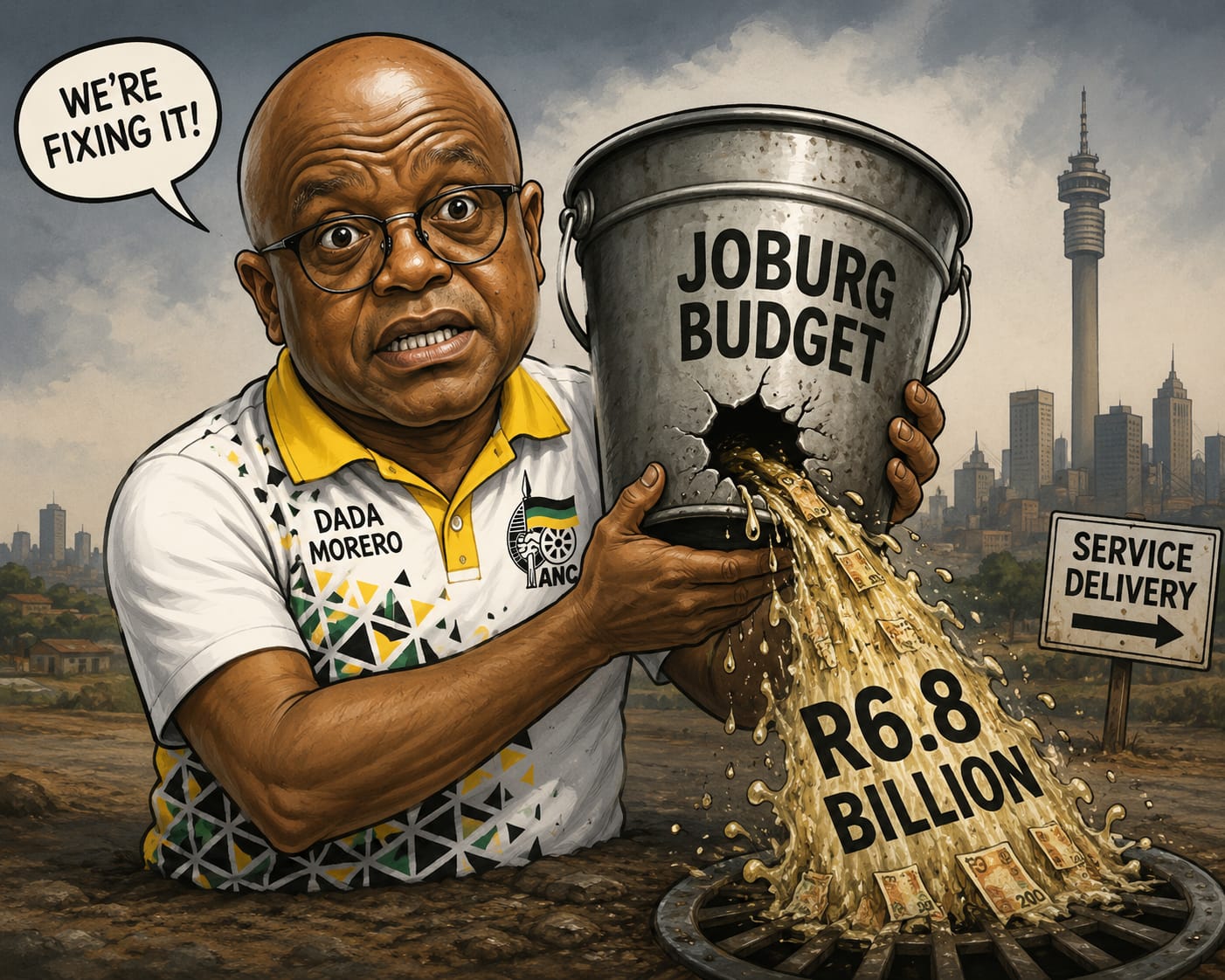
There’s a hole in your bucket, dear Dada

When I was growing up, we had an old vinyl record that I used to play on repeat. Somewhere between the usual kids’ songs was “There’s a Hole in My Bucket”.
If you don’t know it, it’s basically a lesson in going nowhere. Henry has a leaking bucket. Liza tells him to fix it with straw. To cut the straw, he needs an axe. To sharpen the axe, he needs a stone. To wet the stone, he needs water. To fetch the water … well, he needs the bucket.
And of course, the bucket has a hole.
It’s a song that could have been written about Mayor Dada Morero’s Johannesburg.
Service delivery collapses. The response? A Bomb Squad. Leading it? Snuki Zikalala, African National Congress (ANC) veteran, former South African Broadcast Corporation chief executive. Not an engineer. Not a turnaround specialist. A cadre.
When that doesn’t work? Walk faster. Morero and Gauteng Premier Panyaza Lesufi launch what they call “accelerated service delivery”. Walkabouts. Reclaim the city campaigns. Cameras rolling. Clipboards out.
New names. Same loop. Henry never leaves the yard. He just keeps trying to fix the same broken bucket with the same broken tools.
Meanwhile, the city’s debt to Eskom sits at R6.8 billion and growing by the day.
Pointing doesn’t fix anything. None of it touches the structural problem. It isn’t allowed to. The playbook only has ANC pages. And so, the cycle continues ‒ fetch the water, find the hole, start again.
As a councillor in Johannesburg, I deal with the consequences of that loop every day.
That R6.8 billion Eskom debt forces every paying resident to ask the most frustrating question in local government, “Where does our money actually go?”
A few years ago, when I asked for billing data in Ward 72, the payment ratio was more than 100%. That’s what a functioning community looks like, people paying, often ahead of consumption through prepaid systems.
Yes, things are tighter now. The cost of living is up. The economy is flat. But by and large, my residents are still paying. They are doing their part. And yet they are the ones being told they may sit in the dark.
Here’s the uncomfortable truth. When you pay City Power, that money isn’t ring-fenced to pay Eskom. It disappears into the city’s general revenue pool, spread across ballooning wage bills, legacy debt, and a system riddled with inefficiencies.
At the same time, the city continues pushing bulk electricity into areas where there is little to no payment, absorbing massive technical and commercial losses, with virtually no enforcement, not even against government departments.
So, what happens when revenue falls?
We don’t fix the system. We go back into the loop.
Tariffs rise above inflation. New charges appear. Fixed network fees climb to the point where some households are now paying more than R1 700 a month before they’ve used a single unit of electricity.
That’s not sustainability. That’s a slow bleed.
We are watching a municipal death spiral in real time, with a shrinking base of compliant, paying residents expected to carry the cost of dysfunction the city refuses to confront.
So, what do people do when the system stops working? They solve the problem themselves.
In the Johannesburg Jewish community, that instinct runs deep.
In 1888, with no safety net, the Chevrah Kadisha was formed to care for the vulnerable and bury the dead with dignity. When public schools couldn’t meet our needs, we built our own. When policing struggled, CSO and CAP stepped in. When emergency services fell short, Hatzolah filled the gap.
For more than a century, the response to state failure has not been resignation. It has been action.
Not to isolate ourselves, but to ensure that life continues with dignity, while taking pressure off a system already under strain.
The solar panels on our rooftops are simply the latest expression of that instinct. The state couldn’t keep the lights on. So, we kept them on ourselves. Quietly, and at significant personal cost, hundreds of millions of rands went onto rooftops across the northern suburbs. Panels, inverters, batteries, all funded by households, not the municipality.
The city didn’t plan it. It didn’t support it. In many cases, it tried to stop it. And yet it happened anyway. Because this is what this community does.
And in doing so, we’ve already solved half the problem. The infrastructure exists. The investment has been made. The generation capacity is there, producing power every day.
Now comes the second half, and this is where the city’s failure becomes unforgivable.
City Power wants residents to register their solar systems. But residents have a simple answer: fix your bucket first.
Tell us how you plan to use our water before you ask for it.
Because right now, the terms don’t make sense. No long-term tariff clarity. Registration uncertainty. The real risk of being pushed onto more expensive billing structures. Solar users treated as targets, not partners.
So, residents adapt. They don’t fight the system. They go around it. Private energy solutions. Subscription models. Full or partial grid independence.
And every household that disconnects fully is one the city has lost, not just as a contributor to the grid, but as a ratepayer, a participant, a stabilising force.
Here’s what the city is throwing away: when excess solar feeds into the grid, it doesn’t travel across the city to a distant substation. It goes to the nearest demand, usually your neighbour.
A street of solar-equipped homes becomes a micro-network. It stabilises supply. Reduces dependence on Eskom. Brings costs down for everyone, including those who can’t afford panels.
That’s the Cape Town model. Not magic. Policy. Bidirectional meters. Feed-in tariffs. Clear rules. A framework that treats residents as partners, not revenue targets.
Johannesburg’s residents have already done the hard part. The panels are on the roofs. The capacity exists. We’re not asking the city to build anything. We’re asking it to get out of the way.
Instead, we get Snuki Zikalala and a walkabout.
On 4 November, Johannesburg gets the chance to replace our Henry.
A community that has spent more than a century building where the state wouldn’t know the difference between systems that work and systems that collapse under their own contradictions.
We’ve built enough of it ourselves. We know what needs to be done. We’ve already done the hard part.
Now we just need a city, and leadership, willing to meet us halfway.
It’s time to fix the bucket.
- Daniel Schay is a member of the City Council of Johannesburg, serving as the Democratic Alliance spokesperson on Development Planning and councillor for Ward 72.