News

Peripheral Hague bloc lacks ammo on Israel isolation

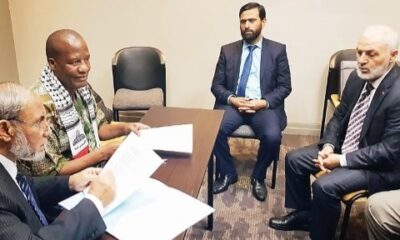
Terrorist organisation Hamas praised the effort of anti-Israel bloc, The Hague Group, which includes the South African government, for its decision last week to isolate and attack Israel. This was decided at its “emergency summit” in Bogotá, Colombia.
The measures they want to implement include the prevention of provision or transfer of arms to Israel; preventing the transit, docking, and servicing of vessels if they may carry arms to Israel; and preventing the carriage of arms to Israel on vessels bearing these countries’ flags.
They also include commencing an “urgent review” of all public contracts to prevent public institutions and funds from supporting Israel; ensuring “accountability under international law, through investigations and prosecutions”; and supporting “universal jurisdiction mandates, national legal frameworks, and judiciaries”.
The South African Department of International Relations and Cooperation (Dirco) called the event “the most ambitious unilateral action” targeting the Jewish state since the Israel-Hamas war began. The South African government was represented at the summit by Dirco Director-General Zane Dangor.
The event was also praised by United Nations Special Rapporteur Francesca Albanese, who was sanctioned by the United States in July. She attended the event, and expressed her “appreciation” to the government of Colombia and South Africa for convening it.
However, esteemed political analysts told the SA Jewish Report that The Hague Group is likely to remain ineffectual on the world stage. This was made clear when only 12 of the 30 states attending agreed to adopt measures targeting Israel.
The 12 are Bolivia, Colombia, Cuba, Indonesia, Iraq, Libya, Malaysia, Namibia, Nicaragua, Oman, Saint Vincent and the Grenadines, and South Africa. After this weak response, the group set 20 September as the date for more states to join them.
The Hague Group is led by the governments of Belize, Bolivia, Colombia, Cuba, Honduras, Malaysia, Namibia, Senegal, and South Africa. The bloc aims to implement “legal, economic, and diplomatic measures to hold Israel accountable”, while ignoring human rights abuses and wars in these countries’ own backyards.
South Africa’s minister of International Relations and Cooperation, Ronald Lamola, said, “The Hague Group was born to advance international law in an era of impunity. The measures adopted in Bogotá show that we are serious, and that co-ordinated state action is possible.”
But a US State Department spokesperson says the US “strongly opposes efforts to weaponise international law to advance radical anti-Western agendas”, and that The Hague Group is “transparently laying the groundwork for targeting the US, our military, and our allies”.
The spokesperson says that the US government will “aggressively defend our interests, our military, and our allies, including Israel, from such co-ordinated legal and diplomatic warfare”.
Says Wendy Kahn, the national director of the South African Jewish Board of Deputies, “Imagine if instead of setting up all these various configurations, and widening the wedge between the two sides, these parties concentrated on peace building efforts? There are no shortcuts to resolving a conflict. The countries that are making some contribution are those that are speaking to both sides in the conflict. The Hague Group was clearly set up with no function other than to criticise Israel.”
Senior professor in the department of political science at the University of the Free State, Dr Hussein Solomon, says he believes The Hague Group to be more an “an exercise in public diplomacy” than a serious endeavour. “These countries aren’t regarded as real power players on the international stage,” he says.
Furthermore, he doubts any of the countries are supplying Israel with arms, “so it’s easy to agree on something they’re not doing anyway, or they don’t have the capacity to do”.
More importantly, he says, this isn’t the time for South Africa to be placing itself in opposition to the US. “South Africa is doubling down while we’re still waiting for the results of the MTN court case; and after the American legislation against South Africa, and the 30% tariffs. What are the economic costs for South African citizens of this supposedly ‘moral’ stance?”
In addition, “given our own levels of corruption in South Africa, do we really have the capacity to be focusing on international issues when our own home situation is so dire?”
Solomon says that if The Hague Group expands to include other states with greater capacity, then it will become a problem for Israel, but at the moment, it isn’t. In terms of South Africa’s leadership of the group, “I’m not quite sure if it’s leadership or ‘followership’,” he says. “The bottom line is we need to act in terms of our own national interests, yet our leadership doesn’t seem to understand what those national interests are.”
But political analyst Daniel Silke says South Africa’s involvement is “a continued sign that it’s not likely to reduce its critique of Israel, despite pressure from the US”. He thinks the African National Congress “continues to see this as a key foreign policy issue, and a winning issue for a domestic audience. On that basis, it’s prepared to disregard pressure from the US.”
This is “a peripheral group of countries” which don’t have much in common “other than a universal desire to single out Israel”, Silke says. He thinks Israel possibly avoids them on shipping routes, so they’re unlikely to affect the country.
“To expect South Africa to change its view on this is naïve,” says Silke. “South Africa will simply have to face potential further diplomatic fallout with the US.”
Ultimately, “the real decisions about the future of the Middle East will be shaped by the US, Israel’s neighbours, and the Gulf countries, particularly after Iran was weakened by the recent war,” Silke says.
International relations expert Dr Glen Segell notes that The Hague Group may try to centre itself, but “Israel’s robust political and military allies, along with its trading partners, continue to show their loyalty. This support extends to the members of the Abraham Accords.” Therefore, he doesn’t think Israel is concerned about The Hague Group.
“The goals of economic and diplomatic isolation by The Hague Group reveal that it functions merely as a forum where nations express their support for the Palestinians,” Segell says. However, “the conflict in Gaza is likely to conclude only with the safe return of all hostages, the acknowledgement of Israel’s right to exist as the Jewish national homeland, and the neutralisation of all threats, both state and non-state,” not as a result of threats from minor global players.