





News
Shutting out Gazans contradicts SA’s own anti-Israel stance

South Africa has closed its airspace to any further flights carrying Palestinians fleeing Gaza, a dramatic escalation in what has become one of the most politically charged and morally tangled refugee sagas in recent years.
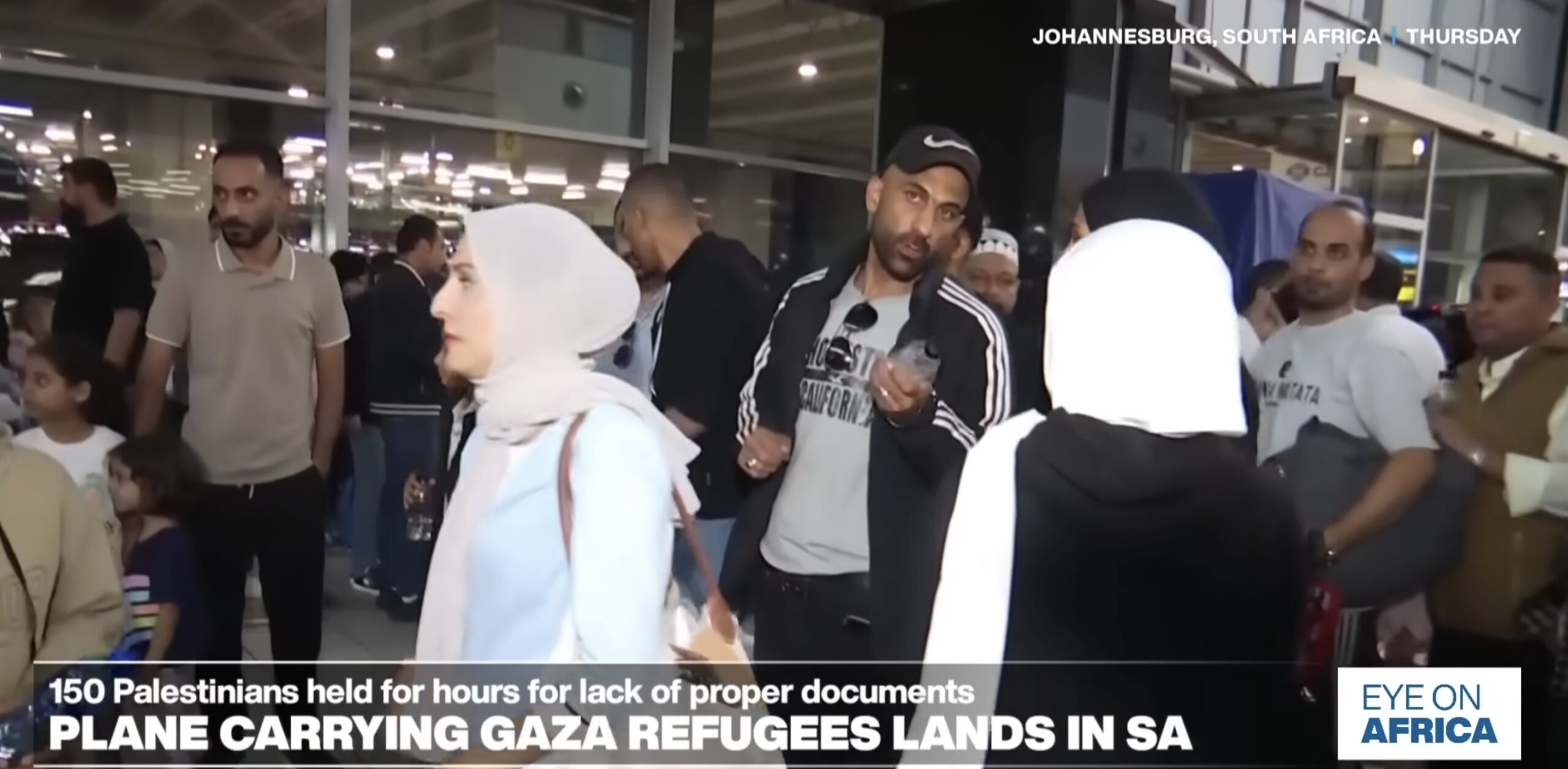
More than 300 Palestinians remain in South Africa after arriving unannounced on two separate chartered planes in October and November, sparking confusion, competing narratives, and a growing standoff between government, civil society actors, and international observers.
The issue has also fuelled a firestorm on social media, where many South Africans protested the arrival of the flights and warned that admitting unvetted Palestinians from a war zone could expose the country to extremist infiltration. The heated online debate has put significant public pressure on the government.
South Africa’s position is further complicated by its status as a signatory to the 1951 Refugee Convention, which commits states to offering protection to individuals fleeing conflict and persecution. The airspace closure raises questions about how these international obligations align with Pretoria’s current stance.
The latest decision means that no additional evacuees will be allowed in despite South Africa’s own claims at the International Court of Justice (ICJ) that Palestinians in Gaza are victims of genocide, ethnic cleansing, and forced displacement.
Weeks earlier, 153 new arrivals were received by humanitarian organisation Gift of the Givers, and Minister of International Relations and Cooperation Ronald Lamola said that flight formed part of “a clear agenda to cleanse Palestinians out of Gaza and the West Bank”.
Gift of the Givers insists that Israel orchestrated the refugees’ “uncoordinated entry” into OR Tambo International Airport, labelling it “forced removals” and “ethnic cleansing”.
Its founder, Dr Imtiaz Sooliman, has urged the government to block any further flights. “We don’t want them to leave their country; we want them all to go back. I encourage the government not to allow any more planes to come here,” he said, arguing that South Africa should instead help ensure that Gaza is opened so that Palestinians who have left may eventually return home.
Professor Loren Landau, senior researcher with the African Centre for Migration and Society at the University of the Witwatersrand, said the government’s decision may be legally permissible, but was morally fraught.
“My understanding is that the government is within its legal rights to refuse entry to almost anyone. However, once they are in the country, they may apply for asylum and under most circumstances, should be allowed to stay until that case is decided. The question is what’s morally right and symbolically aligned with South Africa’s position.
“Supporting displaced Palestinians is the ethical thing to do. Showing public solidarity with Palestinians is also a way of burnishing South Africa’s moral credibility overseas. However, I suspect domestic political calculations in a country rife with anti-immigrant sentiment are preventing the government from doing what’s right.”
Landau said this tension lay at the heart of South Africa’s approach.
“All of diplomacy is a two-level game where they must balance domestic and international considerations. When things work out well, domestic and international interests align. In this case, the moral position South Africa has taken on the global stage definitely rubs uncomfortably with the anti-immigration sentiments that characterise domestic politics.”
Independent commentator and Institute of Race Relations fellow Sara Gon said the government and its allies were constructing a narrative that didn’t align with basic facts.
“They appear to be trying to create a calumny about Israel trying to ‘depopulate’ Gaza. The number of Gazans who have tried to come in or pass through South Africa has been tiny. So it seems an inefficient way to depopulate Gaza. If Gazans can find a way to leave a war zone should they choose, then it’s up to them to do so.
“The Israelis have no administrative control over the Gazans. So Gazans have the right to use their own agency to leave Gaza, and they do it by plane if they can afford it, which some clearly can. Because of geography, the only way to fly out from Gaza is by an airport in southern Israel, which is what they’ve been doing,” Gon said.
“Sooliman is definitely trying to create the impression that it’s dastardly Israel to suit his anti-Israel narrative. It also suits the narrative that has been the basis of propaganda for the past 50 years that the Palestinians are downtrodden, helpless victims of Israeli strength and aggression.
She said it may be that the South African government is supporting that narrative to bolster its pro-Palestinian credentials.
“It also may be that it’s just trying to avoid criticism from local groups about the laxness of its border controls in general, and the charge of large amounts of illegal immigration from Africa. It may not want, therefore, to seem like it’s positively encouraging asylum for Palestinians with this background in mind. Seeming to lay the blame on Israel therefore suits its needs.
“Whether SA is reluctant to admit Gazans for any other reason is unknown, but it’s certainly assisting people like Imtiaz Sooliman to perpetuate another trope.”
For Dr Reuven Ziegler, associate professor in international refugee law at the University of Reading and senior researcher at the University of Johannesburg’s Faculty of Law, the airspace closure exposes an unavoidable contradiction in South Africa’s argument at the ICJ.
“Ultimately there is a protection obligation that follows from the belief that a genocide is being committed, and so in a way, one has to square one’s own circle,” he said. If the South African government truly believes its own claim that Israel is committing genocide, “then it’s inconsistent to be returning people to it”.
Ziegler calls the move “surprising”, noting that South Africa isn’t at risk of being “inundated with planeloads of people from Gaza”. Allowing “a plane or two”, he argues, would symbolically strengthen South Africa’s stance while fulfilling its humanitarian obligations rather than undermining them.
“Closing one’s airspace is just an awkward framing,” he said. “In essence, it means Gazans are no longer going to enjoy the 90-day visa exemption – that arrangement is being suspended.”
With sharp disagreements between government, humanitarian actors, and legal experts, the Gaza refugee saga remains unresolved. What’s clear is that South Africa’s moral case against Israel grows increasingly difficult to reconcile with its refusal to admit the very people it insists are victims of genocide. The conundrum deepens: South Africa is taking an uncompromising stand on the world stage while closing its doors at home.



Denise Sciacca
December 4, 2025 at 7:14 pm
Countries that allowed refugees in have created a serious problem for themselves.Many do not have proper documentation and they could belong to the radical Islamic Brotherhood.
Keep our borders closed.