



Holocaust
Shifting sand of Sobibor reveals horrific past

For decades, the Nazi extermination camp at Sobibor in Poland was deliberately hidden beneath trees, earth, and silence. Now, archaeological discoveries are revealing the physical traces of the people murdered there.
Dr Yoram Haimi, the Israeli archaeologist who has spent almost two decades excavating the site, shared some of those discoveries at the Cape Town Holocaust & Genocide Centre on Thursday, 13 August.
His talk, “Unearthing the Past: Archaeological Research, Discovery, and Commemoration at the Sobibor Extermination Camp”, explored how archaeology can help reconstruct a place where the Nazis deliberately tried to destroy evidence of their crimes.
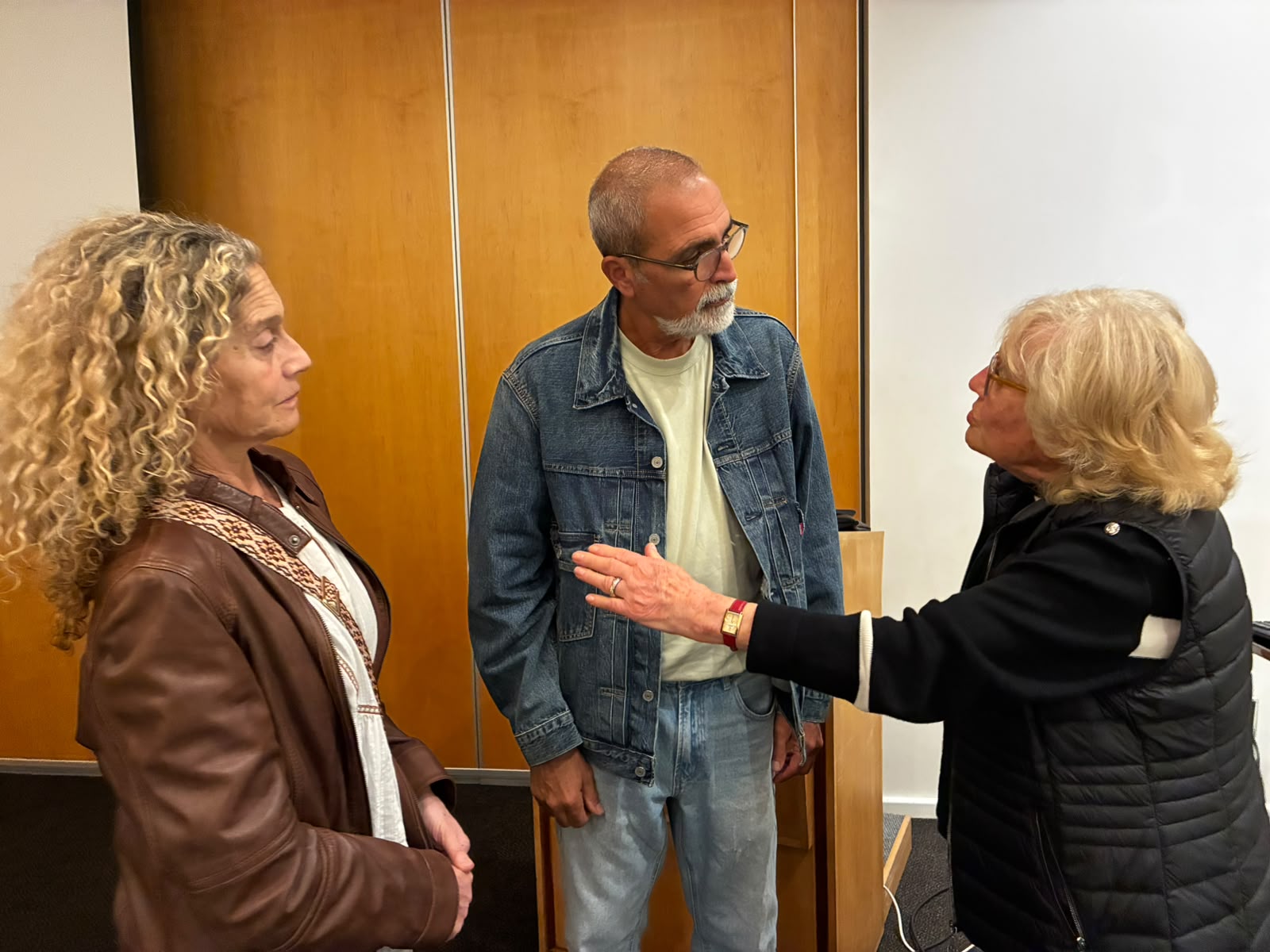
The talk had deeply personal meaning for Holocaust survivor Hélène Joffe, who attended with her daughter Rafael. Joffe was a child when the Nazis invaded France. Her family lived in Marseille, where her father, Ruben Mindal, was arrested by the Nazis and French collaborators in January 1943. He was taken to Drancy, the French transit camp from which Jews were deported to extermination camps. He was subsequently sent to Sobibor, where he was murdered.
Joffe and the rest of her immediate family survived the Holocaust by going into hiding in various parts of France. She later settled in South Africa. For Joffe, the subject of Haimi’s talk was therefore directly connected to the loss of her father.
Sobibor was one of three Nazi killing centres established as part of Operation Reinhard, the Nazi plan to murder Jews in occupied Poland. It operated from 1942 until October 1943 and, unlike concentration camps where some prisoners were selected for forced labour, Sobibor was established primarily as a killing centre. Deportees were murdered in gas chambers shortly after arriving.
The Nazis dismantled the camp following a prisoner uprising on 14 October 1943. They destroyed the buildings, removed traces of the camp, and planted trees over parts of the site. That created an unusual challenge for archaeologists.
Haimi explained that much of what was known about Sobibor came from documents and testimony from the small number of people who survived. “We are not talking, we are reading documents, but when you start to dig and to sift the sand, the evidence starts to show up,” he said.
Haimi began excavating Sobibor in 2007 with Polish archaeologist Wojciech Mazurek. Dutch archaeologist Ivar Schute was also part of the team. They excavated the site using a 5m grid. Every object found was recorded according to the precise section of ground where it was discovered.
The team soon found that the physical evidence did not always correspond with existing plans of the camp. Haimi said there were more than 50 different plans of Sobibor, based largely on the recollections of survivors. However, the plans differed from one another.
This was particularly problematic for Camp III, the area containing the gas chambers, cremation facilities, and mass graves. No prisoner from Camp III survived to provide a direct account of its layout. “We cannot make a plan, the true plan of Sobibor extermination camp,” Haimi said.
The excavations began providing evidence that could help resolve some of those uncertainties. At one site, the team discovered more than 800 objects almost immediately. Haimi said this showed that the structure could not have been a gas chamber. “In a gas chamber, people come naked, with nothing,” he said. “We shouldn’t find any artefacts in the gas chamber.”
The team eventually determined that what had been identified as a building was actually a shooting trench measuring about 100m. They also discovered evidence of a double fence separating different areas of the camp. On one side, they found thousands of artefacts, including dentures and jewellery.
Another significant discovery was the route that led victims from the undressing area to the gas chambers. The Nazis referred to this path as the schlauch, or “road to heaven”. The path was about 5m wide and enclosed by fences. Branches were woven into the fences so people inside could not see what was happening outside.
Haimi explained that the route was designed to prevent deportees from understanding where they were being taken. Survivor testimony indicated that people were told they were going to shower before continuing their journey. They could not see the gas chamber until they were very close to it.
The team also discovered evidence of the railway ramp via which deportees arrived. Haimi said archaeological measurements showed the ramp was about 165m long. This showed how trains and wagons could enter the camp.
For Haimi, however, some of the most significant discoveries were much smaller. The team has found about 220 000 artefacts at Sobibor. These include watches, combs, glasses, perfume bottles, medicine containers, jewellery, religious objects, and pieces of luggage.
Most of these objects belonged to people murdered at the camp. Some have enabled researchers to identify individual victims and connect their belongings to surviving relatives. Haimi showed the audience an identification tag belonging to a seven-year-old child. “It is very important because it connects a name to the place.”
The discovery changed the way Haimi viewed the enormous numbers associated with the Holocaust. “The whole story, which is a story about big numbers, it’s more or less impossible to understand,” he said. “When you see those items, the whole story becomes quite personal. It’s not a story of big figures anymore. It’s a story of one person.”
Artefacts have revealed connections between Sobibor and Jewish communities across Europe. Haimi described objects belonging to Jews from places including France, the Netherlands, and North Africa. One identification tag took the team five years to decipher. Archival research eventually connected it to a Moroccan victim.
Haimi said records identified 402 Jews from Tunisia, Algeria, and Morocco who were sent to Sobibor. His own family history was one of the reasons he began investigating the site. Haimi’s family lived in Paris during World War II and were murdered in the Holocaust. His mother lived in Morocco and spent years trying to discover what had happened to them. He eventually went to Yad Vashem, where he found transport records that helped him trace members of his family. They showed that his relatives had been deported from France.
Haimi also described the difficulty of establishing exactly where particular transports ended. He explained that one from France arrived at Majdanek before some prisoners were sent to Sobibor, according to at least one survivor.
For him, this demonstrated why archaeological evidence is important when reconstructing the history of the camp. “We can see very clearly how important the archaeological excavations, the testimonies, and the history books are because we can combine all this information and bring the true story of the camp.”
Local Polish volunteers have also been involved in the excavation. Haimi described people ranging from teenagers to elderly residents participating in the work. Some volunteers initially knew little about Sobibor. Over time, he said, their understanding of the site changed.
The team has also worked with relatives of victims to identify objects and reconstruct individual stories. For Haimi, this is one of the most important functions of Holocaust archaeology. The Nazis attempted to destroy Sobibor physically after the uprising. They removed structures, destroyed evidence ,and attempted to conceal the purpose of the site.
The archaeological work has shown that the ground still contains evidence of what happened there. Among the thousands of objects are reminders of ordinary lives interrupted by the Holocaust. A watch, a comb, a piece of jewellery, or a child’s identification tag can connect an individual to a place where almost no physical trace remained.
For Haimi, each discovery contributes to reconstructing the history of Sobibor. “Each artefact that we find is a story,” he said. And at a site designed to erase its victims, those stories provide evidence that the people murdered there were never simply numbers.
- Hear him at Limmud JHB this weekend limmud.org.za