


OpEds
Both Zionism and equality need to be defended

South African Jewry is a predominantly Zionist community, proud of its Jewish identity, its place in South African society, and its enduring connection to Israel. For many of us, Zionism is an integral part of our Jewish identity and our understanding of Jewish history.
Our concern, expressed in this opinion, is not simply with the direction of Israeli politics, but particularly with how we, as South African Jews, respond when political leaders in Israel adopt positions that conflict with the democratic principles we profess to uphold.
Being steadfast in our commitment to Zionism should never mean being uncritical of what is done in its name. There is a fundamental difference between supporting Israel and accepting political exclusion based on race or ethnicity as a means of addressing its problems. We should be willing to examine that difference openly, even when doing so creates disagreement within our community.
This matters particularly in South Africa. Our history has taught us the consequences of political exclusion based on identity, and the importance of building a society in which people with profoundly different histories and aspirations can participate as equals.
It also matters for the place of Jews within the wider South African society. We rightly seek understanding and respect for our Jewish identity and our connection to Israel. But our credibility in defending those commitments depends, in part, on demonstrating that our opposition to racism and discrimination is principled and consistent.
The question we want to raise is therefore not whether we should support Israel, but what that support should mean when fundamental democratic values are at stake.
Zionism need not negate the rights of Arabs living in Israel. Theodor Herzl’s vision, particularly as expressed in his novel Altneuland, envisaged a Jewish society in which Arabs and Jews could live together and enjoy equal rights. While this was an idealised vision rather than a complete constitutional programme, it demonstrates that Jewish national aspirations and the rights of others need not be mutually exclusive.
Israel’s Declaration of Independence, proclaimed by David Ben-Gurion in 1948, explicitly promised equal social and political rights to all citizens, irrespective of religion, race, or sex, and invited Arab inhabitants to participate fully in the state and its institutions.
Yet the October 2026 Israeli election exposed a troubling contradiction. We vigorously reject the characterisation of Zionism as inherently racist and challenge accusations that Israel is an apartheid state. But how do we reconcile that position with election campaigning that presented increased Arab voter turnout as a warning to Jewish voters, or with opposition leaders who ruled out cooperation with Arab parties, citing ideological differences?
The distinction is fundamental. There are legitimate reasons to refuse political cooperation with particular individuals or parties. Support for Hamas, endorsement of violence against the state, or rejection of peaceful democratic processes can provide principled grounds for exclusion from a governing coalition. These standards must apply equally to Jewish and Arab parties.
No political party has an automatic right to participate in government. Coalition partners must be able to agree on fundamental principles and governing objectives. But every citizen has an equal right to political representation, and no party should be disqualified from consideration solely because of the ethnic identity of those it represents.
Nor should a party’s refusal to identify as Zionist automatically disqualify it. When high Arab voter turnout is portrayed as a danger in itself, an entire population risks being treated with suspicion simply for exercising its democratic rights. In our view, treating Arab identity or democratic participation itself as a political threat is racism, not legitimate political disagreement.
The Democrats leader Yair Golan has articulated a different approach, arguing that Arab parties should not be excluded from coalition negotiations simply because they represent Arab voters. He has supported cooperation with Mansour Abbas and the Ra’am party on the basis of an agreed political programme. His position demonstrates that Zionism and Arab political partnership need not be incompatible.
Nor is this commitment to equality foreign to religious or nationalist Zionism. Rabbi Yehuda Amital regarded the equality promised in Israel’s Declaration of Independence as a binding obligation under Jewish law. Rabbi Aharon Lichtenstein, confronting a ruling by Israeli rabbis that sought to prohibit selling or renting homes to non-Jews, challenged both their interpretation of Jewish law and their judgement. His intervention demonstrated that even deeply held commitments to the Jewish people and the land of Israel must not prevent us from questioning measures that discriminate against others. Even former prime minister Menachem Begin, whose nationalist Zionist credentials were beyond question, opposed the military government imposed upon Israel’s Arab citizens and argued in the Knesset in 1962 for equal rights irrespective of religion, nationality, or origin.
These were voices from within Zionism who insisted that Jewish national self-determination carries moral responsibilities towards others.
As South African Jews, we should understand this better than most. Our history has taught us that democracy means more than the right to vote. It requires the legitimacy of every citizen’s participation in political life, including the possibility of sharing political power. We know the consequences of exclusion based on identity and the importance of leadership that brings divided communities together rather than exploits their fears.
Many South African Jews are deeply troubled by our government’s one-sided approach to the Israeli-Palestinian conflict, its failure to distinguish adequately between the Palestinian cause and Hamas, and its failure to draw upon South Africa’s experience of negotiation and accommodation to promote peace.
But criticism of our government cannot excuse silence about racism and political exclusion in Israel.
We were horrified by attempts at the Durban conferences to equate Zionism with racism. Yet when we fail to challenge exclusionary politics in Israel, we lend credibility to those who seek to delegitimise Zionism itself.
Our communal leadership has a particular responsibility to make these distinctions clear, but the responsibility does not end there. Each of us must decide whether our commitment to democratic equality is a principle we apply consistently, including when it challenges people and institutions with whom we identify.
We should be prepared to discuss these questions openly within our community and with fellow South Africans. That means defending Jewish self-determination while also being willing to challenge discrimination, listen to contrary views, and seek common ground.
The alternative is to allow our public identity to become associated with positions we may neither hold nor wish to defend. In a country with South Africa’s history, that carries consequences for the credibility of our community and for the relationships we have worked to build across society.
South Africa’s own transition, imperfect as it has been, offers lessons about the courage required to engage with those we do not trust, recognise competing aspirations, and begin building a shared future.
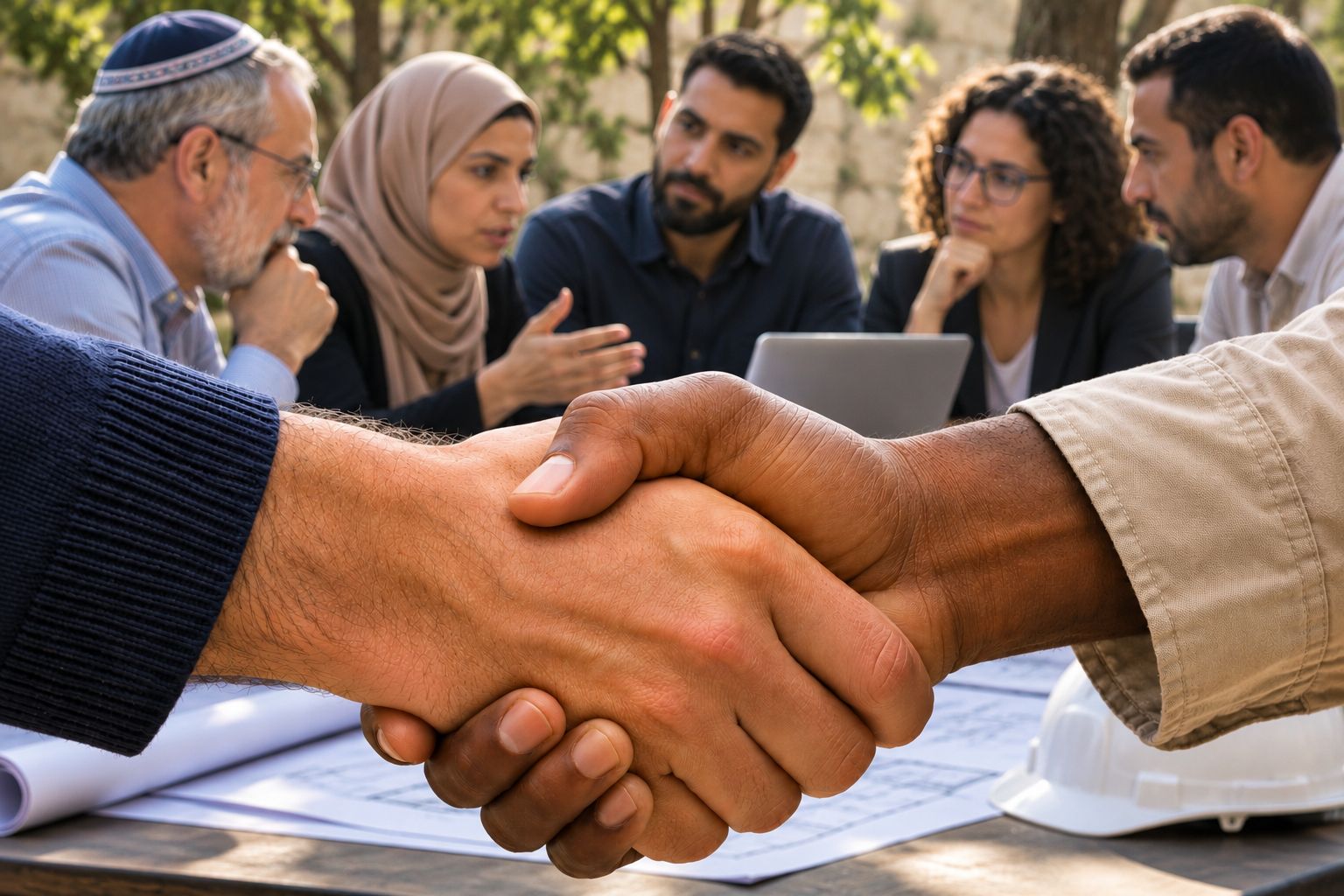
Perhaps our greatest contribution would be to work in partnership with other South Africans to demonstrate how people with deeply opposing views can engage constructively and seek common ground.
Rather than allowing the conflict over Israel and Palestine to deepen divisions within South Africa, could we not become an example of the inclusive dialogue we hope to see in Israel itself – a dialogue that moves beyond fear, hatred, and distrust towards a better future for all?
That would be a meaningful expression of what it means to stand up for our values.
- Charles Chemel is a trustee of Koleinu SA, principal of CSC Advisory, chairperson of Lesaka Life, and former chairperson of the South African Credit and Risk Reporting Association. Rob Katz is founder of the Shoshana Foundation and is currently completing a master’s in Holocaust and Genocide Studies in the US.