





Community
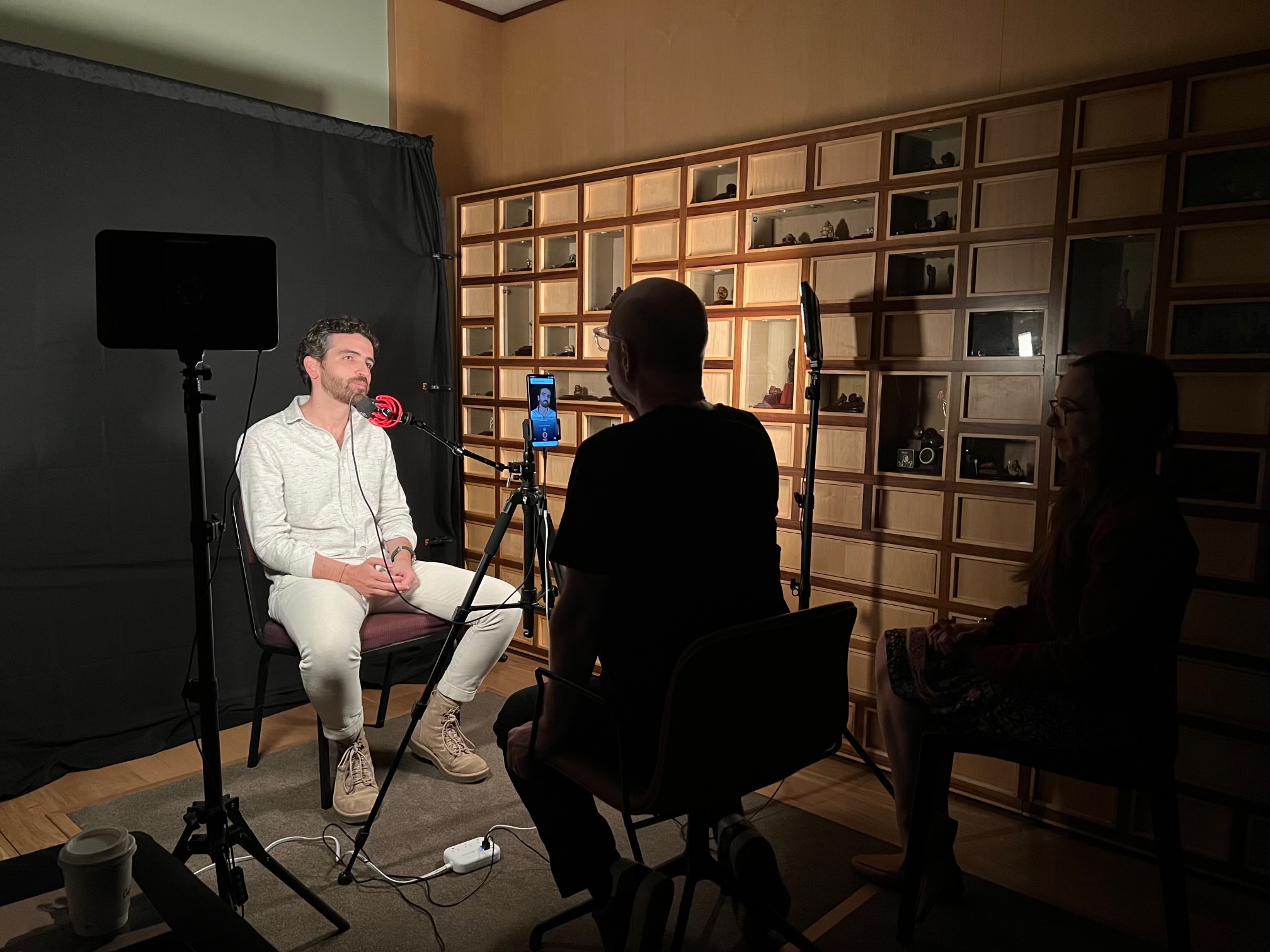
SA Jews add their unique take to Our Jewish Story

Stephen Smith’s goal is to tell 30 000 stories about 30 000 lives that show what it means to be Jewish in the 21st century.
Smith – former executive director of the USC Shoah Foundation, established by filmmaker Steven Spielberg to preserve Holocaust survivor testimonies – was in South Africa this week to interview people for this ambitious project.
The Our Jewish Story project, in partnership with the National Library of Israel, aims to document the lives of 10 000 Jews in Israel and 20 000 across the diaspora, preserving their voices for generations to come.
Expected to take about five years to complete, the project will see Smith, a renowned Holocaust educator and oral historian, and his team travel to Jewish communities across the world, working with local organisations to record stories that reflect the diversity of Jewish life.
Smith has spent the past 30 years interviewing Holocaust survivors, trying to understand and counter antisemitism during the darkest point of Jewish history. But throughout that time, he has always been struck by the resilience of the Jewish community in the face of extreme hostility.
Now he’s turned his attention to documenting contemporary Jewish experiences. From family histories and religious traditions to questions of identity, belonging, and antisemitism, the interviews aim to capture what it means to be Jewish today.
“Today, as antisemitism rises, everyone is rushing to put out fires, strengthen security, and fight the hateful narratives spreading online. But I’ve come to realise that the Jewish community can be a source of strength to itself. When we appreciate and share our own stories, we create something powerful that goes beyond what anyone else says about us.
“Telling your story is, in itself, a Jewish act. It’s an act of resistance, although I wouldn’t describe this as a resistance archive. When you stand up and say, ‘This is who I am’, and make yourself vulnerable enough to share that publicly, it’s a statement of strength. You’re not fighting an antisemite or responding to someone else’s narrative. You’re simply saying, ‘This is who I am, this is what matters to me, and this is why.’
“That’s what motivates me about this project. It’s about allowing individuals and communities to tell their own stories and, in doing so, creating a tapestry of Jewish life. When you stand back and look at it, you see the extraordinary colour, diversity, and beauty of who we are. I think we owe it to ourselves to preserve that.”
South Africa is among the first countries in which the project has begun. The accounts will form part of a permanent archive at the National Library of Israel and be accessible to the public through the Our Jewish Story app, allowing future generations to hear directly from those who lived these experiences.
“Over the past two weeks, we’ve been in Cape Town and Johannesburg, meeting with community leaders to explain the project and conducting around a dozen interviews. We’re interviewing key figures not simply because they’re leaders, but because we want them to understand the value of sharing their own stories and how the process of documenting their community’s experiences works,” Smith said.
He explained that South African Jews were among the first interviewed not just because it’s an English-speaking community, and he has an established relationship with the Cape Town Holocaust & Genocide Centre and SA Jewish Museum, but because he wants to examine a community very different to those in the United States, United Kingdom, and Australia.
“Very often when one thinks of diaspora, because the US has such a large proportion of diaspora, it tends to get first dibs on what it means to be Jewish in diaspora. And I wanted to be really clear that actually some of the smaller communities, like the entire South African community, which is the size of a Philadelphia community, for example, has so much culture, cultural diversity, history, and also a different political, cultural, and historical context in which Jews live,” he explained.
The minimum number of interviews in each country will be based on the size of its Jewish population, while ensuring representation across different backgrounds, denominations, ages, and genders. Working with local organisations, the team hopes to capture voices beyond established communal structures, including unaffiliated Jews, to create an inclusive picture of Jewish life that reflects the unique makeup of each community.
The interviews are tailored to both the country and the individual, exploring issues specific to South African Jewish life, the legacy of apartheid, antisemitism, and Jewish identity. Questions are then adapted to each person’s background, career, and communal involvement, allowing conversations to develop naturally and uncover more personal experiences.
Smith explained that an interview with virologist Professor Barry Schoub, for example, began with questions about balancing his religious observance with his scientific career, but evolved into a deeper discussion about faith, science, and identity. Through this approach, the project aims to capture the complexities of what it means to be Jewish in South Africa today.
One of Smith’s biggest discoveries from 15 interviews has been that South African Jews experience life very differently to what he’d expected. Given the South African government’s accusations of “genocide” by Israel, and its case at the International Court of Justice, Smith had assumed that Jews might find living here oppressive.
“However, I’ve been completely surprised by what I’ve heard. Of course, people still need to be cautious, but the picture emerging is very different from places like Australia, where I’ve heard that many Jews who felt safe two years ago are now deeply fearful,” he said. “By and large, the South African Jews I’ve spoken to say they don’t experience antisemitism in their daily lives, don’t fear for their safety beyond taking general precautions, and feel that South Africa remains a welcoming place where Jews can thrive. That has genuinely surprised me.”
