



World
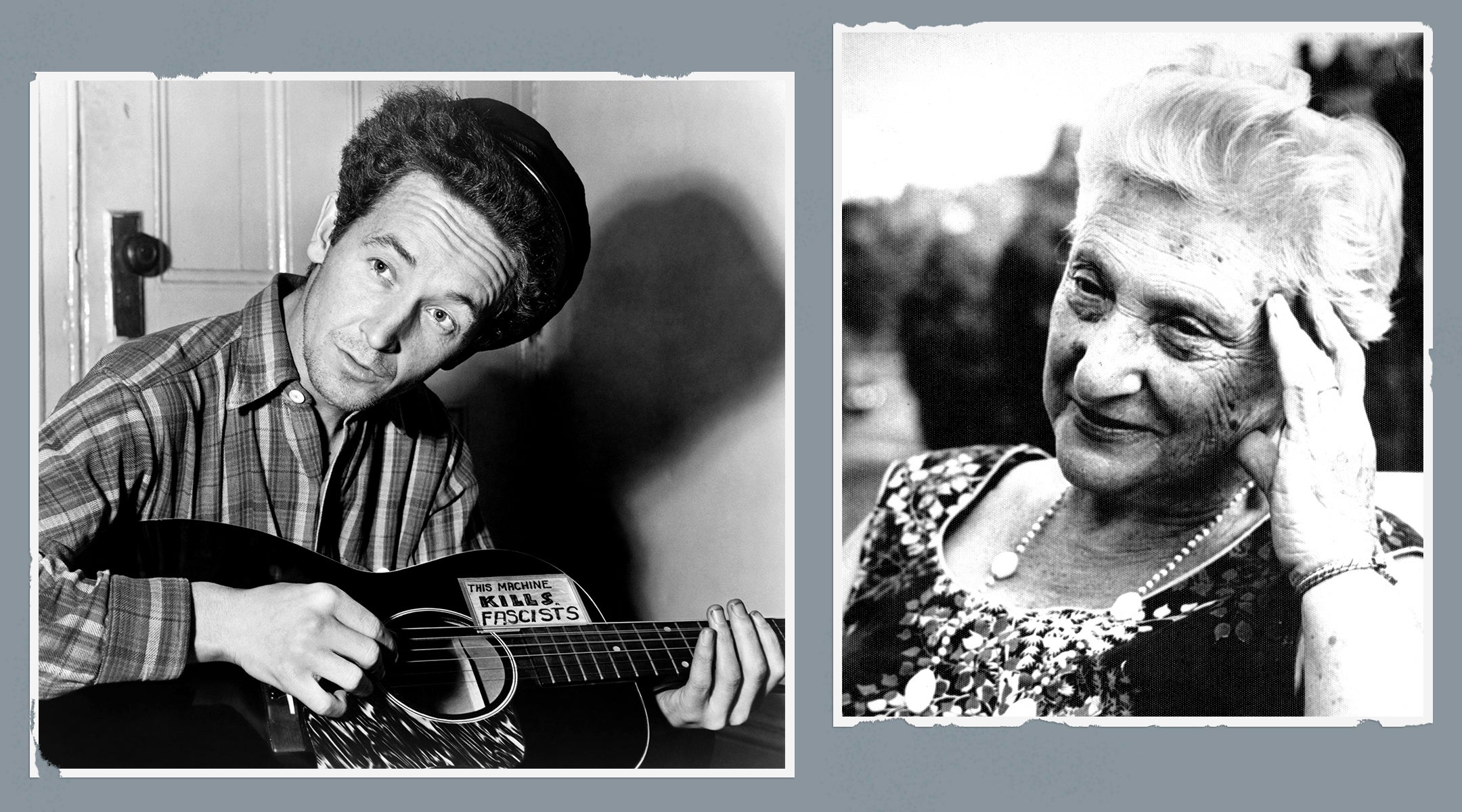
The Woody Guthrie story you’ve probably never heard is deeply Jewish

JTA – I knew that the folk singer Arlo Guthrie’s mom was Jewish in the same way that I knew that jazz great Louis Armstrong spoke some Yiddish. “Guess who’s Jewish (even a little)” is the Jewish national pastime.
But I couldn’t have guessed how deeply Arlo’s father, the legendary folk singer Woody Guthrie, was enmeshed in Jewish culture before seeing Dust Bowls and Jewish Souls: Another Side of Woody Guthrie. Steven Pressman’s engaging new documentary has just begun its rounds on the Jewish film circuit, with screenings this month in Wilmington, North Carolina, and Nashville.
Best known as the bard of the Dust Bowl, the Oklahoma-born Guthrie gave voice to migrants, labourers, and the dispossessed, and his This Land Is Your Land has become something close to an alternative national anthem. His second wife, Arlo’s mom, was born Marjorie Greenblatt, a Martha Graham dancer whose parents were Jewish immigrants from Ukraine. I knew she inspired him to write a few Chanukah songs and that’s about it.
The film, however, makes the case that Guthrie’s extended Jewish family was not incidental but integral in his artistic and personal evolution. It is a story that stretches from Oklahoma to Queens, New York to the Yiddish literary world, and from the folk revival’s Jewish impresarios to one remarkable immigrant woman whose influence has largely gone unrecognised.
That would be Aliza Greenblatt, Marjorie’s mother. A doting grandmother known to Arlo and his siblings as “Bubbie”, she was a Yiddish poet and lyricist of some renown, and what the Jewish Women’s Archive calls “an early, committed leader in Zionist and Jewish women’s organisations”.
Greenblatt is hardly a household name outside Yiddish cultural circles. Yet Pressman’s film suggests that she deserves a place in the Guthrie story alongside Pete Seeger and a young Bob Dylan.
The relationship is striking precisely because it resists stereotype. As Aaron Lansky, founder of the Yiddish Book Center, puts it in the film, “Some people aren’t Jewish. And some people really aren’t Jewish. That was Woody Guthrie.”
But after moving to New York from California and meeting Marjorie, Guthrie didn’t merely come to enjoy Jewish food, sprinkle a few Yiddish words into conversation, or pick up a holiday tune. Through Greenblatt, he entered an immigrant family steeped in Yiddish language, music, poetry, and left-wing idealism. Their exchanges, preserved in letters, songs, and family memories, show an artist captivated by another people’s folk culture because he recognised in it echoes of his own.
Guthrie, after all, grew up poor, and saw his neighbours driven off their land by the economic and environmental disasters of the Great Depression. In teaching him about Jewish history, holidays, and folklore, Greenblatt gave him another vocabulary for thinking about exile, injustice and perseverance – themes that already animated his work.
He found in Jewish culture another vernacular tradition, one built on storytelling, humour, resilience, and moral responsibility.
The film also reminds viewers that Guthrie’s Jewish connections extended well beyond his family.
Among the central figures in his career was Moses Asch, founder of Folkways Records and the son of the celebrated Yiddish novelist Sholem Asch. Without Asch’s obsessive commitment to documenting American folk traditions, and putting them on shellac and vinyl, much of Guthrie’s recorded legacy might never have survived in the form we know today.
Then there was Harold Leventhal, the son of Orthodox Jewish immigrants, who became one of the most influential managers and producers in American folk music. Leventhal helped shape the careers of Guthrie, Seeger, and later generations of performers, including Arlo, while helping transform folk music from a subculture into a national movement.
The Jewish imprint on the folk revival ran even deeper. Dylan, born Robert Zimmerman to a Minnesota Jewish family, famously reinvented himself after absorbing Guthrie’s music. In the film, Arlo and his sister Annie tell a charming story about a scruffy Dylan showing up at the family home in Queens before visiting Woody, by then gravely ill with Huntington’s disease, in the hospital. Singer Ramblin’ Jack Elliott, born Elliott Adnopoz to Jewish parents and raised in Brooklyn, devoted himself to carrying Guthrie’s style and repertoire into the next generation.
Taken together, these figures complicate the familiar story of the folk revival. It wasn’t simply a movement inspired by Appalachian, African-American, cowboy, and rural traditions. It was, in many respects, a conversation that included Jewish intellectuals, producers, performers and organisers who recognised in American folk music something akin to their own inherited traditions.
In a film that includes any of a number of “Who knew?” revelations, perhaps the most startling detail concerns Arlo and his siblings, Annie and Joady. Close in age, the three took Hebrew lessons from a young rabbi who would go on to his own version of fame and infamy. You can look it up, but I won’t spoil it for you here. Silent home movies show the Guthrie kids taking those lessons, celebrating Shabbat with their grandparents, and gathering around what the family called the “Chanukah tree”.
And no doubt singing Woody’s Chanukah songs, of which he wrote quite a few. The same singer/songwriter of I Ain’t Got No Home in This World Anymore also wrote Honeyky Hanukah (“It’s Honeyky Hanukah, shaky my hand,/ My candles are burning all over this land”). In 2006, The Klezmatics recorded them on the Grammy-winning album Woody Guthrie’s Happy Joyous Hanukkah.
I saw Dust Bowls and Jewish Souls on 27 July at a sold-out screening at the Berkshire Jewish Film Festival in Lenox, Massachusetts, in what has become the heart of Guthrie Country. Marjorie first came to the Berkshires to teach dance at Indian Hill Arts Camp in Stockbridge, founded by the musicians and activists Mordecai and Irma Bauman. Arlo made his home in Berkshire County, and his 1967 hit Alice’s Restaurant is set in Stockbridge. The family transformed the church where the real-life Alice lived into the Guthrie Center, now a thriving venue for music and social justice programming. It currently features an exhibit on Woody’s struggle with Huntington’s and Marjorie’s efforts to raise awareness about the disease.
Arlo’s daughter Annie Guthrie is the executive director of the Guthrie Center, and spoke following the Lenox screening, underscoring how the family’s history continues to intersect with Jewish cultural life.
The family carries Woody’s name, but as Annie explained, Aliza Greenblatt’s legacy looms large. The film features a letter written by Aliza to Arlo on his 13th birthday. Even if those Hebrew lessons didn’t take – Arlo explains in the film that he wasn’t called on, or able, to do very much at his Barmitzvah – in her letter Greenblatt reminds him of the significance of the day and blesses him with a life of creativity and independence.
Annie recalled that her grandmother Marjorie wrote a similar letter to her brother Avery on the eve of his 13th birthday.
“Now, we didn’t grow up Jewish,” said Annie, whose mother, the former Jackie Hyde of Salt Lake City, died in 2012. “We were kind of interfaith. But I want to be the grandmother that writes a letter to her grandchild on the eve of their 13th birthday.”
Aliza and Marjorie, she said, “continue to inspire me”.
- Dust Bowls and Jewish Souls: Another Side of Woody Guthrie will next screen at the Wilmington Jewish Film Festival on 5 August, and at the Nashville Jewish Film Festival on 18 August.