


World
Kristallnacht survivor calls on German police to stand firm against hate

JTA – One of the last surviving Jewish witnesses of Kristallnacht told German police leaders they have an “enormous responsibility” to learn the lessons of the past.
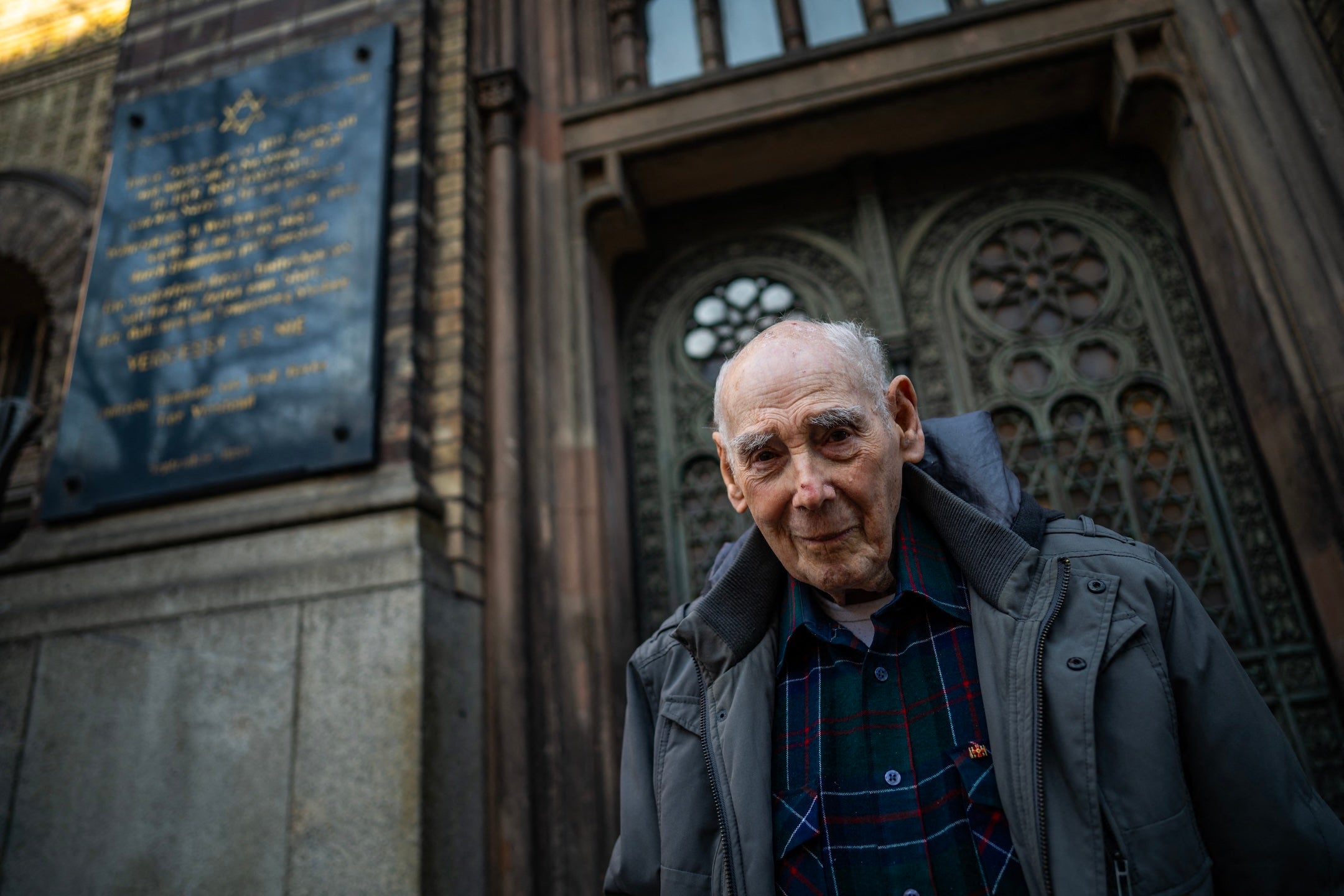
George Shefi, 94, this week returned to the city of his birth to share his story with senior law enforcement representatives from Germany, other European countries, and the United States at the city’s New Synagogue, a target of the Nazi-spurred mobs on Kristallnacht. The event held on Thursday, titled “Not on Our Watch: Operationalising Never Again”, marked the 88th anniversary of the pogrom.
The exact anniversary was Monday night 9 November.
“I have come here at this time to say that Germany’s responsibility to preserve the memory of the Holocaust is eternal,” Shefi told the Jewish Telegraphic Agency (JTA) in an interview before the event. He does not believe today’s generations of Germans are “guilty of what happened”, but nonetheless believes they “have an enormous responsibility and a duty to learn from the past to ensure that it never happens again”.
Shefi was almost seven when the Nazis unleashed violent pogroms across Germany on the night of 9 November 1938, in which the Berlin synagogue that housed his school was burned to the ground.
Months later, his mother sent him alone to safety in Britain on the Kindertransport. He would never see her or her sister again. They were murdered at Auschwitz.
The New Synagogue, like many others across Germany, was set on fire that night, but it was not completely destroyed thanks to the bravery of Wilhelm Krützfeld, the head of the local police precinct, who called the fire brigade. One of the few Germans to stand up to the violent antisemitism on Kristallnacht, his memory was honoured at the event on Thursday night.
The event was an initiative of the International March of the Living, in collaboration with several other partners, including Germany’s largest police trade union. It is part of a wider international educational programme that sends senior police representatives on the annual march in Poland to deepen their understanding of the Holocaust and the need to protect global Jewish communities.
Shefi, who emigrated to Israel in 1949, has shared his personal story with more than 12 000 German students over the past two decades and spent years volunteering with the Israeli police. Last year he received Germany’s Federal Order of Merit for his commitment to Holocaust education.
“There is special significance in giving my testimony before them [the police] in the very synagogue that was saved from burning on Kristallnacht thanks to a police officer who did the right thing. He was a human being. He did not stand by, and he did not allow the flames of hatred to spread,” Shefi told JTA.
“I call on police officers in Germany to learn from him and draw inspiration from his courageous act,” he said. “If he could act that way under Nazi rule, police officers today must also act and refuse to stand by in the face of hatred.”
Shefi recalled the immediate aftermath of Kristallnacht in an onstage interview with Revital Yakin Krakovsky, the March of the Living Israel chief executive. He said that when he had woken up the following day, his mother had told him there was no school but gave no explanation.
It was only three days later that he saw the result of the carnage. He recalled seeing the remains of a vandalised hat shop close to his house.
“The windows were broken. Glass was everywhere. Hats were thrown around, and half of them were probably stolen. That’s one picture I’ll never forget.”
He also recalled antisemitic graffiti daubed on the side of a store belonging to a Jewish man and his Christian wife. “The Nazis didn’t break their store, but on the sidewalk they wrote in big letters ‘This store belongs to a Jewish pig who is married to a German swine’.” He said that while someone had tried to clean up the abuse, dozens of people had stood around “yelling and screaming”.
A day before the event, Shefi returned to the area where he was brought up to see the stolpersteine, memorial stones, laid for his mother and aunt. Last month, a town in Germany voted to ban the stones, something Shefi said had to be “fought tooth and nail”.
“That’s the way things start,” he said. “You start out with a law that looks very mild and very quickly grows, and people have to wake up to it. If you want to keep this country democratic, you have to start immediately to fight against such situations.”
Stressing the importance of the stones, which have become a feature of remembrance in Germany and other countries that had been occupied by the Nazis, he said, “That’s the only symbol we have that there was a Jewish community here, and they always will be if the police protect that right.”
The event came at a time of heightened antisemitism globally. According to a new report published by Israel’s Ministry of Diaspora Affairs and Fighting Antisemitism, 244 incidents targeting synagogues, Chabad centres, and worshippers in their vicinity were documented across 34 countries between 7 October 2023 and 21 October 2026.
Phyllis Greenberg Heideman, the president of the International March of the Living, told JTA that remembering Kristallnacht is important because it was a “critical warning sign of what was to come”.
“Had the world acted to stop the violence and persecution at that time, the devastating consequences might have been different. We do not see Kristallnacht merely as a lesson in history, but as a reminder and a warning about antisemitism today,” she said.
“This year, we chose to hold the event in Berlin, where the pogrom took place, in a synagogue that survived thanks to the courage and humanity of one police officer, Wilhelm Krützfeld, who prevented the mob from setting it on fire,” Heideman said. “Our message to the senior police officials attending this event is clear: learn from his example. Do not stand by in the face of antisemitism and hatred. Do what is right, and protect those who need your protection.”
Jochen Kopelke, the federal chairperson of the German Police Union (GdP) and president of the European Federation of Police Unions, lit a torch dedicated to combatting antisemitism at this year’s march in April.
“The Federal Republic of Germany bears immense guilt,” he said. “It cannot absolve itself of that guilt, now or ever. Our enduring obligation is to remember the unimaginable atrocities of the Holocaust.
“In view of the alarming increase in antisemitic acts in Germany, I feel compelled, as a citizen, as a democrat, as a trade unionist, as a police officer and, above all, as a human being, to use every means at my disposal to confront the terrible, deeply troubling, and unmistakable rise of homegrown German antisemitism,” Kopelke said.
Paul Goldenberg, who served as a police officer in New Jersey for more than 25 years, heads up the “Operationalising Never Again” initiative.
He said its lessons apply not just to German police but to their colleagues worldwide. Livestreaming of the event was made available to a majority of major police associations across North America.
“It would be a serious mistake for police leaders elsewhere to regard these lessons as Germany’s responsibility alone,” he told JTA. “No country is immune from the politicisation of policing, prejudice, or an institutional culture in which people stop questioning improper decisions. As an American police leader and chair of this international delegation, I believe we must bring the same scrutiny to our own institutions that we ask of others.”