Personal Story
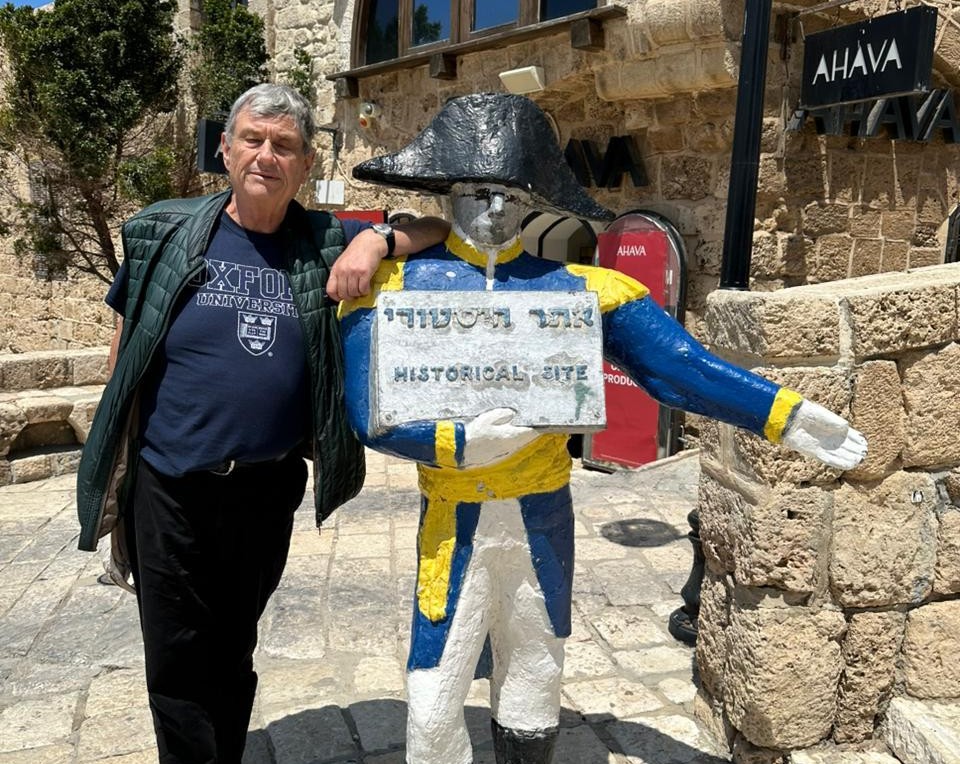
A first-time visitor’s view of Israel

I had put a visit to the holy land at the top of my bucket list when I’d left full-time employment to start writing books three years ago. I had every intention of going for Christmas 2023 until, let’s say, events got in the way.
When I visited just after Easter this year, it was hardly in ideal conditions. The tour operator told us it was touch and go, as Iran was bombing Israel, and one of its missiles had come close to landing on the Al-Aqsa Mosque itself. The possibility of a repeat attack was worrying as the tour of the Jerusalem Old City was the highlight of the trip.
I was reminded of my father’s stories when he worked in firefighting during the London Blitz and the 1944 Second Blitz, when London was hit by Doodle Bugs, a kind of primitive drone, and missiles. There was something of that stiff upper lip spirit in the Israelis – their generally noisy nature notwithstanding.
It was reassuring, as we travelled through Israel, to see the sophisticated civil defence. There were air-raid shelters at the hotel and, we were told, in every apartment block in Jerusalem and Greater Tel Aviv, where the majority of Israelis live. Gaza, by contrast, has thousands of miles of tunnels, but apparently no room for women and children to shelter in during air raids.
A few things struck me immediately on landing at Ben-Gurion Airport. We were told to stick together as a group. I was concerned that the Israeli authorities might dig out some of my criticisms of the current government. I’d been quite vocal when the demonstrations around Bibi’s Supreme Court reforms were taking place. But the man at passport control wasn’t intimidating at all. He was quite sloppy; his shirt wasn’t even tucked in. I soon found out that this is quite normal in Israel. I felt very overdressed when I put on a blazer for Shabbat dinner.
When we went to collect our bags there was a snack but there were no signs in English or Latin script. It was all in Hebrew. I assume the black stuff in the bottle was some kind of cola, and our South African-Australian tour guide ordered it for me in fluent Hebrew.
It is just as well I am a fan of the crime drama series Fauda, as it had already cleared up some of my misperceptions. I’d thought that the Hebrew language, like Irish Gaelic, might be a gimmick for tourists and that the lingua franca was some kind of Brooklynese English. This wasn’t the case at all.
As a South African tour group, all the conversations with the tour guides were in English – though, as it happened, I was the only native English speaker – and only white male – in the party. But the guides would speak Hebrew or Arabic among themselves.
I knew from Fauda that Jewish and Arab Israelis are often indistinguishable. I met a prominent Arab Israeli podcaster, who certainly contradicts the trite view that Israel is some kind of Jewish ethnostate.
We were grateful for Israeli Arab shawarma shops in the Old City of Jerusalem and in Jaffa (Yafo), the most historic part of Tel Aviv. The hummus and baba ganoush in the Muslim Quarter of Jerusalem was very welcome at Shabbat lunchtime when, of course, Jewish-owned restaurants were closed.
But even in the hotels – and we stayed in strictly kosher establishments – there was no sign of New York deli food. Israel is in the Eastern Mediterranean, not in the Baltic or the Lower East Side of New York, and the diet reflects that. Israelis eat more fruit and vegetables per head than practically any other people in the world.
There is very little obesity, certainly compared with North America and Western Europe.
Israel is very much not part of the West in terms of demography. Even among secular Israelis working in the tech sector, it is quite common to have four children. The birth rate is even higher among the Haredi ultra-Orthodox and Israeli Arabs.
This presents its own set of problems; there are people much better equipped to discuss this than I am. But since the 7 October war, it was inevitable that Haredis could no longer dodge the draft into the Israel Defense Forces, unless they were bona fide religious scholars.
We had the chance to go into the West Bank without our Israeli guide. It’s clearly marked that Israeli citizens aren’t welcome in the main population centres of the West Bank. It’s recommended, though an unwritten rule, that “visibly Jewish” people don’t attempt it either, especially not to visit the capital, Ramallah. Jews who took the wrong turning and accidentally ended up in Ramallah were lynched not so long ago.
Conditions in the West Bank are nothing remarkable for anyone who has visited South African townships; they are substantially better than they were in Bantustans such as the Transkei and Bophuthatswana, both of which I visited often as a young journalist. A Palestinian guide took us into a “camp” that wasn’t under canvas and was substantially more comfortable than Alexandra township in Joburg.
The Palestinian Authority is deeply unpopular and apparently incompetent, comparable perhaps to the Transkei under the Matanzimas. There could be a breakthrough if it had leadership half as strong as the better homeland leaders such as Major General Bantu Holomisa, after he took over from the Matanzimas through a South African-organised coup, and the shrewd Lucas Mangope in Bophuthatswana.
But as it stands, all the polls show that Hamas would win by a landslide in a free and fair election in the West Bank.
The election runup in Israel is in full swing now, but not a big topic when I was there. People were more worried about the next Iranian missile that might fall on their heads. If one had landed on our minibus that would have been tickets.
But I could that see Israel is a vibrant democracy – two Israelis, three different opinions, as they say. The current prime minister is deeply unpopular, especially in Tel Aviv. Even more so possibly now that there’s been a stalemate in the US-Iran War.
- Stephen Cranston is a former associate editor of the Financial Mail and is writing a book on the history of the Investec Group.