OpEds
Yom Yerushalayim, a city the world cannot ignore

In the Moreh Nevuchim (3:45), the Rambam addresses the striking absence of Yerushalayim from the Torah. Though Tanach later overflows with references to the city, the Torah itself never names it explicitly, even when describing visits to it. The Rambam explains that this omission is deliberate. Had the Torah clearly identified the site of the Mikdash and the resting place of the Shechinah, it would have drawn the attention and hostility of surrounding nations, who might have seized or desecrated it. The city would have been engulfed in violence.
Evidently, not every element of this plan, as described by the Rambam, has unfolded as envisioned. From as early as 500 BCE, Yerushalayim has stood at the centre of relentless struggle, fought over, claimed, and reclaimed across generations. That struggle has not faded. To this day, we continue to grapple with asserting a fully recognised and internationally accepted Jewish sovereignty over our city.
Though the name Yerushalayim does not appear explicitly in the Torah, each of our Avot (Patriarchs) encountered this mountain. Avraham’s journey to the Akeidah already traces the future path and trajectory of our city.
In truth, Avraham had already visited Yerushalayim long before the Akeidah. After defeating the four tyrants who had imposed a reign of terror across the region, Avraham arrives at the city then known as Shalem. There he encounters a mysterious religious figure, Malki Tzedek, a priest-king who presides over the city.
Something about this place stands apart. Unlike Sedom, already marked by corruption, unlike the culture of Egypt, which seizes women from their husbands, and unlike the empires of the four kings who ruled with brute force, this city carries a different tone. They offer bread and wine to a war-weary Avraham and extend hospitality and shelter as he recovers.
This behaviour is not incidental. The city is called Shalem, suggesting a human striving for moral wholeness, guided by a religiously attuned leader who seeks to shape a city worthy of that name. Chazal identify this figure as Shem, the son of Noach, who had already grasped a form of monotheism even before Avraham’s discovery.
This encounter between Avraham and Malki Tzedek shows what had already been achieved. It also shows what still remained beyond reach and begins to point towards what Avraham himself would later introduce. They had built a moral city and were striving for ethical refinement. Yet their vision of shleimut (wholeness) was limited. They could not grasp that full religious perfection cannot be achieved on human terms, through human logic or moral intuition alone.
Religious perfection requires transcendence, an encounter with the Ribbono Shel Olam, a presence that does not conform to human categories. That encounter arrives in Parashat Vayeira, when Avraham is summoned up the mountain to meet Hashem on His terms, beyond human comprehension and beyond moral instinct, to perform a command that defies understanding.
This is why the Torah spotlights the bread and wine. Rashi comments that this gesture foreshadows the korbanot (sacrifices) that Avraham’s descendants will one day bring upon this mountain, particularly the menachot, composed of flour and wine. There is a quiet contrast embedded in this moment. Malki Tzedek does not offer these items as sacrifice. The bread and wine remain gestures of hospitality and expressions of human courtesy. They are noble gestures, but they remain within the human sphere. One day, Avraham and his children will take these same materials and place them upon a mizbe’ach (altar), redirecting them toward a Higher Being and transforming them into a korban. The same bread and wine will be lifted from the human sphere of courtesy into the divine realm of Avodat Hashem (Service of G-d). From morality to divine encounter.
At the Akeidah, Avraham hears the mountain named as the site where Hashem “sees”, or behar Hashem yera’eh. It is not a place where human beings come to see or comprehend Hashem. That remains beyond reach. Hashem cannot be grasped, and His commands, as the Akeidah so sharply illustrates, do not submit to the limits of the human mind. This is not a mountain we ascend to see Hashem, but to be seen by Him.
Eventually, the city carries both original names, preserving the achievement of Malki Tzedek alongside Avraham’s breakthrough. It is formed from the joining of Shalem and Yir’eh, becoming Yerushalayim.
For generations, we retraced Avraham’s steps, ascending to Yerushalayim three times a year, not to behold Hashem but to stand before Him. We came without expecting to understand, without expecting to see, but ready to stand there before Hashem.
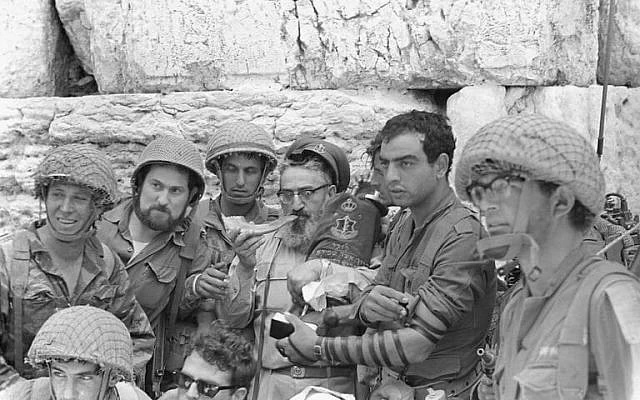
In 1967, we returned to this city in a manner that echoes the Akeidah, beyond calculation and beyond logic. In the weeks and months leading up to the war, fear dominated. The prospect of returning to Yerushalayim did not enter the imagination. It was a war for survival.
What followed defied expectation. In a sudden and astonishing turn, Hashem restored us to His city. The victory unfolded with a swiftness and scope unlike anything familiar in military history. Just as the natural world was formed in six days, so too, after thousands of years, the world of geulah (redemption) took shape in six days. Not through the steady logic of history, but in a moment that stood beyond comprehension.
When the people of Hashem return to Yerushalayim, the world reacts. In 1967, some embraced it, and many religious non-Jews continue to support our presence with conviction. Others recoiled. This return signalled more than survival. It suggested that history itself was advancing, that Hashem’s presence was re-entering the world in a more visible way.
In Shir HaShirim, the nations of the world are described as the daughters of Yerushalayim. The Midrash teaches that in the future, every nation will stand in relation to Yerushalayim, as branches extending from a central city that reclaims its place at the heart of human experience, under the gaze of Hashem.
People sense, even if they cannot explain it, that Yerushalayim will one day stand at the centre of history. That is why events in and around the city draw the attention of the entire world. Not everyone can articulate it. Malki Tzedek himself could not fully give it language. But the intuition remains.
- Moshe Taragin is a rabbi at Yeshivat Har Etzion/Gush, a hesder yeshiva. He has smicha and a BA in computer science from Yeshiva University as well as a Master’s degree in English literature from the City University of New York.