





Featured Item
Cape conference helps leaders engage with tough times

“The most revolutionary act is introducing people to one another,” Robert Bank, the president and chief executive of the American Jewish World Service, told more than 100 Jewish rabbis, teachers, business leaders, and volunteers in Cape Town last Sunday, 2 November, epitomising the reason for the gathering.
Bank was speaking at the Eliot Osrin Leadership Institute (EOLI’s) first-ever InGathering, held in Cape Town on 2 and 3 November.
The two-day event brought Jewish leaders and professionals from across South Africa and abroad together to explore what leadership means in turbulent times. There were no speeches to endure, no slogans to repeat, just honest conversations about courage, responsibility, and renewal.
“Leadership isn’t about recognition,” said EOLI Director Viv Anstey. “It’s about responsibility, about equipping one another to lead.”
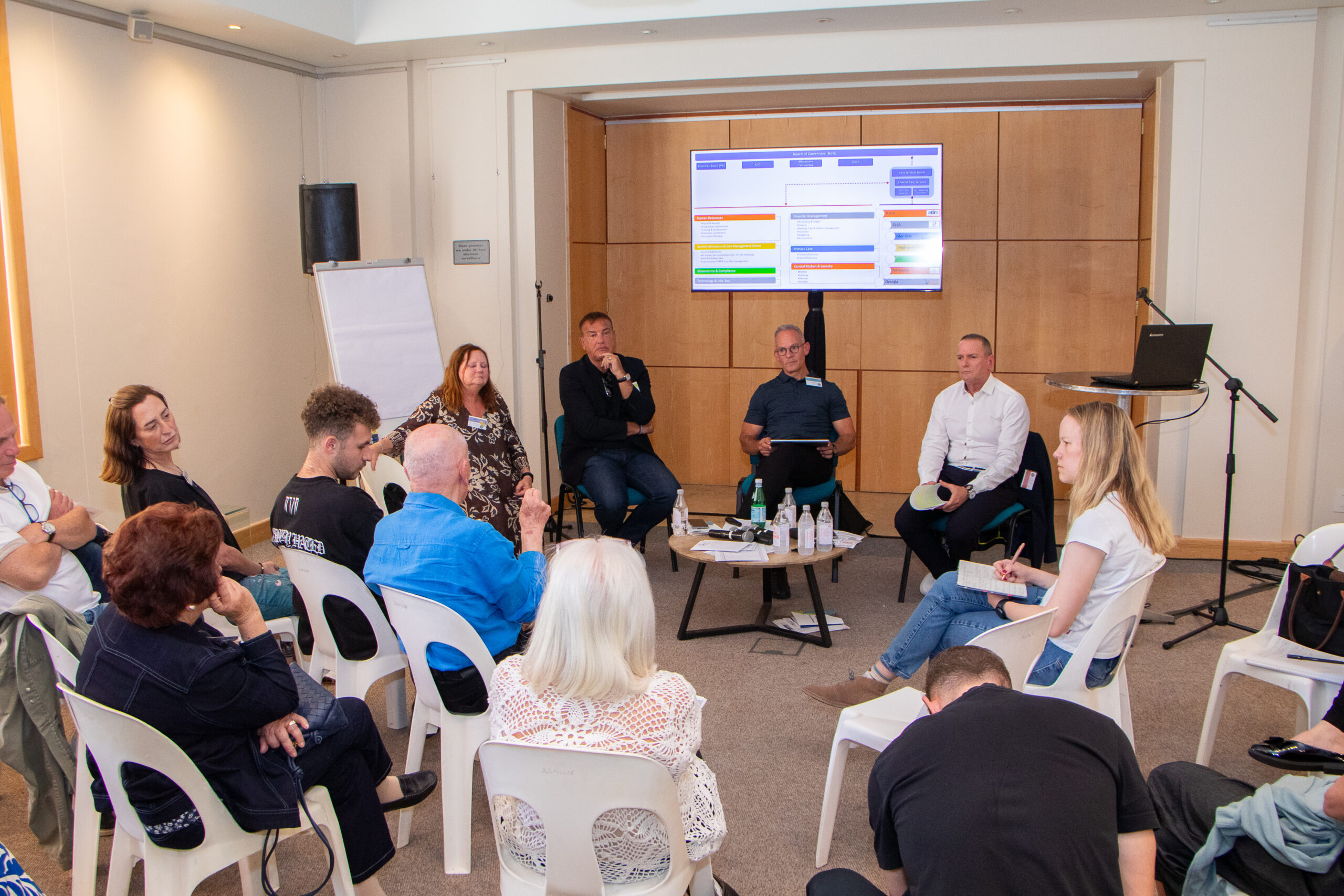
One of the event’s most anticipated sessions was “CT 2040: Route Map to Lead into the Future”, led by Raoul Miller, Paul Berman, Samuel Seeff, and Anstey. The team outlined Vision 2040, a long-term plan for the Cape Town Jewish community that emphasises collaboration, efficiency, and continuity.
“Vision 2040 imagines a smaller but stronger community,” Anstey said. “It’s about staying connected while adapting to change.”
Miller described the project as “right-sizing, not downsizing”, while Seeff highlighted the importance of creating a leadership pipeline for younger generations. “We have emerging talent,” he said. “Now we need pathways from involvement to influence.”
Although focused on Cape Town, the conversation struck a chord nationally. Delegates from Johannesburg and Durban nodded in recognition of shared challenges around sustainability and succession.
Global experience met local reality in “Leadership in Turbulent Times”, a live discussion between Anstey, Bank, and Gali Cooks, the president and chief executive of Leading Edge. Cooks spoke about the pressure facing Jewish non-profit organisations worldwide. “Our job is to raise the floor,” she said. “We want leaders to flourish, not just survive.”
Bank reflected on the moral dimensions of leadership in a divided world. “When we connect authentically, we dissolve fear,” he said. The exchange left a mark. “Leadership today is messy,” Cooks admitted. “But it’s also where the hope lies.” That sense of hope carried into Rabbi David Rosen’s address, “Building Interfaith Bridges over Troubled Waters.”
In conversation with Rabbi Osher Feldman and interfaith activist Alana Pugh-Jones Baranov, Rosen recalled how his years in Cape Town in the 1970s inspired a lifelong commitment to interreligious co-operation, a journey that later saw him help establish diplomatic ties between Israel and the Vatican, and advise the Abu Dhabi-based Abrahamic Family House.
Rosen described his early experiences in apartheid-era South Africa, when creating the country’s first interfaith forum meant engaging courageously across divides of race, politics, and religion. “Judaism,” he said, “isn’t an insular faith. It calls us to engage with creation, with all of it.”
Rosen acknowledged that global events, particularly the war in the Middle East, have tested interfaith relationships, but insisted that dialogue must continue. “Every bridge we build matters,” he said. “For every two steps forward, there may be one step back, but without those steps, nothing changes.”
“Our shared responsibility,” Pugh-Jones Baranov said, “is to protect the most vulnerable: refugees, minorities, and those marginalised by faith or circumstance. That’s where leadership begins.”
The final timeslot of the first day the session, “Managing Reputation from the Inside Out”, pulled no punches. Media trainer Janine Lazarus, joined by Annika Larsen, unpacked how organisations can survive – and even grow – through crises. “Reputation isn’t what others say about you,” Lazarus said. “It’s what you do when they’re watching.”
She urged organisations to respond with transparency and empathy in times of controversy. “The story will be told either way,” she warned. “You can tell it, or someone else will.” For attendees juggling public-facing roles, the advice was blunt but welcome. “In leadership, perception is reality,” Larsen said. “But it can be shaped with honesty, skill, and speed.”
If Sunday was about ideas, Monday was about implementation. The second day of the InGathering, exclusive to community professionals and lay leaders, turned inspiration into practice through a series of hands-on workshops.
Sessions tackled the dilemmas that keep leaders awake at night, such as making tough ethical calls; sustaining partnerships; navigating media crises; and finding new energy after difficult years. A common thread emerged, that Jewish leadership in South Africa must continue to evolve, remaining rooted in values while open to new ideas and partnerships.
Many younger participants at the InGathering spoke of feeling energised by the openness of the discussions and the sense that they, too, have a role in shaping the community’s next chapter.
“The conversations were challenging but hopeful,” said a participant from the Cape Town Progressive Jewish Congregation. “It felt like a true community dialogue, not just a lecture series.”
The event also reflected EOLI’s growing reputation as the Jewish community’s central hub for leadership development. Since its establishment in 2018, the institute has trained dozens of emerging leaders through its leadership development programme, board governance masterclass, and leadership conversations series.
Anstey said the InGathering was a natural next step, a forum where those graduates and community heads could come together to exchange experience. “We’ve spent years equipping individuals,” she said. “Now we’re weaving them into a network of practice and purpose.”
The conference reflected on Eliot Osrin’s enduring influence. A pioneering communal professional and chief executive of the United Jewish Campaign in Cape Town for nearly two decades, Osrin was remembered for his humility, mentorship, and belief that strong leadership is an act of service.
“Eliot Osrin built systems that worked, but more importantly, he built people who believed they could make a difference,” said Anstey. “Our mission at EOLI is to keep that flame alive.” As participants lingered after the final session, exchanging ideas and contact details, it was clear that the InGathering had achieved what its name promised.
In a world often marked by fragmentation, the EOLI’s first InGathering was a reminder that real, lasting leadership, begins with connection, curiosity, and courage. “We leave here reminded that leadership isn’t a title,” Anstey said. “It’s a commitment, to learn, listen, and serve.”
