Featured Item
Sirens, shelters, and separation: South African olim endure Israel’s war with Iran

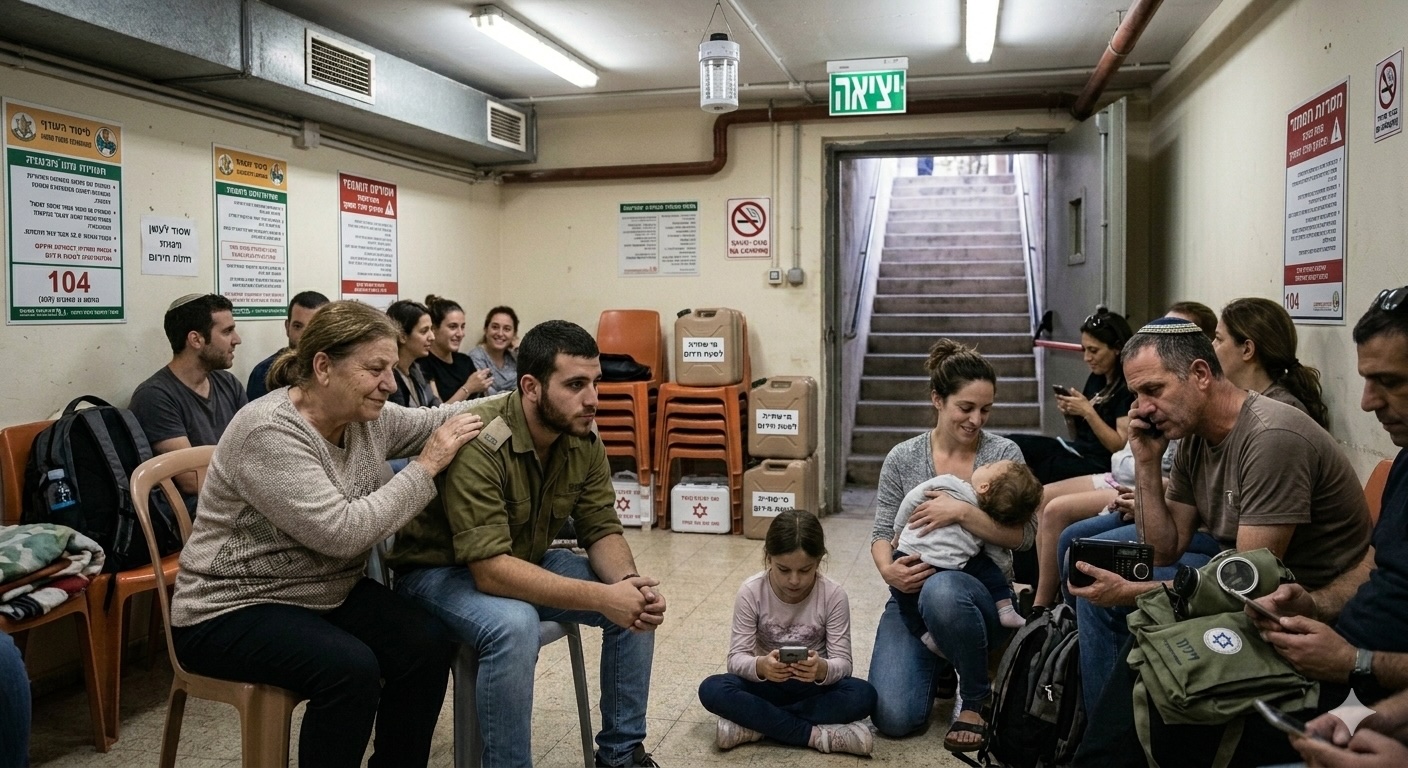
For South African olim, the war has been experienced not through headlines, but in reinforced rooms, hurried phone calls, and interrupted routines. In one central Israeli apartment block, amid the sound of interceptions overhead, a one-year-old boy took his first steps on the concrete floor of a bomb shelter.
His parents, both South African-born, had rushed downstairs with neighbours when the first alert sounded on Saturday. Like many families in older buildings without in-unit reinforced rooms, they gathered in the communal shelter. As the adults checked news updates and counted the seconds between booms, their son steadied himself against a plastic chair and let go. In the middle of an air-raid alert, he walked for the first time.
“It wasn’t how we’d imagined it,” his mother said later. “But in that moment, everyone in the shelter clapped.” The juxtaposition of milestone and missile captures the surreal rhythm of the past few days for many South Africans in Israel.
In Tel Aviv, Carol*, a Johannesburg-born mother of three who has lived in Israel for several years, spent most of Saturday in the mamad (safe room) of her apartment with her youngest daughter. Her husband is in South Africa on business and unable to return because of flight cancellations.
“We spent pretty much the whole day on Saturday in the mamad, just not knowing really what the coming days would bring,” she said. Her middle daughter had been at a friend for Shabbat when the alerts began. “I did say to her, though, if something did happen that she must contact me and break Shabbat, which she did do.”
Tel Aviv, particularly its northern neighbourhoods, has been among the areas targeted. Although Carol and her family have not been physically harmed, the noise has been constant. “There have been a lot of interceptions, a lot of noises, a lot of booms, bangs, the windows shake,” she said. “My daughter’s friend’s apartment building, which is in Tel Aviv, got struck and his home is destroyed. But thank goodness we are all intact.”
Daily life has narrowed to essentials. Schools have closed and Purim celebrations were cancelled. Carol’s eldest daughter is in her final year of school. “All the Purim celebrations have been cancelled, which was quite devastating because under all these circumstances you really look forward to the small celebrations,” she said.
The uncertainty stretches beyond Israel’s borders. With airspace periodically closed, families are separated. Some South Africans have attempted complex routes through other countries to return home. Carol said her husband has decided to remain in South Africa until more direct flights resume. “He’s just going to stay put until the sky starts opening,” she said.
In Rishon LeZion, another South African oleh, Jonathan*, described hours of repeated alerts in his neighbourhood of Ramat Eliyahu. “From 08:00 to 14:00, from 15:30 all the way to 03:00 we were pretty much in and out of the shelters,” he said. Sirens were going off “two to three times every hour”.
The only pause came mid-afternoon. “The only time we got to really just sit and relax for a bit and gather supplies, cook food, take a shower was about one and a half hours in the afternoon and then they started up again.” Jonathan has since relocated north to stay with friends in Haifa, where the frequency of sirens has been lower. “There’s less stress on that side, just in terms of the frequency of sirens,” he said.
For Gavin*, who made aliya from South Africa in the 1980s and lives in Netanya, the current conflict revives memories of earlier wars in which he served in the Israel Defense Forces. Now, his concern is his wife, Rolene*, who has amyotrophic lateral sclerosis, a progressive neurodegenerative disease that has left her wheelchair-bound and dependent on constant care.
Although their building has a shelter, each alert brings anxiety. Rolene fears she will not be able to reach the shelter in time, and the stress aggravates her condition. Neighbours assist where they can, and Gavin remains by her side during every siren.
The urgency of moving to safety is a shared concern, particularly for families without reinforced rooms inside their apartments. Carol says her family is fortunate to have a mamad. In earlier conflicts, they sheltered in a stairwell. “This is definitely a lot more civilised, less scary,” she said. Still, the psychological strain is evident. “You do come here for freedom and you’re cooped inside a bomb shelter for hours on end,” she said.
For many South African olim, the comparison with life back home is complex. Carol said that while South Africa has its own security challenges, the nature of the threat feels different. “It’s a very different sense,” she said, contrasting crime-related insecurity with missile attacks. Yet amid the fear and fatigue, life continues. Babies learn to walk. Teenagers revise for exams between alerts. Neighbours share snacks and updates in underground rooms.
The South African Zionist Federation (SAZF) has publicly aligned itself with Israel’s military response. In a statement shared with the SA Jewish Report, national chairperson Craig Pantanowitz said the organisation “unequivocally affirms Israel’s sacred and inalienable right to self-defence against existential threats”.
Pantanowitz said the SAZF stands “resolutely with Israel in its decisive actions to dismantle Iran’s illicit nuclear programme, its feverish pursuit of severely dangerous ballistic missiles capable of mass destruction, and its relentless state sponsorship of terrorism”.
Referring to Iran’s regional alliances, Pantanowitz described what he called a “decades-long campaign of aggression” through the funding and arming of proxy groups targeting Israel. He said the threat had become “intolerable and unacceptable” and could no longer be contained “through patience or diplomacy alone”.
“Israel has no choice but to act decisively to safeguard her people, secure her survival, and defend the free world from this fanatical regime’s genocidal ambitions,” Pantanowitz said, adding that the SAZF “fully and unreservedly supports these necessary measures to end Iran’s nuclear ambitions, ballistic terror arsenal, and sponsorship of murderous proxies once and for all”.
On the ground, however, the war is measured less in strategic objectives than in the number of times a family must move to safety in a single night. For the parents who watched their son take his first steps on a shelter floor, the memory will always be tied to sirens. “We didn’t choose the timing,” his mother said. “But we’ll remember that even there, in the shelter, life carries on.”
*Sources have asked to remain anonymous for security reasons.