


Featured Item
Brotman visits the remains of a diverse world Jewry

The more that avid traveller and global citizen Dan Brotman visits Jewish communities off the beaten path, the more he feels connected to his Jewish identity.
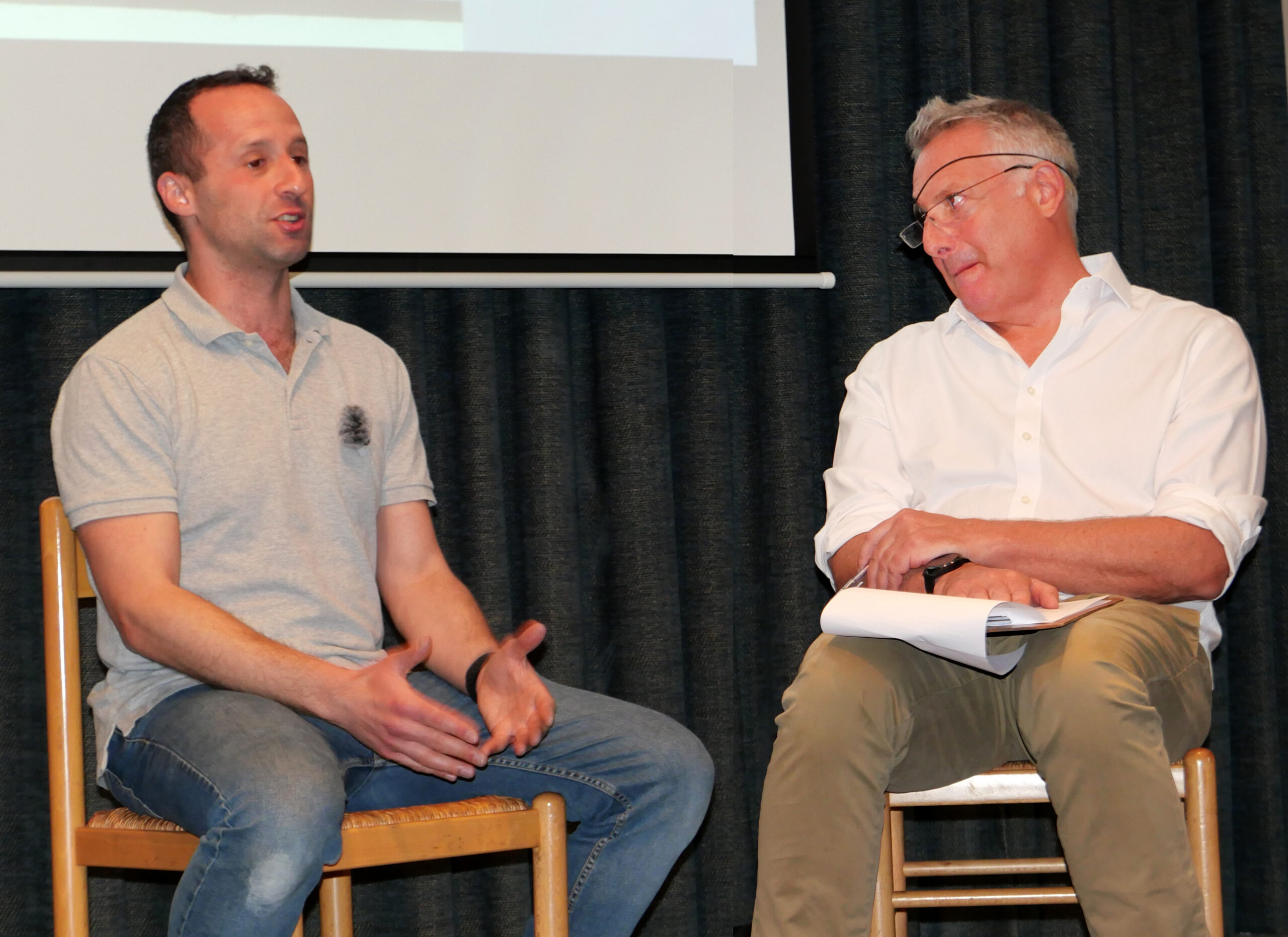
“As I started to see Jewish communities in other countries, I said, ‘Wow, these people look different and sound different, but my story is part of their story and vice versa,’” said Brotman in conversation with ChaiFM radio host Simon Anstey on Sunday 1 March at the Rabbi Cyril Harris Community Centre at the Great Park Shul in Johannesburg.
“And it just wasn’t part of my Jewish education. So for me, the more I see Jewish communities in other countries, the more I learn about my own Jewish identity,” he said.
Brotman grew up in a typical, assimilated American Jewish home, but after experiencing bullying in suburban Boston, he was eager to leave. As a child, he was captivated by books about the Rainbow Nation and Nelson Mandela, so in 2001, while in Grade 7, he persuaded his father to take him and his brother to Cape Town. During a visit to Herzlia, the principal jokingly said he would be welcome to attend the school. Brotman didn’t take it as a joke; he saw it as his way out.
Brotman then moved to Cape Town and lived in South Africa. While in the country, he saw the beauty of the Jewish community and wanted to expand his horizons and see more Jewish communities around the globe.
He said that what keeps him interested in seeing and documenting different Jewish communities is that much of the diversity of Jews around the world has been lost, as 85% of Jews in the world live in only two places.
“Linguistically, the Jewish world is essentially becoming only a Hebrew- and English-speaking community. A lot of traditions, like biblically old traditions from these communities, are getting watered down because when people emigrate to other countries, the language gets lost and the traditions get mixed up,” he said.
When Brotman got his South African passport after naturalising in 2018, he wanted to go somewhere that he couldn’t have travelled with his American and Israeli passports. Iran was the first place on his list.
“I found myself in Esfahan, Iran on a Friday night and when I heard that there was a shul there, I knew I had to go. My guide and I stopped a young boy in the street and asked where the synagogue was. Miraculously, he said he was on his way there, and we went,” he said. “It was the first time I’d ever had to take off my shoes before entering a synagogue as they’d adopted local customs, with beautiful Persian carpets. The women sat upstairs with their hair covered; the men sat downstairs. The community was terrified to speak to me. They didn’t know who I was, and Jews in Iran live under heavy government surveillance.”
Halfway through the service, one man gathered the courage to sit beside him. “He spoke English, and for the first time, I could ask direct questions about what it’s like to be Jewish in Iran today.” The man told Brotman that almost everyone in the synagogue had secretly visited Israel, but when the government discovers such visits, it imposes collective punishment on the community; what that means, Brotman doesn’t know.
What Brotman found fascinating about Jews in Iran is that one would think that there was no way that Jewish life could continue in this environment, as Jews aren’t allowed to practise openly and aren’t allowed to own businesses, yet the shul was full. He explained that the Jews in Iran are always aware that they are being watched and are constantly having to show allegiance to the regime. Similarly, they aren’t allowed to acknowledge the existence of Israel.
However, for other Jewish communities, it’s not as black and white. For the six Jews left in Syria, there seems to be an openness to Israel and Judaism, particularly since the collapse of the Bashar al-Assad regime between 27 November and 8 December 2024.
“The government in Syria very much wants international recognition, and their treatment of Jews is a way to signal that they’re ready to join the West. So they’ve set up a special liaison for Jewish affairs within the foreign ministry. And they’re in the process of returning Jewish property to Syrians who left in 1992. It isn’t finalised, but it’s an ongoing discussion. They’ve also been welcoming back groups of former Jewish Syrians to Damascus. They’re opening up synagogues and sites that really haven’t been touched since 1992. They’re basically saying that they welcome any Syrian Jew back into the country,” he said.
Similarly, he’s seen communities that were once thought to be dead and dying are now being reinvigorated. In Slovenia, the Jewish population had dwindled to about 100 people, but since 7 October, hundreds of Russian-speaking Jews from Israel have moved there, helping to breathe new life into a once-fragile community.
“My big mantra is that we’re not living at the end of history. Israel and the US aren’t it. It’s not the end. History is dynamic. We don’t know what’s going to happen in the world. We’re not at our final destination,” he said. “Some people write off South African Jewry. It’s going to continue shrinking, and you don’t know what’s going to happen. We don’t know what’s going to happen in the world. You could have World War III, and people want to get out of the Middle East and Europe. You don’t know what’s going to happen in the US, and maybe people want to live in very far away destinations, and this is very far away.”