





OpEds
Joburg needs a force of nature. We have it.

Johannesburg has been here before. Hopeful moments. Promising candidates. Talk of change. And then coalition chaos, institutional sabotage, and a slow slide back into dysfunction. So, when people ask why this time is different, their scepticism is understandable.
But this time really is different. And not for the reasons the analysts are talking about.
Ghost mayors
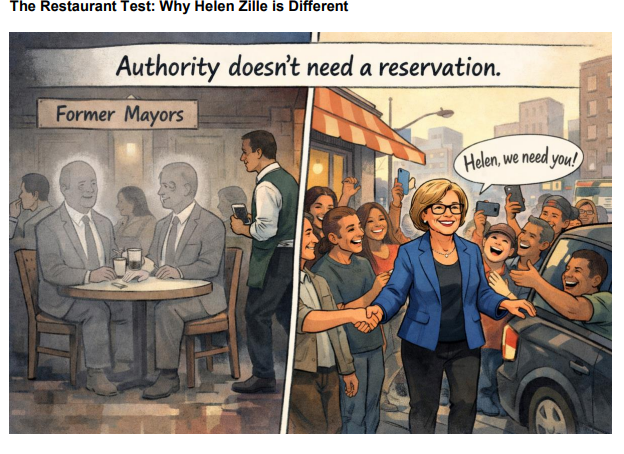
A colleague of mine recently told me a story that explains why. He was sitting in a restaurant in Linksfield, having lunch with his wife. He glanced across the room, and noticed someone familiar. A former mayor of Johannesburg. Sitting quietly. No reaction from the room. No acknowledgement. No-one even noticing.
Then, he realised who the former mayor was sitting with. Another former mayor of Johannesburg.
Two people who had held the highest office in our economic heartland, sitting in a packed restaurant, completely anonymous. No recognition. No engagement. No sense that anyone even knew – or cared – who they were. They were ghosts in the city they used to run.
This anonymity wasn’t peaceful; it was diagnostic. It tells you everything about the nature of their tenure. These were the puppet mayors of the coalition era – minority party proxies installed to facilitate looting, not leadership. They hadn’t arrested the decline; they had accelerated it. They had signed the deals that broke the city, yet they had left no footprint on its soul. They were safe to eat in peace because, to the residents of Johannesburg, they were never truly in charge. They were just the guys holding the seat warm while the city was stripped bare.
Force of nature
Now contrast that with what I experienced walking through Kensington with Helen Zille last week.
We were walking up a road that is physically falling apart – gaping pits, sewage streams, the decay residents have learned to accept because they’ve been given no alternative. And people were sticking their heads out of car windows shouting, “Viva DA!” Residents came out of their houses just to see her. To talk to her. To engage. There was no rally. No stage. No introduction. We weren’t selling anything. We were just walking.
The same thing played out in Dobsonville, Soweto – hardly traditional Democratic Alliance turf. The plan was a simple walk through a mall. Zille didn’t make it past the first few metres. She was swamped. People wanted photos. They wanted to talk. One photographer stopped a paid family shoot just to photograph her instead.
That isn’t choreography. It isn’t branding. It’s instinct. And it tells you the most important thing about this election: we are moving from people who hold office to a person who carries authority.
Governing and winning aren’t the same skill. Johannesburg has had mayors who could technically read a council agenda but couldn’t make a resident feel heard. Zille stops traffic. That matters. It matters because to fix a city this broken, you need more than a manager. You need a mandate. You need a leader who can walk into a room, or a street, and command the space. The residents of Soweto and Kensington weren’t reacting to a politician; they were reacting to the possibility that someone finally had the strength to stop the rot.
Bureaucratic wall and the culture of “no”
There’s another reason this difference matters, and it’s one we don’t talk about enough. Johannesburg suffers from institutional sabotage. Previous mayors, even well-intentioned ones, were often outmanoeuvred by captured officials who knew how to kick the can down the road.
There’s a “deep state” of inertia in this city. It’s a culture of malicious compliance where officials nod at political instructions, agree to the timeline, and then bury the execution in red tape. They know how to reword reports to ensure nothing happens. They know how to “send it back for signature” until the politician loses interest or loses office. They rely on their political heads being too busy, too distracted, or too inexperienced to check the fine print.
That doesn’t work on Helen Zille.
She lives and breathes the fine print. She reads past the bureaucratic language. She understands incentives. She recognises a delay tactic for what it is. You cannot slow-walk Zille. You cannot hide the file. She knows the Municipal Systems Act as well as they do. She knows the disciplinary codes better than they do.
Her autobiography is titled Not Without a Fight. That isn’t just a title; it’s a governance style. In a city where dysfunction thrives on ambiguity and avoidance, having a mayor who cannot be fooled is a structural reform in itself. She transforms the mayoralty from a ceremonial oversight role into an executive command post.
Escaping the coalition trap
We also need to be honest about the trauma of the past few years. The city has been paralysed not just by corruption, but by the fragility of its politics. We have lived through the era of the “one-seat kingmaker”, where tiny parties with no mandate hold the entire city hostage, demanding positions and perks in exchange for passing a budget.
This instability trickles down. Why would an official sign a controversial contract or take a tough stance on corruption if the mayor might change next week? Why would an investor put money into the CBD if the coalition government is one argument away from collapse?
Zille changes the calculus. This campaign isn’t aiming for a fragile 50% plus one coalition of chaos. It’s aiming for a stable majority or a dominant coalition anchor. Governing not by permission, but by mandate. A strong mayor, backed by a strong council, changes the psychology of the entire city. It signals to officials, investors, and residents that the direction is set for five years, not five minutes.
The mathematics of belief
This election is also far more straightforward than people think. There’s a persistent myth that the DA needs massive African National Congress (ANC) voter defections to win Johannesburg. It doesn’t.
The DA doesn’t need ANC voters to turn out in their millions and vote blue. It needs its own voters – the traditional DA base that has drifted into apathy, emigration, or semigration – to simply come back. That alone wins the election.
The “stay-away vote” is the biggest political party in the suburbs. These are people who checked out because they stopped believing that voting changed anything. They stopped believing that the city was salvageable.
But the fact that polling shows that ANC voters are increasingly comfortable with Zille? That’s the upside. That’s the margin. But the core requirement is simpler: belief.
It requires that the residents who have given up look at this moment and realise that this is the last, best chance to turn the ship around.
The choice
You don’t have to like Zille. You don’t have to like the DA. You don’t have to agree with every tweet or every statement ever made. This election is not a popularity contest. It’s a rescue mission.
It’s a question of whether you believe in Johannesburg. If you believe this city can work. If you believe it deserves competent, decisive leadership. If you believe it should be governed with confidence rather than managed decline.
We don’t need another mayor who can eat lunch anonymously in Linksfield while the city burns. We don’t need another nice person who gets rolled by the unions and the “tenderpreneurs”. We don’t need another coalition manager who spends more time negotiating with minor parties than fixing potholes.
We need a mayor who can’t walk down a street in Soweto without being stopped by residents who know that she is the only one who will actually get the job done. We need a force of nature.
That’s the difference. And that’s why this time, it works.
- Daniel Schay is a member of the city council of Johannesburg, serving as the DA Shadow MMC of Development Planning and Ward Councillor for Ward 72.







Neuren Pietersen
February 14, 2026 at 10:56 pm
Well put Cllr Schay.