OpEds
Iranian war clouds gather over the Cape of Storms

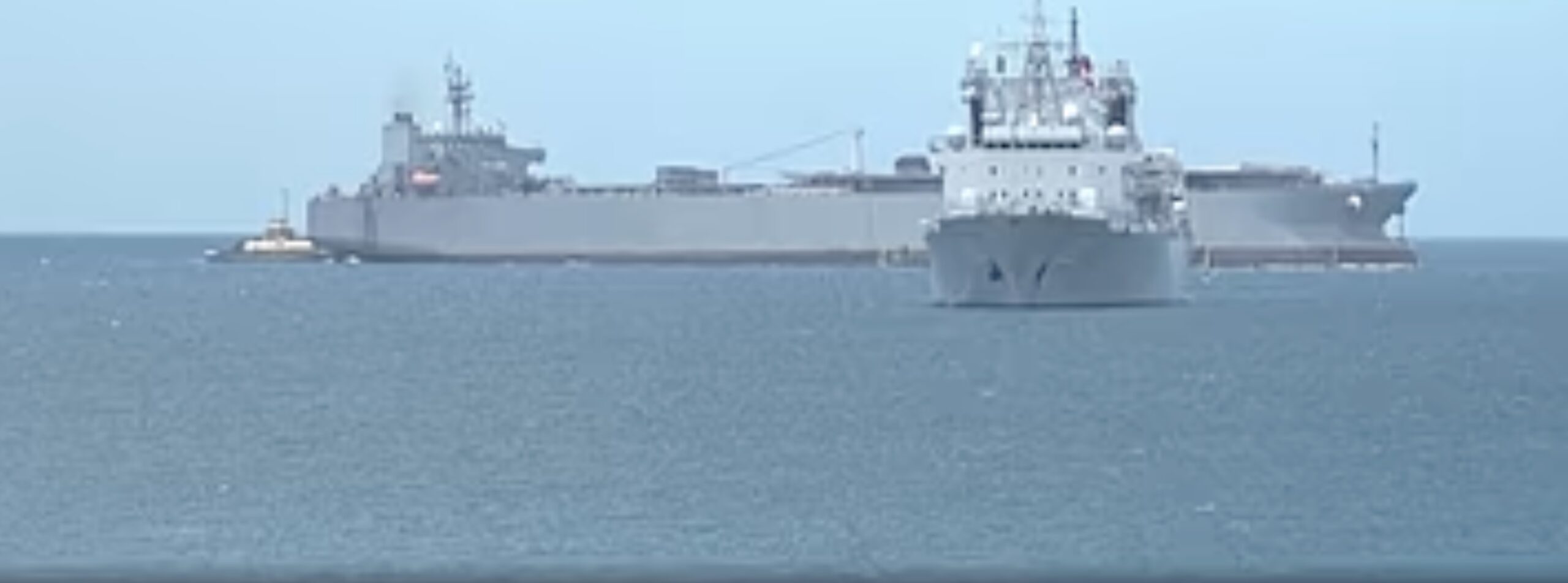
War ships assembled this past week at the Cape of Storms. A flotilla of “battleships” led by China converged on the Simon’s Town naval base for war games dubbed “Will for Peace”. The drills brought together a handful of ships from the navies of China, Russia, and Iran alongside the remnants of what was once the South African Navy. This is the first time that Iran has attempted to participate in BRICS naval exercises.
Given South Africa’s sharply diminished naval capacity, this was less a full-scale war exercise than a limited “passage drill”. The South African Navy has one operational frigate, the SAS Amatola, supported by a small number of inshore patrol vessels. Submarines and broader blue-water capabilities are effectively inoperable.
The False Bay military exercises are being held under the auspices of BRICS, the intergovernmental organisation comprising Brazil, China, Egypt, Ethiopia, India, Indonesia, Iran, the Russian Federation, South Africa, and the United Arab Emirates. What began as a platform for economic cooperation, is now increasingly acquiring a military and strategic character, one that is unmistakably hostile to the West. Significantly, India and Brazil stayed away from the naval exercises, while those present all share deeply strained relations with the United States.
On 1 January 2024, South Africa championed the expansion of BRICS into BRICS Plus, admitting Iran and several other nations. That decision fundamentally altered the character of the grouping.
The inclusion of Iran was driven by former minister of foreign affairs, Dr Naledi Pandor, a zealous convert to Islam; her husband, Sharif Pandor, who is closely aligned to Iran; and the director general of the Department of International Relations and Cooperation, Zane Dangor, whose radicalised sister, Jessie Duarte, stood on a stage outside the Israeli embassy claiming that Israel wished to drive black people in South Africa into the sea.
As an illicit funder of both the African National Congress (ANC) and South African politicians, Iran has used its cash payments to ensure that South Africa protects it at the International Atomic Energy Agency; has brought Iran out of international isolation through the expansion of BRICS; and acts as Iran’s proxy in its fight against Israel by, inter alia, taking Israel to the International Court of Justice (ICJ) in The Hague accusing Israel of genocide. Pandor travelled to Tehran weeks after the Hamas invasion of Israel on 7 October 2023 to coordinate responses with the murderous mullahs of Iran.
That alignment deepened further in August 2025, when South African National Defence Force Chief General Rudzani Maphwanya visited Iran and spoke publicly of “shared goals” between the two countries.
The naval exercises themselves were originally planned for November 2025 as a trilateral drill between South Africa, China, and Russia. They were postponed due to South Africa’s hosting of the G20 summit and later expanded and rebranded to include Iran.
Operation “Will for Peace” couldn’t have happened at a worse time for South Africa in the shadow of heightened tensions between Washington and Pretoria. The new American Ambassador to South Africa, L. Brent Bozell III, a conservative ally of American President Donald Trump, with no particular sympathy for the ANC’s shenanigans, arrives to assume his new post in early February.
South Africa’s growing alignment with China, Russia, and Iran, all states accused of severe human rights abuses, directly undermines President Cyril Ramaphosa’s claim to champion human rights globally, particularly as South Africa presses its genocide case against Israel at the ICJ.
Russia’s invasion of Ukraine in February 2022 has resulted in hundreds of thousands of deaths, widespread destruction, and systematic attacks on civilian infrastructure. President Vladimir Putin is now subject to an International Criminal Court arrest warrant for war crimes. The previous trilateral naval drills, Mosi II, in 2023, drew international condemnation for coinciding with the first anniversary of that invasion.
China, meanwhile, stands accused of the mass detention of Uyghurs and other Muslim minorities in Xinjiang, the repression of Tibet, and escalating military threats against Taiwan.
Yet the brutal theocratic dictatorship of Iran presents perhaps the most acute moral challenge for Ramaphosa. The country is in the grip of renewed anti-government uprising. Internet access has been shut down, and human rights organisations report large-scale killings of protesters, with some claiming between 2 000 and 20 000 protesters having been massacred in the past few days alone. Iranian exiles have filled streets around the world demanding the fall of the regime.
With the call for freedom echoing through the streets of every major city in Iran, Ramaphosa has remained conspicuously silent, refusing to condemn his paymasters.
South Africa and Iran share a long and uncomfortable history. Even after Iran’s Islamic Revolution, Tehran supplied oil to apartheid South Africa, breaking the international oil embargo on South Africa. If not for Iran, apartheid may have ended a decade earlier.
The naval exercises placed South Africa squarely within an emerging anti-Western, anti-democratic axis. On 12 January under mounting pressure, amidst the Iranian crackdown on pro-democracy protesters, and with the death toll mounting, it was purported that the Iranian fleet would no longer put to sea as part of the military expedition. It was a reversal that came too late, after the damage to South Africa’s reputation had already been done.
Ramaphosa appears to be at a loss of how to meander in a new world order. Without the requisite skills to guide South Africa in the current era, Ramaphosa appears to have merely given up, searching for a legacy after eight years of a failed, wasted presidency. His new legacy: positioning South Africa further and further from the West. But actions have consequences, and America’s bark has become its bite.
As the Russian vessel entered Simon’s Town port, it flew the South African flag upside-down, a traditional maritime signal of distress. The harbour master ordered it corrected, but the signals of distress may be the most prophetic part of the naval exercises so far.
- Howard Sackstein is a human rights advocate, a political analyst and chairperson of the SA Jewish Report. He writes in his personal capacity.