


OpEds
Can SA afford to waste another five years?

I remember the anticipation surrounding PW Botha’s Rubicon speech in August 1985. South Africa was in turmoil. The economy was under pressure, the country increasingly isolated, and there was growing recognition that the political status quo could not continue. Yet there was also hope. We had been led to believe that Botha was finally going to acknowledge the inevitable and announce meaningful reform.
The world listened. And then came the disappointment.
Instead of the breakthrough many expected, Botha dug in. Ironically, he declared that South Africa was “crossing the Rubicon”, but the speech came to symbolise precisely the opposite – a government unwilling to take the decisive step the moment demanded. The speech fell far short of the major reforms widely anticipated.
The economic consequences were severe. Isolation and financial pressure intensified, and confidence in South Africa deteriorated. It would take almost another five years before FW de Klerk, Botha’s successor, changed course and began the process that ultimately led to democracy.
I have been thinking about that speech again. Not because South Africa today resembles South Africa of 1985. It does not. We live in a constitutional democracy. But there is an uncomfortable similarity. Once again, expectations of a change in direction have risen, only for politics to threaten to squander the opportunity.
The municipal elections delivered a remarkable verdict. The ANC’s national support fell to 31%, while the DA received 25%. More significantly for Gauteng, the DA emerged as the largest party in Johannesburg, Tshwane, and Ekurhuleni, although without a majority in any of them. The electorate might not have delivered a clear governing majority, but it delivered a remarkably clear message that the status quo is no longer acceptable.
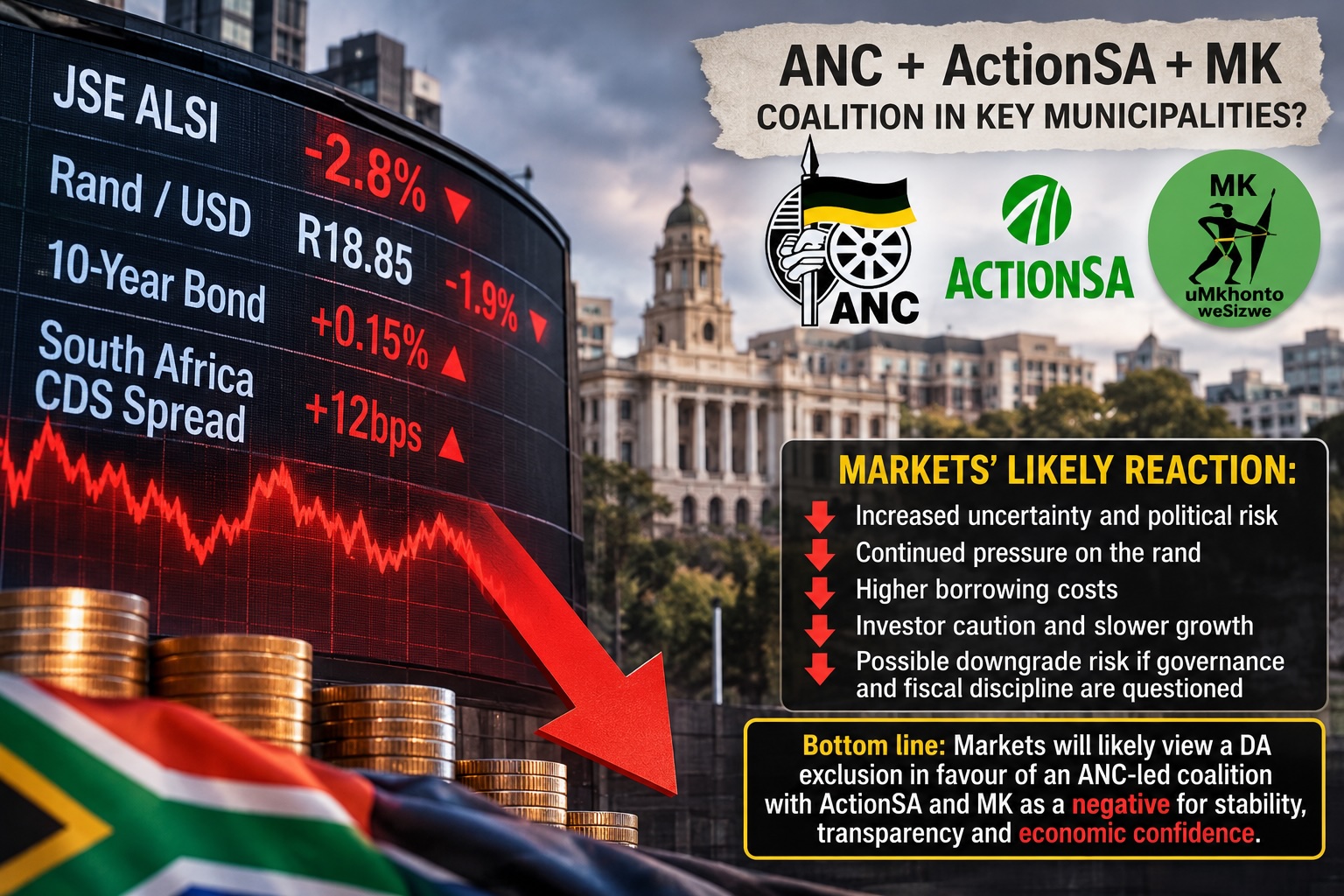
Yet the emerging coalition arrangements appear set to exclude the DA from all three Gauteng metros in which it emerged as the largest party. There is nothing undemocratic about this. The largest party has no automatic right to govern if others can construct a majority. Nor is the failure to reach an alternative coalition agreement the ANC’s responsibility alone. Disagreements between the DA and ActionSA, particularly over mayoral candidates, contributed materially to the breakdown in their talks.
What disappoints me is what the negotiations say about priorities. At a moment when voters were demanding change, politics appears again to be dominated by personalities, ideology, and party advantage. The opportunity wasn’t simply to put the DA into government. It was to show that political parties had heard the electorate and were prepared to put competent government and economic reconstruction ahead of political interest.
Financial markets have noticed. The rand fell sharply in the week after the elections and breached R17 to the dollar. But it would be wrong to attribute every movement in the currency to politics. The dollar, US interest-rate expectations, and global risk appetite also matter enormously.
The ANC is correct that financial markets have no right to dictate coalition negotiations. They don’t. But markets have their own ballot box. Investors decide whether to buy our bonds, hold our currency, build a factory, expand a business, or take their capital elsewhere. Governments are free to make political choices. They are not free to choose the economic consequences.
And this is where the comparison with 1985 becomes more troubling. When political reform finally came in the early 1990s, the incoming democratic government would eventually inherit a deeply divided and unequal society. But it also inherited a sophisticated economy and substantial physical and institutional infrastructure. Much of it served South Africans unequally. But the machinery existed.
Today the challenge is different. We are no longer simply trying to change political direction. We are trying to repair the machinery itself. Anyone living in Johannesburg hardly needs an economist to explain this. It is visible in potholes, broken traffic lights, water interruptions, sewage spills, and deteriorating public infrastructure. These things may sound mundane beside our great political debates. They aren’t. A functioning sewerage system is economic policy. Municipal competence sits at the foundation of economic growth.
South Africa knows broadly what needs to be done: reliable electricity, better logistics, functioning water infrastructure, capable municipalities, and an environment in which businesses have enough confidence to employ people and invest. The question is whether politics accelerates that process or once again gets in its way.
Which brings me back to the Rubicon. South Africa eventually changed course after 1985. De Klerk did what Botha had failed to do. Political organisations were unbanned, Nelson Mandela was released, and negotiations began. History moved forward. But almost five years had been lost.
That is what troubles me most. Does today’s South Africa have another five years to waste?
Another five years of municipal deterioration, inadequate investment, and skilled South Africans deciding that their children’s futures lie elsewhere? Another five years in an economy unable to create enough opportunities for millions of young people who desperately need work?
The municipal elections offered our political leaders an opportunity to demonstrate that they understood the urgency of the moment. Perhaps the new coalitions will surprise us. I sincerely hope they do. But hope is not an economic strategy.
The electorate has sent its message. The markets are sending theirs. The question is whether our political leaders are present.
- David Shapiro is a veteran stockbroker and market commentator.