



OpEds
When broadcasters cross the line, accountability matters

When a radio guest repeatedly calls Israel the “Zionist entity” and the presenter lets it pass without question, listeners are hearing more than an uncomfortable choice of words. They are hearing a political position presented without the context or challenge it demands.
For those listening at home or while driving to work, the frustration is familiar. A discussion about Israel becomes a succession of accusations. The guest’s credentials are offered as reassurance. Questions that might test the argument never come.
The answer for the South African Zionist Federation (SAZF) is to do something about it.
This year, our pursuit of broadcasting complaints has secured two favourable adjudications from the Broadcasting Complaints Commission of South Africa (BCCSA) against radio stations 702 and Kaya FM. Both were ordered to broadcast apologies for failing to ensure balance. A separate complaint against 702 was resolved through an agreed right of reply.
These outcomes matter because they turn justified concern into public accountability.
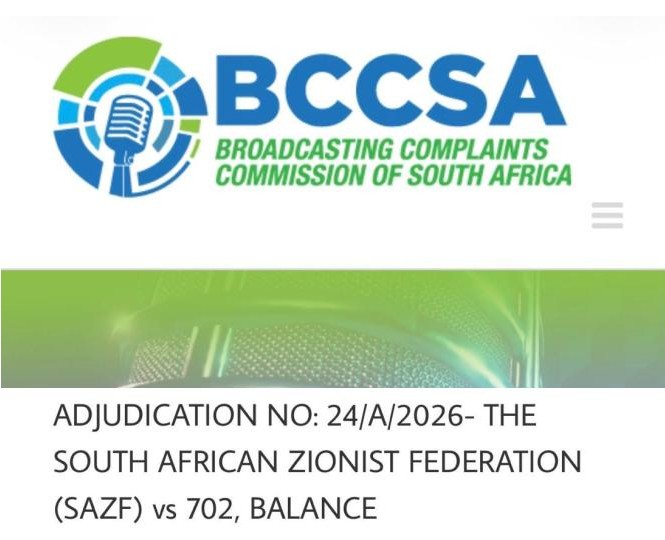
The 702 ruling concerned an interview with academic Jessica Breakey on 21 May 2026. Siyabonga Motha, standing in for Aubrey Masango, allowed Breakey’s repeated references to Israel as the “Zionist entity” to go unchallenged.
The commission’s assessment was direct. Substituting a sovereign nation’s name with a phrase of non-recognition represented “a deliberate political stance rather than neutral descriptive reporting”.
It then addressed the presenter’s responsibility. “By allowing the guest to repeatedly substitute a sovereign nation’s name with a delegitimising trope without counter-questioning or context, the presenter permitted the broadcast to lean into uncorrected political bias, breaching Clause 13.1.”
For a community that repeatedly raises concerns about the language used to discuss Israel, this finding is significant. The BCCSA recognised that terminology carries meaning and that a presenter has a responsibility to engage with that meaning. Listeners should have been given context, counter-questioning, or an opposing perspective.
Radio 702 accepted the finding and was ordered to broadcast a correction and apology.
The Kaya FM matter exposed a similar failure. On 11 August 2026, Point of View with Phemelo Motene featured commentator Thembisa Fakude discussing Israel and its prime minister.
The commission found that Motene could have asked questions to elicit an opposing viewpoint. Its conclusion was blunt, “No such attempt was made by her.”
It also found no indication that the broadcaster had made the required efforts to achieve balance through subsequent programming. It ordered Kaya FM to apologise and acknowledge that strong, controversial, one-sided opinions had been aired without an attempt to present an alternative perspective.
During the proceedings, the station reported that it had voluntarily introduced a protocol for all presenters covering editorial responsibility, active challenge, and the handling of controversial subjects. That is a welcome development. An apology addresses a particular broadcast; better editorial practice can improve those that follow.
Our third complaint, concerning an interview with Fakude on The Aubrey Masango Show, secured an agreed right of reply. This created an opportunity to put an alternative perspective before the programme’s listeners.
There is a practical lesson here for our community. Challenging a broadcast requires more than expressing anger. It means identifying the specific failure, documenting it carefully, and pursuing the process through responses, submissions, and findings. Much of that work happens quietly. Its value becomes visible when a broadcaster must answer publicly for falling short.
These rulings also give us a firmer basis for engagement with newsrooms. Criticism of Israel is legitimate. Broadcasting standards apply to that criticism, and expertise does not exempt a guest’s arguments from scrutiny.
We should expect presenters to ask difficult questions, recognise loaded language, and make reasonable efforts to ensure that opposing perspectives receive a fair hearing.
The SAZF will continue to insist on those standards. South African audiences deserve informed debate, and our community deserves to know that when broadcasters fail in their responsibilities, there is a determined effort to hold them accountable.
- Angie Segal is Head of Media at the South African Zionist Federation.