


OpEds

Light in the darkest of places

“In the darkest place, I succeeded in seeing the light.” These were the words of Segev Kalfon. He would know about darkness after 738 days in Hamas tunnels. For it is in the dark that light can best be appreciated, as King Solomon famously describes in Ecclesiastes 2: “The superiority of light over darkness.”
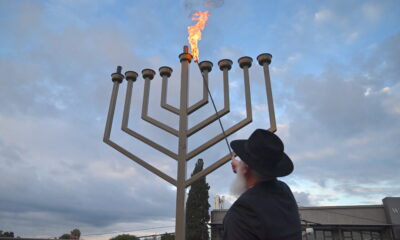
Chanukah, the Festival of Light, will thus take on special meaning in the current world, enveloped by darkness. We are living through an era when truth is eclipsed by lies, when hatred overtakes love, when warped values prevail over morality. We shall spend eight days looking for light, spreading this light, and adding light to the world.
Our national history is tragically filled with periods of blackness. Yet we have discovered that it’s precisely during those times that we have grown and strengthened. Beginning with the very first exile, back in Pharaoh’s Egypt, “The more they were oppressed, the more they increased and spread out.” This is the pattern that has repeated itself again and again over the centuries. It is during the dark times that our resilience and grit, our perseverance and tenacity, our ability to adapt and overcome all shone through brightly.
When we light our Chanukah candles during the eight days of the festival, we recite a blessing thanking Hashem who “has performed miracles for us, in those days, at this time”. The literal meaning of this blessing is that miracles happened many hundreds of years ago at this time of the year.
But the words take on a deeper meaning with the addition of a silent yet implied conjunction. “He performed miracles for us, in those days [and] at this time.” Miracles aren’t just part of our past, they are very much in our present. Usually, we are unaware of wonders as they unfold, disguised as they are in the natural order of things. They become evident only with hindsight.
These past two years, we have all felt like we were living through history. True, there was pain and loss, destruction and chaos. The events of 7 October 2023 still loom huge. But through this thick smoke, we witnessed the open hand of Hashem. There was the obliteration of Hamas and Hezbollah; regime changes in Lebanon and Syria; and the virtual collapse of Iran and its nuclear ambitions. Ongoing bombardment from all sides, mostly intercepted, resulting in few casualties. Internal terror attacks repeatedly thwarted through intelligence and the security forces’ acumen.
In times past, we reflected on the heroes of our history. This year, on this festival of deliverance, we can think of our contemporary heroes. All inhabitants of the holy land who continue to lead “normal” lives in positively abnormal conditions. Particularly those who have served in the Israel Defense Forces, young men and women currently in uniform as part of national service, as well as many not-so-young citizens who have had to give up their civilian lives to clock up hundreds of days of reserve duty, often leaving wives with young children at home.
On each of the nights of Chanukah, as I light my candles in successive numbers, I will think of modern-day heroes who experienced the darkest of all darkness and were still able to see the light.
On the first night, it will be the light of Kalfon, who had a recurring dream that he would stand on the stage during his liberation “ceremony” and shout out “Shema Yisrael!” Thankfully, he was spared the ordeal of those travesties and absolute violations of human rights and dignity.
On the second night, I will visualise the light of Matan Angrest – in captivity for 738 days – who managed to obtain tefillin and a siddur from his captors, and prayed three times daily.
On night three, my inspiration will be Rom Braslavski (738 days), kept starving and continually tortured, who was promised improved conditions and increased food if he converted to Islam and had the strength to resist and refuse.
On the fourth night of Chanukah, my light will be Bar Kupershtein (738 days), who pledged tzedakah from the money in his wallet back home as a merit for his liberation.
When I light the fifth candle, I will think of Eitan Horn (738 days), who fasted for the first time ever this past Yom Kippur.
On night number six, the courage of Agam Berger (482 days) will light up my home, as I remember that she refused to work on Shabbat – she was expected to cook for her captors – or to eat non-kosher food.
On the seventh night, I will think of Eli Sharabi (491 days), the author of the best-seller Hostage, an account of his torment, who described himself as a non-religious prior to his abduction, but started to recite the Shema every single day.
On the final night, when all eight candle holders will be filled with light, I will think of Omer Shem Tov (505 days) making kiddush every Friday night, then sitting in physical darkness for 24 hours, refusing to use his torch in the obscurity of the tunnels, yet basking in full spiritual light the entire Shabbat.
The correct time to light the Chanukah candles is when it’s dark outside, for this is when the light of the candles is needed and when it will be most noticed. For it is in the darkest places that we must succeed in finding the light.
Chanukah sameach!
- Rabbi Yossi Chaikin is the rabbi at Oxford Shul and the chairperson of the South African Rabbinical Association.