





World
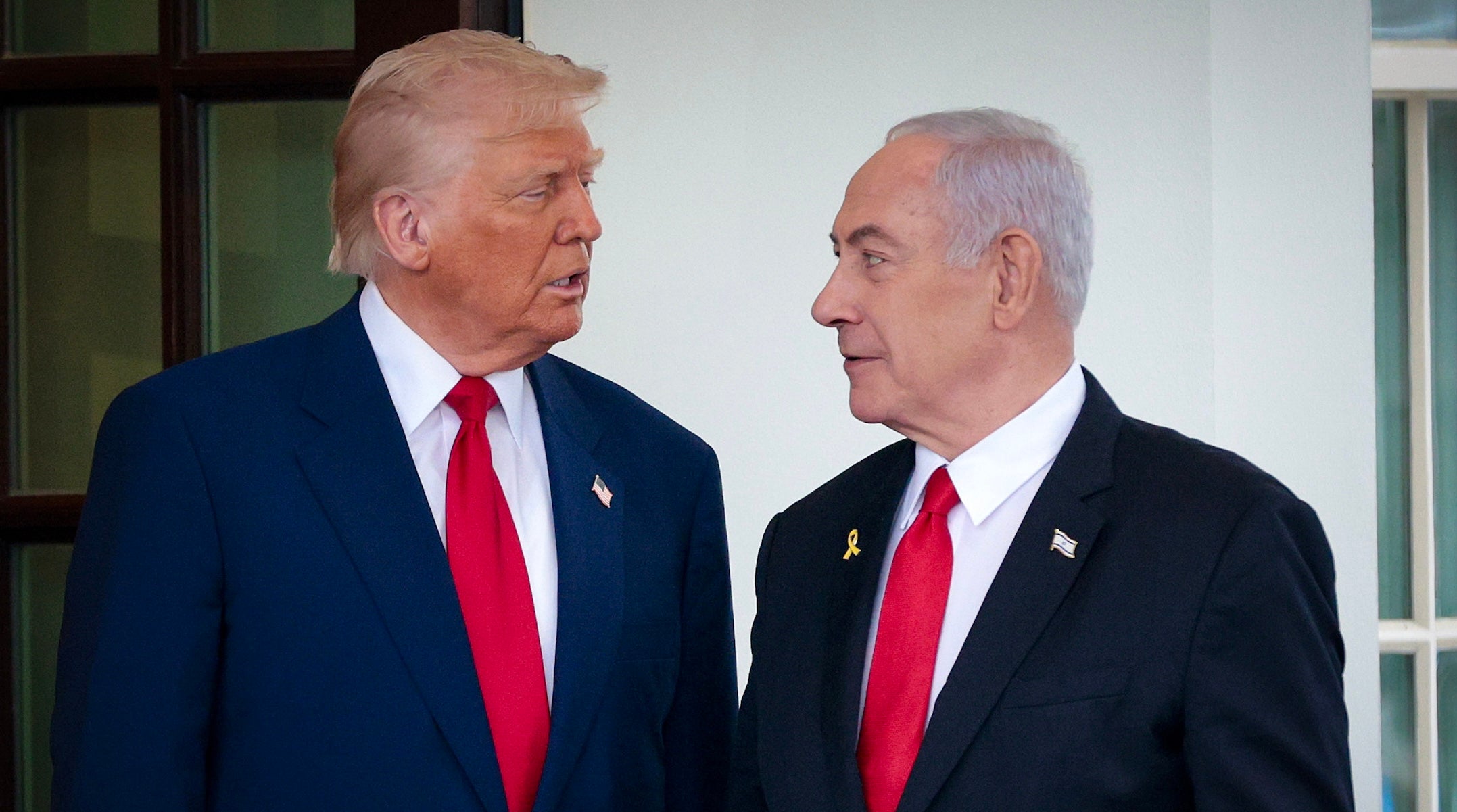
Netanyahu to meet Trump with Iran, Gaza, and Saudi Arabia on the line

JTA – Israeli Prime Minister Benjamin Netanyahu is set to meet with US President Donald Trump on Tuesday, as the American leader is weighing whether to expand his bombing campaign against Iran or to find a diplomatic resolution regarding the Straits of Hormuz and the Islamic Republic’s nuclear programme.
Israel fears that Trump is going to negotiate a premature end to the war without eliminating Iran’s capacity to develop nuclear weapons in the future. Trump has persistently insisted that Iran can’t possess nuclear weapons, but the war and the economic upheaval it has spurred has contributed to Trump’s approval rating hitting record lows in his second term. The poor marks are ringing alarm bells for Republicans ahead of midterm elections that could return Democrats to leadership in at least one chamber of Congress.
Netanyahu and Trump are also at odds over other issues, however, including the recent US-Saudi nuclear deal, the pending sale of F-35 advance fighter jets to Turkey, and the extent of Israel’s troop presence in Gaza, Lebanon, and Syria.
Netanyahu is coming to the United States to attend the funeral of Republican Senator Lindsey Graham of South Carolina, who remained one of Israel’s most unyielding advocates even as its popularity plummeted, and was one of the most important Trump associates in pressing for the Iran war. Former Israeli Prime Minister Yair Lapid, now the opposition leader, will also be at the service at Washington’s National Cathedral on Tuesday.
But while in Washington, Netanyahu will seek to close the widening gaps between himself and Trump over Middle East strategy. In a video statement he released before Monday’s departure, Netanyahu said, “I am embarking on this mission with one clear goal – to ensure the security, strength and future of our dear State of Israel.”
“We will discuss all the issues on the agenda, first and foremost, Iran,” he said. “Naturally, our goal is to safeguard our security and also to expand the circle of peace around us.”
During the trip, Netanyahu said, he would also pay his final respects to Graham, “one of the greatest friends the State of Israel has ever known”.
Israelis are acutely aware of the emerging differences between the allies. “It will not be an easy visit,” former Israel Defence Forces intelligence chief Amos Yadlin told Israel Radio on Monday morning. “There is no doubt that Netanyahu wants the United States to return to war.”
Trump himself spoke on Monday of the discord between himself and Netanyahu while speaking to reporters aboard Air Force One, even as he lauded the Israeli leader, stating that Netanyahu had been “great” and that “we did very well together”.
On the plane Trump was quizzed about US plans to sell advanced F-35 fighter jets to Turkey, which Netanyahu has publicly opposed. “Turkey has been a great ally for me,” Trump told reporters, stressing, “No one tells me what we should be selling or not.” He acknowledged that Turkey “is not a big fan” of Israel and Netanyahu.
When it comes to the Saudi civilian nuclear power programme that the Trump administration recently completed, Israel has been more circumspect. But it has deep concerns about an agreement that allows for plants with the capacity to enrich uranium. Assisting in the building of those plants had been one of the key incentives former US President Joe Biden had used as a means to sway Saudi Arabia to normalise ties with Israel and join the Abraham Accords between Israel and several other Muslim countries.
Trump has since said that US support for a Saudi civilian nuclear programme would be contingent on normalisation with Israel and that the plants wouldn’t be allowed to enrich uranium. But on Monday, he told reporters aboard Air Force One that he hadn’t spoken with Saudi Arabia about the Abraham Accords. Tuesday’s meeting is the first face-to-face encounter between Trump and Netanyahu since the announcement.
The closer Netanyahu appears to Trump and the centre of US decision making, the better it is for him domestically ahead of Israel’s 27 October election. Trump has in his second term met with Netanyahu more than any other leader. This will be their eighth such conversation, and the fifth time he has hosted the Israeli leader in the White House.
Tight ties with Netanyahu also plays well for Trump with his evangelical base ahead of the mid-terms in November, but they run the risk of further alienating the larger American public that opposes the conflict.
Netanyahu’s influence in America had diminished, in part because of how unpopular the war has become in the United States and the role he played spurring it on.
“This is not the same Netanyahu of 2025 or even of February 2026. He is greeted with suspicion,” Yadlin said of the reception he expects for the prime minister in the United States.
Netanyahu last visited Washington in February, when he successfully advocated for the joint Israeli-US military aerial bombing campaign against Iran launched on the 28th of that month.
Tehran retaliated by closing the Strait of Hormuz, the waterway through which 20% of the world’s oil supply is shipped. That step caused crude oil prices to spike in the first quarter of 2026 from $61 a barrel to $118, according to the US Energy Information Administration.
Iran allowed the strait to reopen in a limited way after an April ceasefire that was followed by a Memorandum of Understanding with the US in June. The agreement fell apart in early July, with the parties resuming attacks – but without any Israeli military involvement. The United States bombed Iran for 13 consecutive nights, ending on Thursday, even as talks with the Islamic Republic continued.
The United States and Israel in February were initially aligned around their joint goal of destroying Iran’s nuclear and ballistic missile programme, with Netanyahu also focused on the collapse of the Islamic Republic.
Over the weekend, Trump stressed that the war was still about eliminating Iran’s nuclear programme. Last week he spoke about specifically hitting the nuclear facility at Pickaxe mountain.
In an interview with NBC News’s Meet the Press on Sunday, US Ambassador to the United Nations Mike Waltz said the United States was “keeping all options on the table”, but was giving space for talks.
He dismissed media reports that lack of military supplies was part of Trump’s motivation to pause its bombing campaign, stating that the United States had everything it needed militarily.
Waltz warned Iran not to ignore American military threats. Early on Monday morning, Trump published a short AI video in which his likeness planted an American flag on an Iranian oil tanker, with a slogan that stated “It’s our oil tanker now”.
Later in the day, the president told reporters on Air Force One that he was having “good talks” with the Iranians, “so we will see what happens. I think there is a good chance something could happen. If it does, good. If it doesn’t, we go back to doing what we were doing two days ago.”
Yadlin told Israel Radio that at the end of the day, “What interests President Trump is the reopening of the Strait of Hormuz.”
The war might have begun in February with a focus on the Iranian regime and its nuclear programme, but it will end, Yadlin predicted, with the reopening of the strait and some kind of diplomatic achievement with regard to Iran’s nuclear weapons programme.
Israel has watched the US-Iran reengagement warily from the sidelines.
Sima Shine, an Iran expert at the Tel Aviv-based International Institute of Strategic Studies, said that until now, neither Washington nor Tehran had wanted Israel’s involvement in the resumed fighting, fearing that such a step would “widen the scope of the war”.
Maintaining its status as a bilateral conflict makes it easier to return to negotiations, she told the Jewish Telegraphic Agency.
The United States could better control the battlefield without Israel, which would have its own military agenda and objectives, Shine said. Israel could enter the war only if it was attacked by Iran or invited to do so by the United States, she added.
In an interview with Fox News on Sunday, Netanyahu warned of a forceful response should Iran attack Israel.
Iran had to end its nuclear programme, he stressed, saying that the military strikes so far have set the programme back but have not eliminated it.
A nuclear-armed Iran was a danger to Israel, the region, the United States, and the world, he said, adding, “President Trump and I are both committed to prevent this danger.”






David Crossley
July 28, 2026 at 4:39 pm
Regarding the Mayor of New York, he is on dangerous ground and his stance on Israel is completely wrong.
It is such a pity that Mayoral candidates have political affiliations – they should be non political appointees with one mission – the efficient running of the city.
Mamdani May well live to regret his anti Israel stance.