





SA
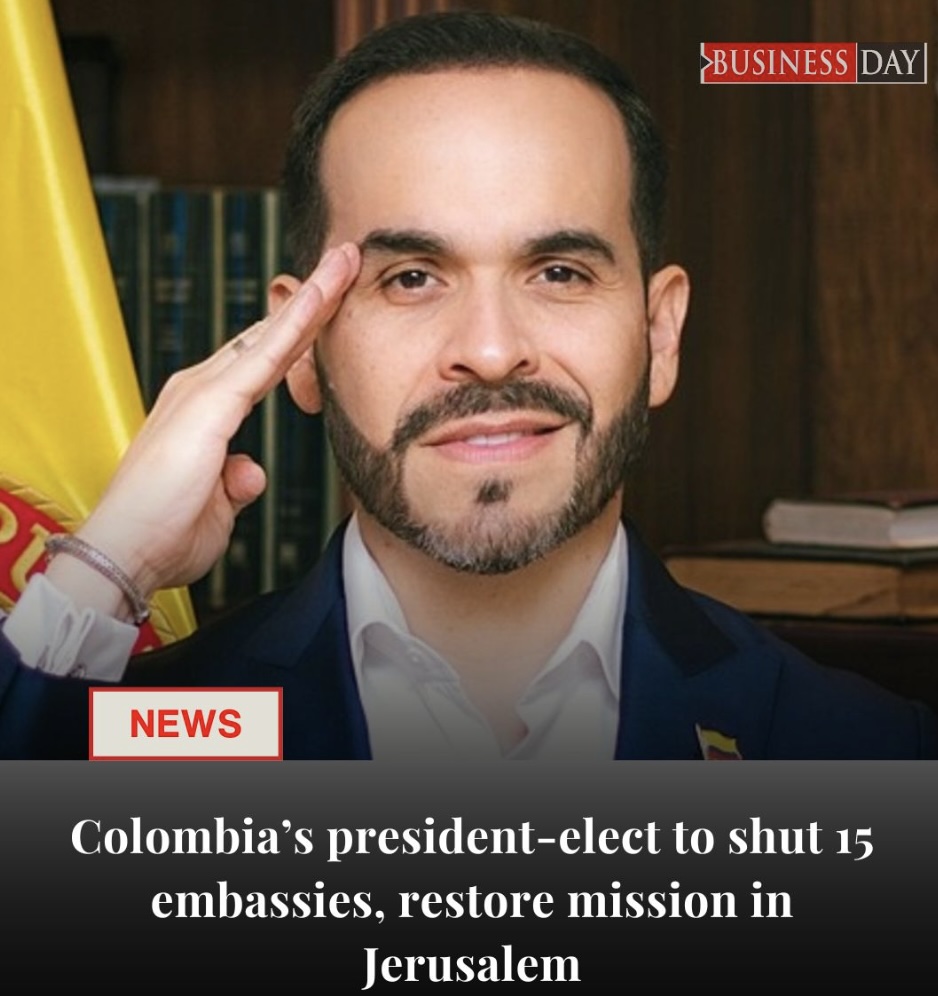
SA loses key ally as Colombia chooses Israel

South Africa is losing one of its closest international partners in its diplomatic campaign against Israel. This after Colombia’s newly elected president, Abelardo de la Espriella, announced the closure of his country’s embassy in Pretoria as part of a sweeping foreign policy overhaul.
The decision comes just 18 months after South Africa and Colombia co-founded The Hague Group, a coalition established to coordinate legal, diplomatic, and economic pressure on Israel over the war in Gaza. Under outgoing President Gustavo Petro, Colombia emerged as one of Pretoria’s strongest allies, backing South Africa’s “genocide” case against Israel at the International Court of Justice (ICJ).
While Bogotá has said the embassy closure forms part of a cost-cutting exercise, analysts say it also reflects a dramatic shift in foreign policy under De la Espriella, who has pledged to restore relations with Israel, strengthen ties with the United States, and reverse many of Petro’s pro-Palestinian policies.
Benji Shulman, executive director of the Middle East Africa Research Institute, says South Africa and Colombia’s relationship had become significantly stronger under Petro because of their shared position on Israel.
“Given South Africa’s close coordination with Colombia’s previous government in The Hague Group, which was designed to target Israel using the fig leaf of international law, it seems likely the new Colombian government no longer sees the same value in that diplomatic relationship.”
Shulman says that historically, relations between the two countries had been relatively limited because of geographical distance and modest trade.
“What strengthened the relationship over the past few years was ideological cooperation against Israel. The new government’s closer alignment with the United States, together with South Africa’s strained relationship with Washington and relatively limited trade between the two countries, means that once there is no longer the same ideological cooperation, reducing diplomatic representation becomes a logical part of Colombia’s broader recalibration of its international relations,” he says.
Under Petro, Colombia became one of Israel’s fiercest critics, severing diplomatic relations in May 2024, and repeatedly accusing Israel of “genocide”.
When The Hague Group was established in January 2025, South Africa and Colombia co-chaired the coalition. Bolivia, Cuba, Honduras, Malaysia, Namibia, and Senegal are also members. The group’s stated objectives include supporting proceedings against Israel before the ICJ, backing International Criminal Court arrest warrants for Israeli leaders, coordinating measures to restrict arms transfers to Israel, and encouraging other countries to adopt similar action.
For South Africa, The Hague Group became a key platform for building international support around its legal campaign against Israel, and Colombia’s participation gave Pretoria an influential Latin American ally.
De la Espriella has indicated that his administration intends taking Colombia in the opposite direction. He has pledged to restore diplomatic relations with Israel, relocate Colombia’s embassy from Tel Aviv to Jerusalem, cancel Petro’s plans to open an embassy to the Palestinians, and rebuild security and defence cooperation with Israel while pursuing closer relations with the United States and other Western democracies.
The Colombian government has described the South African embassy closure as part of a broader diplomatic restructuring that will see 14 embassies shut worldwide. This is aimed at streamlining what it considers an oversized foreign service and redirecting diplomatic resources to countries it regards as strategically more important.
Anne Herzberg, legal adviser at NGO Monitor, says, “The closure of the Colombian embassy marks a dramatic foreign policy shift despite the stated cost-cutting rationale.
“It is clear that President De la Espriella seeks to reverse the damaging decisions of his predecessor, including the former government’s alignment with South Africa’s hostile stance towards Israel, support for Hamas, and exploitation of the International Court of Justice. De la Espriella has determined that a strong relationship with Israel is morally correct and far more beneficial to his country’s interests.”
South African Zionist Federation national chairperson Craig Pantanowitz describes Colombia’s policy reversal as a significant development for South Africa’s international campaign against Israel.
“South Africa’s case against Israel at the ICJ has suffered its first defection, and it is a serious one,” he says.
“Colombia’s incoming government has confirmed that it will withdraw its declaration of intervention when President-elect Abelardo de la Espriella takes office on 7 August. No state that joined the case in support of Pretoria has reversed itself before. Colombia is the first.”
Pantanowitz says Colombia had been one of South Africa’s closest partners on Israel-related diplomacy.
“Colombia filed its intervention in April 2024, severed relations with Israel a month later, and stood beside Pretoria as a founding member of The Hague Group. This was not a sympathetic bystander. It was among the most committed partners the campaign had.”
Political analyst Daniel Silke says the move illustrates how foreign policy often shifts with changes in government.
“Colombia’s new centre-right administration is reviewing the foreign policy decisions of its predecessor.
“We are likely to continue seeing countries alter their positions on Israel as governments change. These shifts make it more difficult to sustain international coalitions because foreign policy priorities evolve alongside domestic political change.”
Pantanowitz says changes in political leadership could ultimately reshape support for South Africa’s case.
“The reply from Pretoria’s defenders will be that this is merely Colombian domestic politics, a new government discarding its predecessor’s foreign policy. That is precisely the point, and it is an admission rather than a defence. A case that depends on which faction happens to hold office in a handful of capitals is not a principled application of the Genocide Convention. It’s a political coalition in legal dress, and political coalitions don’t survive elections.”
Referring to the ICJ’s decision to grant South Africa a further 18 months to file its next submission, he adds, “The case is now measured in years. Its backers are measured in electoral terms. The question is no longer whether the case is sustainable. It’s how many of its supporters will still be standing there when the filing date arrives.”
South Africa and Colombia established diplomatic relations in 1994 following the end of apartheid. For much of the time that followed, relations remained cordial but relatively low profile, centred on multilateral cooperation rather than deep strategic or economic ties.
It was only under Petro that the relationship acquired a strong ideological dimension through the two governments’ close alignment on Israel and the Palestinian issue.






Gary Selikow
July 30, 2026 at 4:30 pm
Let us hope and pray that in the not too distant future SA too will have a new government that is friendly to Israel.