





Israel
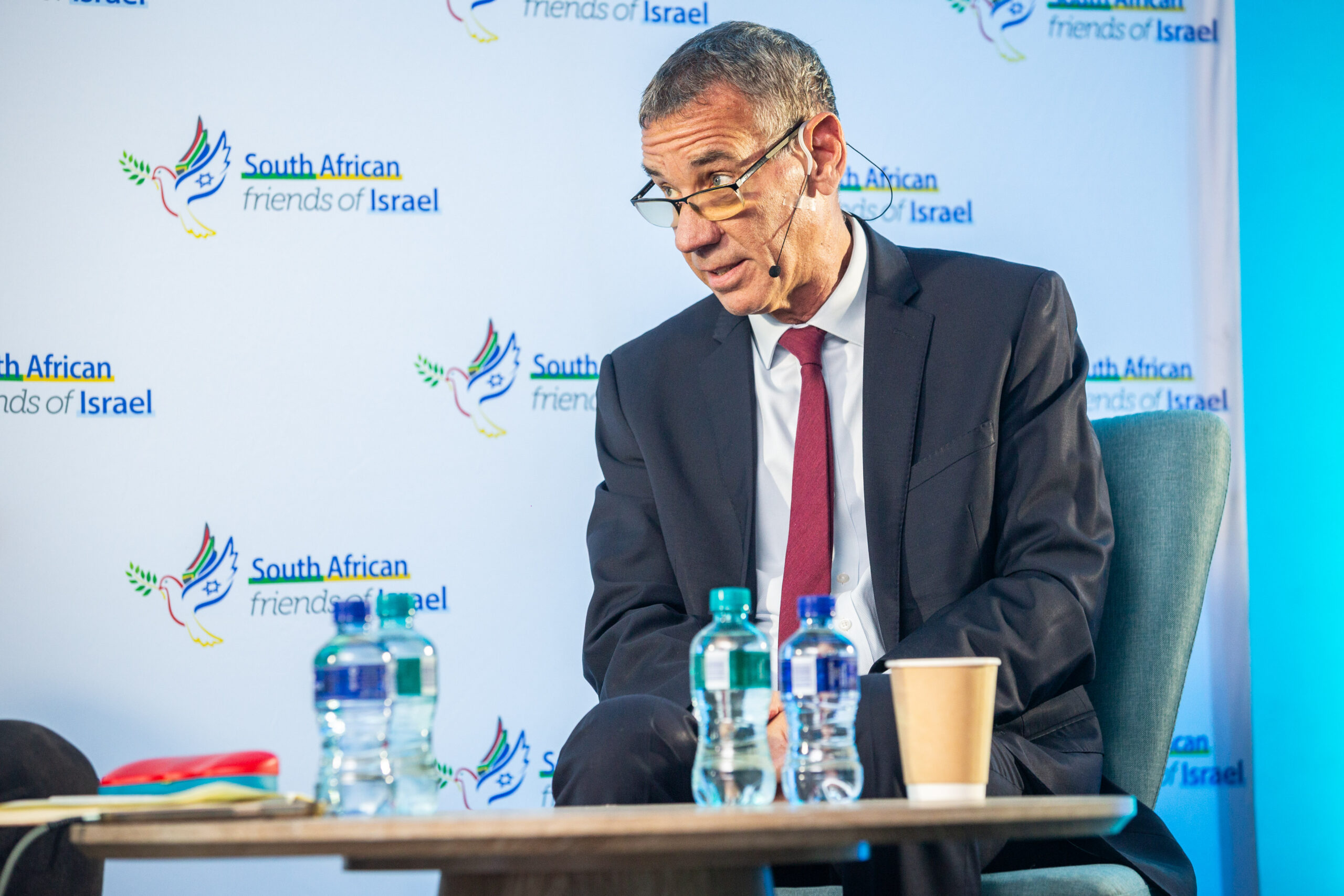
Regev says diplomacy matters most in wartime

Mark Regev, former Israeli ambassador and senior adviser to Prime Minister Benjamin Netanyahu, offered a rare glimpse into diplomatic decision-making during war when he addressed a packed audience in Cape Town recently.
In conversation with SA Jewish Report chairperson and commentator Howard Sackstein, Regev reflected on global diplomacy, regional security, Israel’s relationships with its allies, and why he remains optimistic despite almost three years of war.
The event was hosted jointly by the South African Zionist Federation Cape Council, the SA Jewish Report, and South African Friends of Israel. It formed part of Regev’s national visit, during which he addressed more than 1 700 people at public events, leadership briefings, media interviews, and meetings with Christian and Jewish leaders.
Regev spent decades at the centre of Israeli diplomacy, advising prime ministers, and participating in conversations with world leaders during some of the country’s most significant moments.
He was born in Melbourne, Australia and, as the son of Holocaust survivors, his family’s history shaped his outlook even though little was spoken about it at home. After completing a youth programme in Israel through Habonim Dror, he returned to Australia to complete his studies before making aliya at the age of 21. “I went to Israel and never looked back.”
His diplomatic career began almost by accident. After deciding that academia wasn’t for him, he saw an advertisement for Israel’s foreign service entrance exams, applied, and was accepted.
Regev acknowledged that he had considered carefully whether to visit South Africa now, given the strained relationship between the government and Israel. “I spoke to the relevant people and they said it would be okay.”
Asked whether anything had surprised him during his visit, Regev responded by recalling how his son had once formed friendships with Egyptian and Palestinian teenagers at an international peace camp in the United States. Although they remained friends while abroad, invitations to visit Egypt never materialised. “My son told me, ‘They can be my friend in Maine. They can’t be my friend in Cairo’,” Regev recalled. The experience illustrated how political realities often prevented personal relationships from developing beyond neutral settings, he said.
The conversation then shifted to Regev’s decade working alongside Netanyahu.
“You have a life, but it’s not yours,” he said of serving in the prime minister’s office. He described countless family dinners interrupted by urgent phone calls from the prime minister, saying such a position demanded complete commitment. Regev said Netanyahu had one of the most demanding leadership positions because the role combined national security responsibilities with the everyday pressures of governing a small, politically divided country.
He’d regarded his role as making the prime minister’s job easier, but “It didn’t mean that I didn’t tell him things when I disagreed.”
Regev said Netanyahu valued advisers willing to challenge him, rather than surrounding himself with yes men.
Looking back, Regev said his respect for Netanyahu had deepened rather than diminished while working with him. “I know that he’s fallible. I know that he’s a human being,” he said. “When you see them close up, you see warts and all, and still, I learned so much working for Netanyahu.”
On Israel’s relationship with the US, Regev said that US President Donald Trump’s first administration had fundamentally changed Israeli public opinion by recognising Jerusalem as Israel’s capital, recognising Israeli sovereignty over the Golan Heights, facilitating the Abraham Accords, and adopting a tougher approach towards Iran.
He expressed concern about the future of bipartisan support for Israel in the US. “The relationship with the US is our most important one,” he said, warning that younger Democratic politicians appeared more willing to criticise Israel than previous generations.
Turning to the Middle East, Regev said one of the most overlooked developments was the changing political landscape in Lebanon. He argued that Hezbollah’s weakened military position had created opportunities that hadn’t existed previously. Lebanon had elected a president whom Hezbollah would previously have blocked and who had publicly called for the organisation to be disarmed.
“The dynamic in Lebanon is very positive,” Regev said, adding that he believed a peace agreement between Israel and Lebanon was possible before the end of the current US administration.
Regarding Gaza, Regev acknowledged that Israel hadn’t yet achieved every objective it had set after 7 October. “If you take the stated war aims of Israel, it failed,” he said. “But in the real world, never let the perfect stand in the way of the possible.”
He pointed out that Hamas’s military capabilities had been substantially degraded and that Israeli communities bordering Gaza were now significantly more secure than they had been.
As for the Palestinian Authority, Regev said its president, Mahmoud Abbas, had missed an opportunity after 7 October. “If he had stopped on 8 October 2023 and said, ‘We condemn what Hamas did’, he would be in a totally different position than he is today.”
Instead, Abbas has alienated even many Israelis who had historically supported a negotiated peace process, he said.
Responding to questions about South Africa’s relationship with Israel, Regev said meaningful diplomacy required engagement with both sides of the Israel-Palestinian conflict. “How do you advance peace when you only talk to one side?”
Regev encouraged South African Jews to work more closely with Christian supporters of Israel. “The Jewish community might be wonderful, but you’re small,” he said. “Think about coalitions.”
South Africa, he said, carried significant influence internationally because of its history and moral standing. “South Africa punches above its weight in soft power. If South Africa was to have a better relationship with Israel, I think that’s a global game changer.”
Sackstein asked Regev why he remained optimistic after years of conflict. Regev pointed to Israel’s consistently high ranking in the United Nations World Happiness Report, despite repeated wars and security threats.
He said Israelis drew strength from a sense of shared purpose, resilience, and belief in the future. “We’ve been through a very tough time, but we’re coming out of it, and the future’s only going to be better,” he said.







yitzchak
August 7, 2026 at 7:58 am
“War is the continuation of policy with other means.”[2]: 87 : Von Clausewitz
i.e.where diplomacy fails,war begins.
Our antagonists wont recognise us, let alone meet with us. So simmering war is the answer.