Featured Item
Wiener exposes GNU back story in The Deal

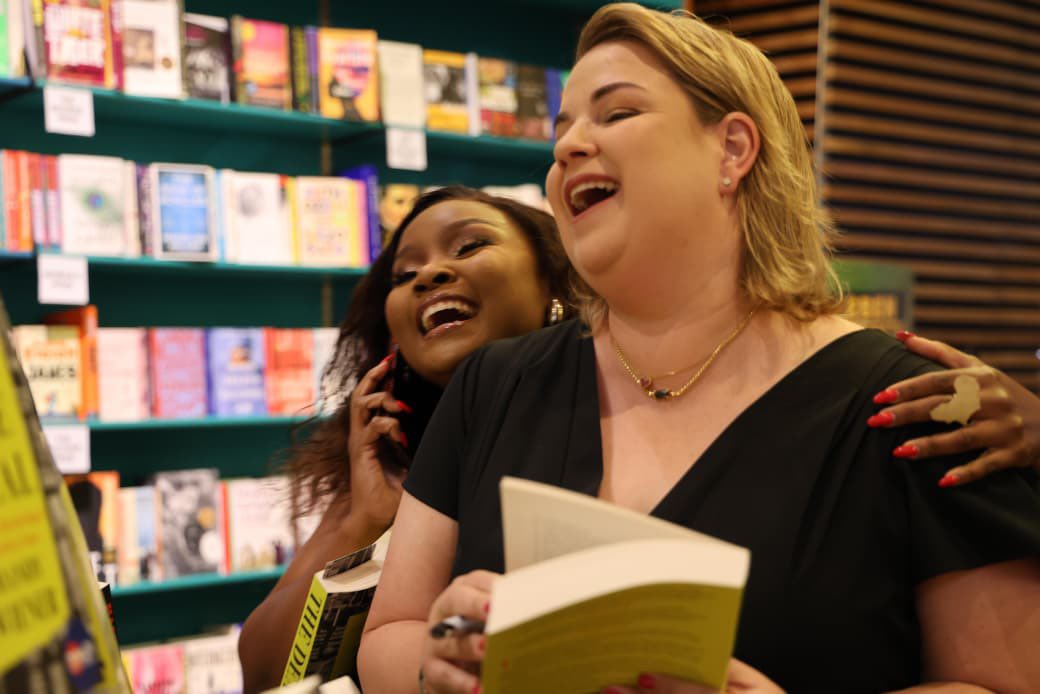
When acclaimed journalist Mandy Wiener sat down to write The Deal, she didn’t intend to write a book. “It was never the plan,” she admitted at her recent book launch at Exclusive Books in Hyde Park on 16 October. “It just evolved, and then it happened. Before I knew it, I was really deep in it.”
Wiener was in conversation with fellow senior political journalist Ziyanda Ngcobo, who also covered the origins of the Government of National Unity (GNU). The two of them are great friends, and originally agreed to write the book together, but that didn’t materialise.
Wiener was sure that when the dust had settled after South Africa’s most unpredictable election in 30 years, the story of how the GNU came about would have to be told. “All of us in the journalist class were trying to work out what the hell was going on behind closed doors,” she said. “A few people started tweeting, saying, ‘Don’t worry, some journalist will write a book about this.’ And I thought, you know what, I’ll be that journalist.”
For Wiener, The Deal isn’t just another political book, it’s a historical record. “Growing up, I was really fascinated by books like Tomorrow’s Another Country and Eight Days in September,” she said. “I always thought, I’d love to write a book that stood the test of time, that for generations, for posterity, would continue to tell the story of South Africa.”
That sense of responsibility drove her to document the behind-the-scenes negotiations that followed the 2024 election – the chaos, the secrecy, and the monumental shift that led to the country’s first true government of national unity since 1994.
“This is a story that had to be told as a record of our history,” Wiener said. “It’s not pro-GNU or anti-GNU. It doesn’t take a side. I wanted to include everybody’s voice.”
The Deal delves far deeper than news reports or sound bites ever could. The book is based on nearly 100 hours of interviews with political leaders – from President Cyril Ramaphosa to the Democratic Alliance’s John Steenhuisen, and Freedom Front Plus’s Pieter Groenewald.
Some interviews were easy to secure, others required relentless persistence, she said. “Every Monday morning, I’d message Vincent Magwenya, the president’s spokesperson, begging for an interview with President Ramaphosa,” Wiener recalled. “He finally told me, ‘Tomorrow morning, 11:00 at the Foundation – get someone to stand in for you.’ I couldn’t believe it. It was 20:00 and I had finally got this interview.”
That interview, squeezed in just before the book went to print, proved essential. “The story would never have been told fully without the president,” she said. “He was the strategist behind the ANC’s [African National Congress’s] negotiating team, co-ordinating, using tactics from CODESA [the Convention for a Democratic South Africa]. To get him was necessary.”
The book reveals that even those at the top were blindsided by the ANC’s electoral collapse. “When I asked President Ramaphosa about it, he said it was like watching a horror show,” Wiener said. “Another person close to him said it was like a bomb exploding under their feet.”
Ramaphosa, she noted, had ignored the polls. “He felt going door to door, seeing the impact of the R350 grant, that that would get people to vote for the ANC.” Instead, the ruling party lost its majority, a moment Wiener describes as “a fundamental shift in our politics”.
“I call it a coalition draped in rainbow flair,” she said of the new government. “What our politicians achieved in 14 days takes others 18 months to do. It was largely peaceful. The judiciary presided over it, and a president and Cabinet were appointed in 30 days. I don’t think we celebrate that enough.”
One of the most gripping parts of The Deal delves into the internal tensions of political parties. Said Ngcobo, “We always report on factions within the ANC, but the infighting in the DA [Democratic Alliance] was something else.”
Wiener agreed. “They described it as robust and creative differences,” she said, laughing. “But there were stand-up screaming matches on the pavement outside a hotel with Tony Leon waving his finger in Helen Zille’s face.”
Even after the book was finished, several politicians asked her to remove expletives from their quotes. “The amount of F-bombs were vastly reduced upon request,” she admitted. “But that’s the thing, everyone has a different version of the truth.”
Wiener also uncovered how business interests shaped negotiations. “There was this constant hovering, ominous threat of the markets,” she said. “The DA spoke about being under pressure from funders, getting phone calls from lawyers in New York and investors saying, ‘You have to get a deal over the line.’”
Ramaphosa himself, she noted, confronted business leaders. “He told them, ‘Don’t come here and put pressure on me. You’ve been bad-mouthing the country. Go speak to the DA and sort this out.’”
Much of the real action, Wiener said, happened through “back channels” – informal networks of wealthy intermediaries. “That’s the story you didn’t get in the media at the time,” she said. “That’s why telling it retrospectively matters.”
Though The Deal is rich in political intrigue, Wiener insists it’s ultimately about people. “I wanted to get to know them as humans,” she said. “We see politicians campaigning, but we don’t see who they are when they’re home, watching the results come in.”
She laughed about her curiosity. “I want to know what’s going through John Steenhuisen’s mind when he wakes up in the middle of the night and turns to his wife and says, ‘I’m not sure we’re going to be able to get this back.’ Or what Ramaphosa is thinking when he’s watching the results at home in Hyde Park.”
Reflecting on the fragile GNU, Wiener offered perhaps her most memorable metaphor of the night: “I like to describe it as the parents being in a miserable marriage but staying together for the kids. The kids are you and me – the citizens. And I think they realise they have to stay together because the alternative is too terrifying to contemplate.”
Despite the uncertainty, she believes the coalition will endure, at least for now. “It’s going to hold,” she said. “Because the alternative is too terrible to contemplate.”
After months of research and interviews, Wiener confessed that finishing The Deal was its own kind of victory. “It was exhausting,” she said. “It took a lot of begging, a lot of energy, a lot of patience from my family. But the best part was actually getting access to these people and understanding them.”
As the launch drew to a close, Wiener said her publisher, Terry Morris, called The Deal “one of those books that will stand the test of time”. It’s a sentiment hard to argue with as it is a work that captures not just a political turning point, but a nation trying to redefine itself.
Or, as Wiener herself put it, “We’ve had a fundamental shift in the landscape of our politics. There has been a seminal change, and because it all happened so smoothly, we haven’t truly felt the impact yet.”