





Featured Item
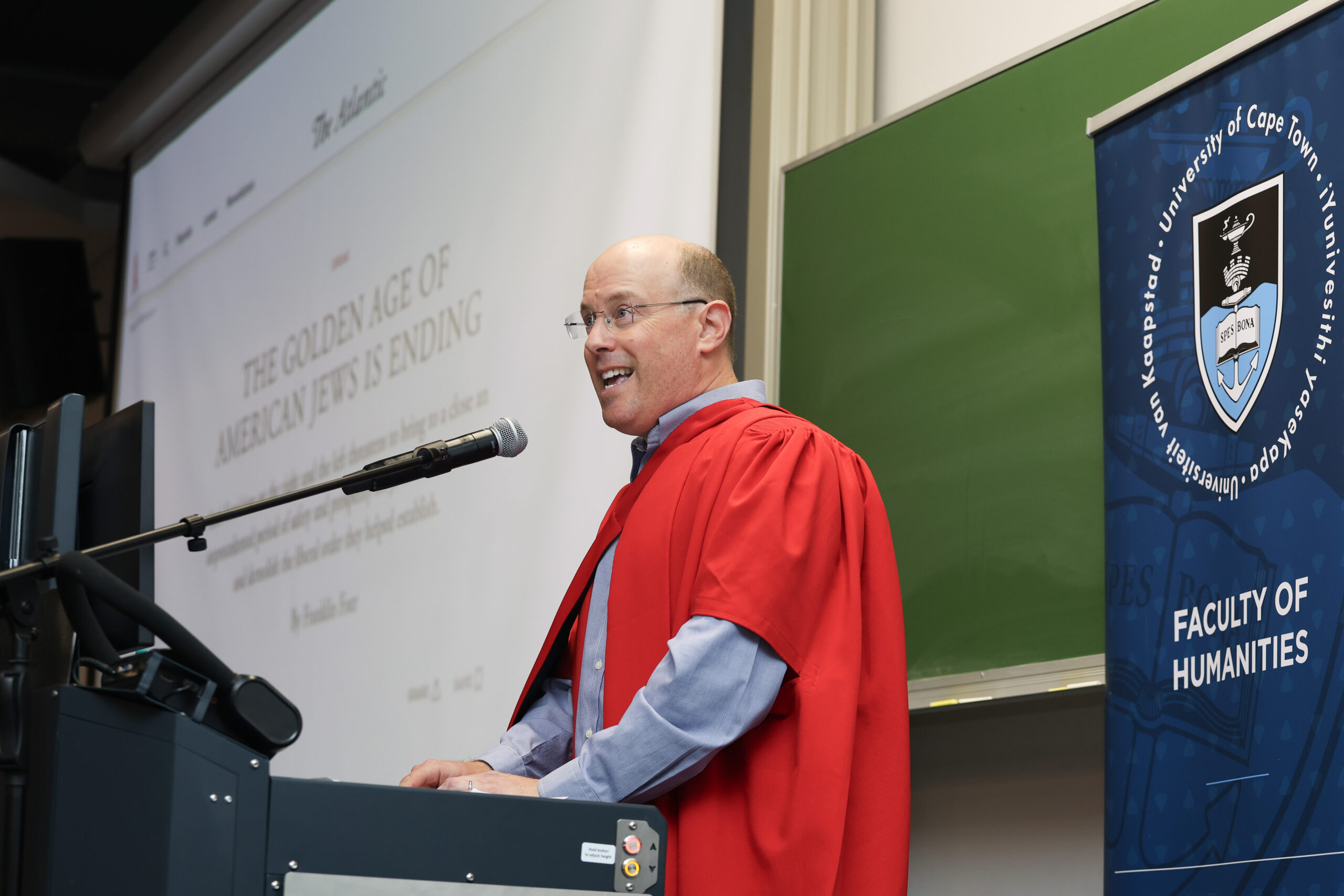
Mendelsohn’s lecture raises urgent questions about Jewish future

Students at the University of Cape Town (UCT) are concealing their Jewish identity and reporting experiences of exclusion and hostility on campus.
That was one of the stark realities Professor Adam Mendelsohn spoke of in his inaugural lecture at UCT on 29 April, in which he questioned whether Jews can still feel fully at home in institutions.
“What is happening in societies and institutions where they once felt most at home?” he said, describing Jews’ growing sense of uncertainty in places long associated with belonging.
He told the audience that some Jewish students concealed their school background or religious identity to avoid hostility. “I have heard plenty examples … of being excluded and targeted,” he said. Students were concealing “clothing and jewellery that could visibly mark them as Jewish”, a sign of how everyday behaviour has changed.
For Mendelsohn, these experiences are part of a broader pattern. He described a growing expectation that Jews declare political positions, particularly on Israel, and face consequences if they do not.
“Are Jews required to conform to the dictates and expectations of others?” he said. He described this as “coerced speech”, saying Jews are increasingly expected to take positions publicly “lest they be classed as bad Jews or, even worse, Zionists”.
He argued that such demands are not applied to other groups. Instead, they reflect a deeper uncertainty about whether Jews can remain fully accepted in institutions where they once felt at home.
“Has a golden age of Jewish life ended?” Mendelsohn said, suggesting that assumptions about security and acceptance may no longer hold.
That question carries particular weight at UCT. Mendelsohn traced a long history of Jewish belonging at the university, where Jewish students were welcomed at a time when universities elsewhere imposed quotas or exclusions.
In 1928, then Vice-Chancellor Sir John Carruthers Beattie stated that there would be no discrimination against Jews at the institution. That commitment helped make UCT a place of opportunity for Jewish immigrants and their children. For many families, the university became a pathway to social mobility. Mendelsohn described how access to education transformed lives within a single generation. “Here was the transformative power of the university,” he said.
That history, he suggested, makes the present moment more significant. “How times have changed.”
Mendelsohn linked current tensions to wider developments in South Africa and globally. He pointed to a resurgence of antisemitism in public discourse, including the reappearance of long-standing tropes.
“The sensation is like that of a palaeontologist transported to Jurassic Park,” he said. “We are seeing alive in the wild what we assumed only lived on in textbooks”
At the same time, Jewish concerns about antisemitism are often dismissed. Mendelsohn referred to claims made within UCT that Jews “instrumentalise claims of antisemitism”. He questioned whether similar claims would be made about other groups. “The real problem … is not one of definitions, but of hate. Can you imagine the same being said for other forms of prejudice?”
Mendelsohn also pointed to what he described as inconsistent institutional responses. He referred to recent controversies at the university, including the decision to award an honorary doctorate to Dr Imtiaz Sooliman of Gift of the Givers.
While acknowledging Sooliman’s humanitarian work, Mendelsohn suggested that the reaction to the award highlighted a growing sense among some Jewish stakeholders that their concerns aren’t taken seriously. He placed this within a broader pattern of responses that, in his view, have failed to engage meaningfully with Jewish anxiety about antisemitism and exclusion.
These concerns unfold against the backdrop of a broader dispute between Mendelsohn and UCT over governance and academic freedom. Legal proceedings and public debate have brought increased scrutiny to the institution.
At the same time, Mendelsohn emphasised, the Jewish community in South Africa is becoming smaller and less visible. The population has declined from 118 000 in 1970 to about 50 000 today, largely due to emigration. “That absence matters,” he said.
With fewer everyday interactions between Jews and the wider population, misunderstandings can deepen and prejudice can go unchallenged. Research by the Kaplan Centre, which Mendelsohn heads, shows a surge in antisemitic content on social media since 2024. He described much of this material as crude and widely normalised.
This content … escapes comment, criticism, and moderation,” he said, noting how it increasingly moves from online spaces into real-world behaviour.
Although South Africa has not seen the levels of antisemitic violence reported elsewhere, he said the current climate has created anxiety and heightened vigilance within Jewish communities. “None of this is normal,” he said, referring to the need for security at Jewish institutions and the climate of fear reported by some students.
The university’s response to his lecture was restrained. Vice-Chancellor Professor Mosa Moshabela spoke about scholarship, dialogue, and the importance of reflecting on identity and belonging.
However, he didn’t address concerns about antisemitism on campus. He didn’t offer assurances to Jewish students or staff about their place at the university. The contrast was clear. Mendelsohn’s lecture focused on uncertainty, vulnerability, and pulled no punches. The institutional response remained general.
By the end of the lecture, Mendelsohn returned to his central question. Jewish history, he said, is marked by cycles of acceptance and exclusion.
“The unanticipated reappearance of the Jewish question” is now part of public discourse again, echoing debates that many believed had been settled after World War II. “What does the future hold?” he asked. For those listening, the question was no longer theoretical. It was immediate.





Mark Wade
May 7, 2026 at 3:32 pm
Let’s not forget that it was three Jews, the key figures in UCT’s establishment, Alfred Beit (via a bequest), mining magnates Julius Wernher and Otto Beit.
Paysach Burke
May 7, 2026 at 6:46 pm
I heard his lecture, I encourage you to too. It was no normal talk. It was classic, an example of where history is turned into art. The context, the timing, the dynamic ebb and flow culminating in a forceful crescendo and fortissimmo. This was not just a lecture, it was art.