SA
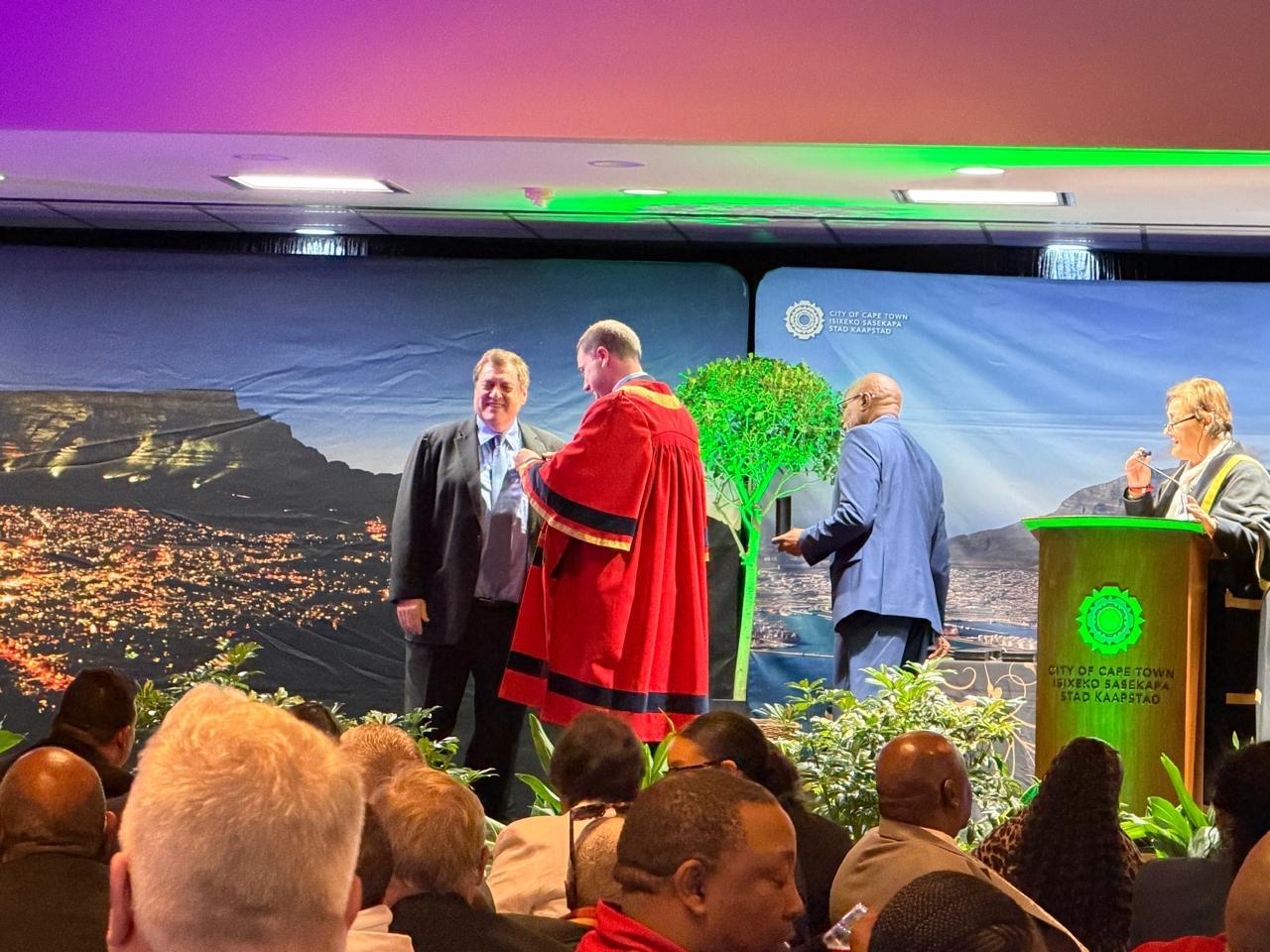
Anstey recognised with Alderman title

Errol Anstey has been awarded the title of Alderman after 16 years as a City of Cape Town councillor. It recognises a political career that began decades before he entered local government.
Anstey, who isn’t standing for another term, says the honour is a fitting conclusion to his time on council. “It’s nice recognition because I consider I did a lot of hard work over the past 16 years,” he says.
Ironically, he wouldn’t have received the title if his own push for stricter qualifying criteria had succeeded.
The title of Alderman is awarded to councillors based on length of service and responsibilities held. Anstey says the system previously worked differently. Historically, serving as mayor automatically resulted in becoming an Alderman, but about 25 years ago, Cape Town introduced a points-based system. Now councillors who serve for 20 years can qualify through their length of service. Those with at least 15 years can also qualify by accumulating additional points through positions such as chairing a portfolio committee.
Anstey has served for 16 years and qualified through this system after earning additional points for his portfolio chairperson role. But for the past two, he had tried to change the rules, proposing that a councillor should serve at least 20 years before qualifying.
Had that amendment passed, Anstey would not have qualified for the honour himself.
“I was prepared to sacrifice being an Alderman to make it more prestigious,” he says.
Nevertheless, Anstey’s political involvement predates his time in council by several decades. It began when he was a teenager. “The thing then was to end apartheid,” he says. He became involved with the Progressive Party, which later became the Democratic Party, and remained committed to its political principles.
He has worked on every national election, by-election, municipal election, and two referendums since 1974.
Anstey became a city councillor in 2011 after being encouraged to stand because the caucus wanted more business people involved. He was elected on the proportional representation list.
During his second term, he was elected deputy chief whip. He was re-elected to the position during his third term and later became a portfolio chairperson responsible for innovation and ease of doing business.
Much of his work in council has focused on making it easier for residents and businesses to interact with the City. Anstey says his portfolio work involved reviewing systems and processes to make them more efficient and reduce delays.
Among the initiatives he highlights are online appointments for driving and vehicle licensing, faster processing of certain permits, and improvements to the City’s reporting systems. He also chaired a task team focused on improving the collection of traffic fines. Anstey says the collection rate quadrupled over a period of about 10 years.
Another major focus has been the Cape Town Stadium, with Anstey involved in reducing its losses. Asked about the legacy he hopes to leave, he told the SA Jewish Report, “For the City of Cape Town, it would be turning the Cape Town Stadium into profit within two years.”
His political career has also been closely connected to his Jewish identity. Anstey says his Habonim upbringing had a major influence on both his political involvement and his approach to community service. “My values come from Habonim and obviously from my Jewish background,” he says. He believes the movement’s emphasis on service, community, Zionism, Judaism, and social responsibility shaped his activism.
Michael Bagraim, a longtime political colleague and Member of Parliament, says Anstey’s contribution extends well beyond his formal responsibilities as a councillor. He describes Anstey as an “unsung resource” for the Jewish community for many years. Jewish communal organisations regularly turned to Anstey when they encountered municipal or council problems.
Bagraim recalls an incident involving a major Friday Night Live event at the Gardens Synagogue in Cape Town. The event was expected to attract more than 1 000 people, but a planned electricity interruption threatened to disrupt it.
He contacted Anstey, who provided a contact who could help resolve the problem. Bagraim says the electricity was ultimately restored for the event. This was one of many occasions on which Anstey helped Jewish organisations navigate municipal issues. “He under-promises and over-delivers,” Bagraim says.
Anstey’s knowledge of City officials, departments, and processes also made him an important resource for both councillors and community members, Bagraim says.
He believes it will be a significant loss for the Jewish community when Anstey leaves council. Attempts were made to persuade him to stand for another term, but Anstey had declined.
Helen Zille, former premier of the Western Cape and a longtime colleague of Anstey, also praised his contribution. “Errol goes back to the early days of the Progressive Party. He was a stalwart in Sea Point since his youth.”
Zille describes Anstey as someone with “staying power” who takes commitment seriously. She says he remained dedicated to advancing democracy in South Africa, with a particular focus on Cape Town. “He’s made a major contribution to his city and country,” Zille told the SA Jewish Report. “Errol thoroughly deserves the honour that has been bestowed on him.”
For Anstey, the title is less about personal recognition than the work that preceded it. He says one of his mentors, former Progressive Party leader Colin Eglin, used to remind him that people are eventually forgotten. Anstey says this shaped his view of what constitutes a meaningful legacy.
“I left the place in a better situation than when I found it,” he says. He believes that if people build on what they inherit and leave it in a better condition, they have achieved something worthwhile.
As Anstey prepares to leave elected office, the Alderman title provides formal recognition of a political career that began with anti-apartheid activism and continued through 16 years of local government service.
For a man who says he was never particularly interested in recognition, the honour marks the end of one chapter of public service. It also leaves the Cape Town Jewish community without a longstanding link to the City’s corridors of power.