

SA
SA one of the safest places to be Jewish

The J7 Annual Report on Antisemitism reveals a harrowing story that is unfortunately no longer a surprise to any Jew in the diaspora. However, we feel a deep empathy and pain when studying the data.
The J7 is a coalition of major Jewish organisations representing the seven largest Jewish diaspora communities outside Israel. It doesn’t include us in South Africa, but the report, and the data it encompasses, reveals a lot about our unique position.
At the South African Jewish Board of Deputies (SAJBD) we compile our own data on antisemitism. Through the year, in conjunction with CSO, we receive reports of antisemitic incidents and events that we then categorise. It’s important to say that not all antisemitism can be counted as an “incident” and that we make a special effort to ensure that every incident is correctly counted.
Additionally, public statements may leave our community feeling uneasy (“Red Card Israel” in graffiti at a busy intersection), but aren’t themselves antisemitic and thus aren’t counted. Conversely, an incident that may affect only one person, such as verbal abuse, can have very little impact on the overall atmosphere among the community, but will register in the statistics. This means the numbers represent only verifiable antisemitic incidents, and may not directly reflect the mood or general feeling within the community.
Finally, we have a strict “broken windows” policy, chasing down and addressing even the most minor incident to ensure that major attacks don’t occur.
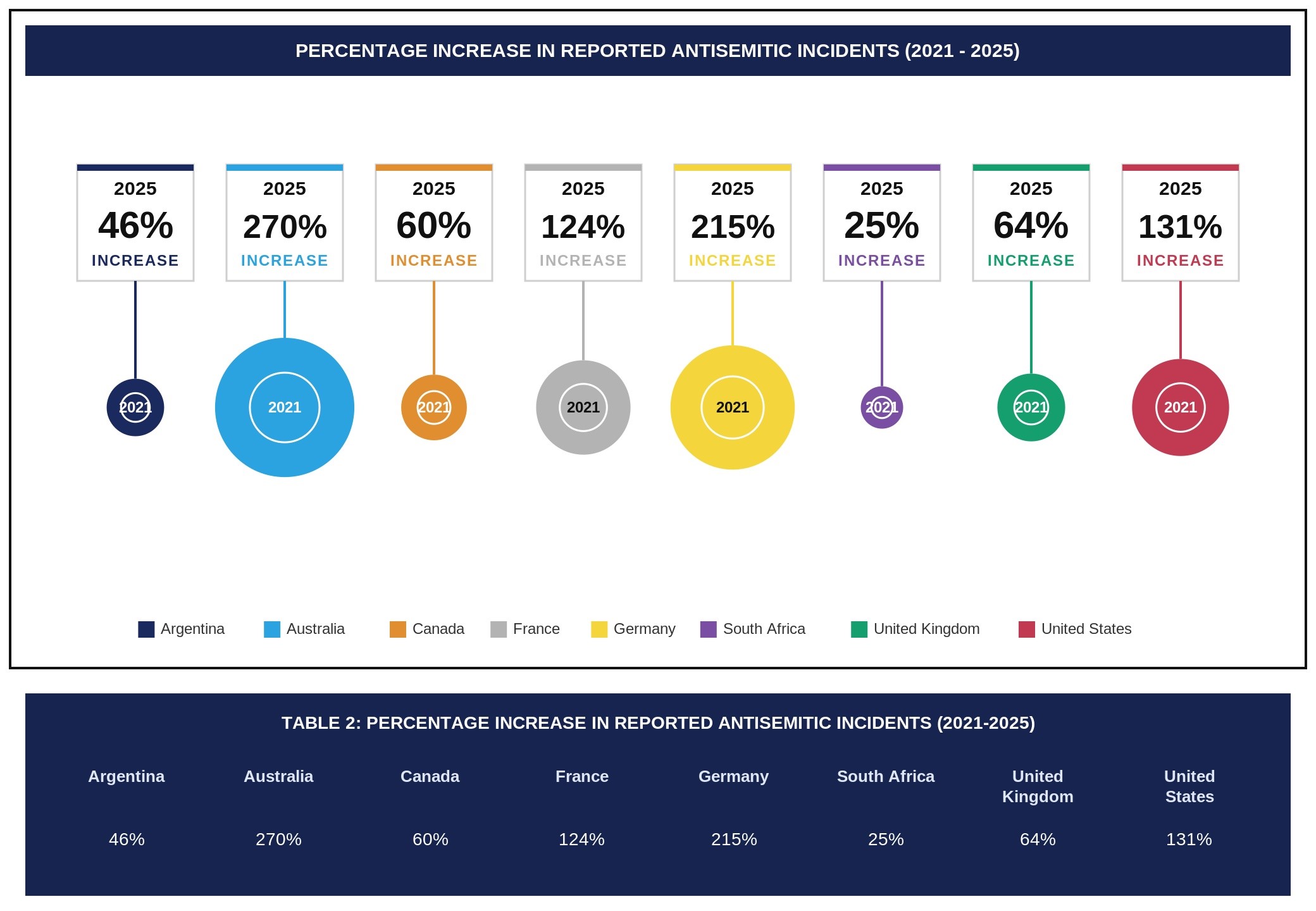
A particularly notable graph produced by the J7 compares the number of incidents in 2021 – before the 7 October massacre – with their recorded number in 2025, as a demonstration of the large increases in recorded incidents. When reproducing the graph to include our statistics, we see that South Africa has recorded a much smaller increase, of 25%. While this is not to be taken lightly, as a 25% increase is still a noteworthy bump, the base of 76 incidents in 2021 is relatively low, and it takes only a few incidents to register a significant increase. It is also worth noting that 25% is well below the next lowest increase, which was witnessed in Argentina (46%).
It is humbling to understand that our statistics have come down sharply since the peak in 2023-24 and now resemble our pre-7 October norm. And while no act of antisemitism is acceptable or palatable, it is worth noting that we haven’t seen anything like the increase in violence that fellow communities have witnessed.
The J7 report indicates that across the countries measured, incidents that can be considered “violent” are up by 78% when comparing 2021 with 2025. Our statistics show numbers that are nowhere near the type of violence and hostility that have come to define the type of antisemitism in the post-7 October context.
SAJBD president Zev Krengel uses his “stadium kippah test” as a measure of the comfort of the community in the country. Certainly, we remain one of the last countries in which Jews can wear kippot openly in any stadium in the country without fear. Anecdotally, the Walk the Talk event held in Johannesburg in July featured openly identifying Jews, who even held a Shacharit minyan, tefillin, and all in the public space (and outside of a stadium!), without fear or worry.
With that said, we cannot congratulate ourselves too much, and the fight against antisemitism remains an ongoing endeavour. Just last week the Board was able to resolve amicably two significant incidences of antisemitism, choosing to work without publicity to create sustainable, effective, and good-faith resolutions.
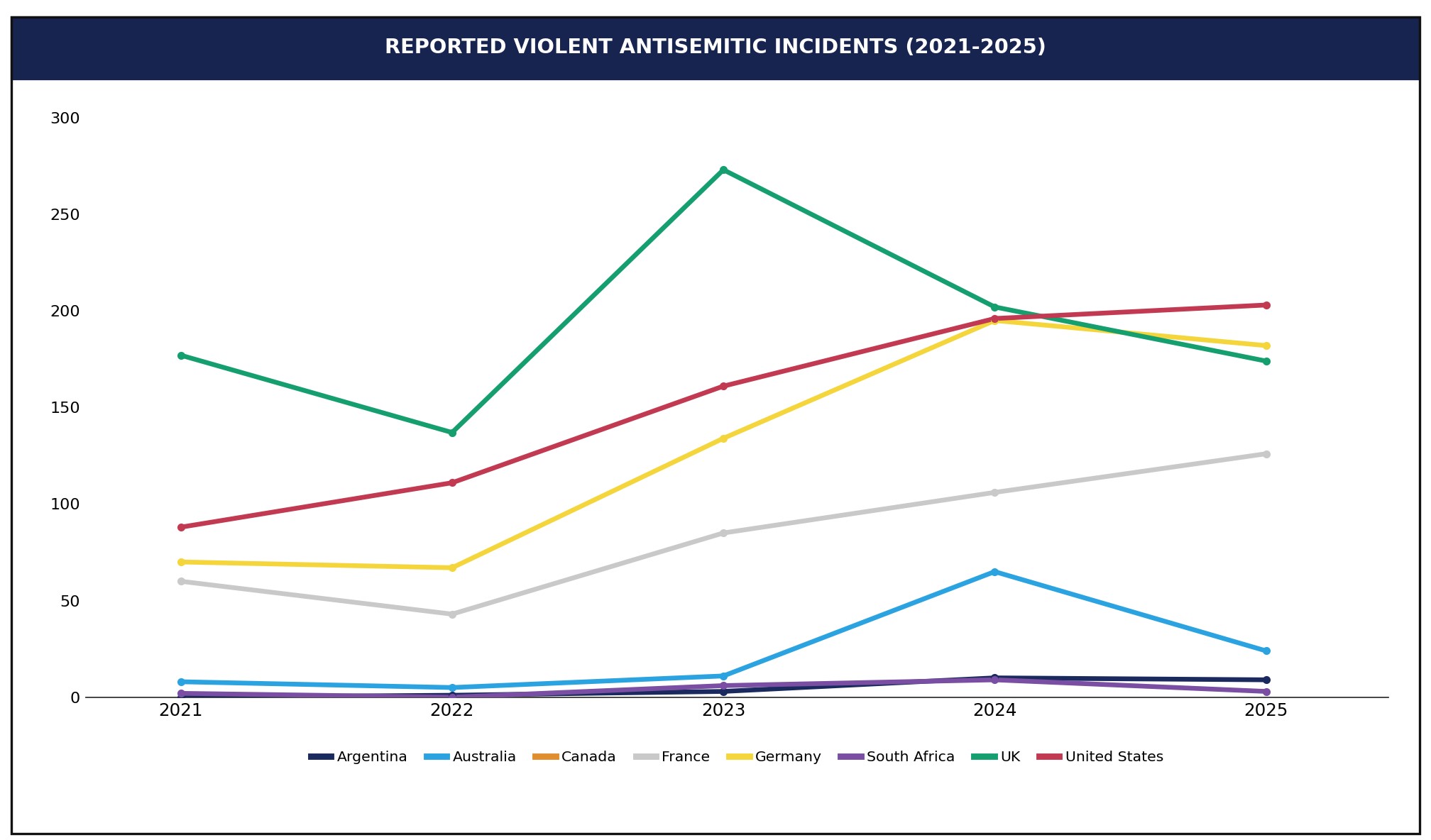
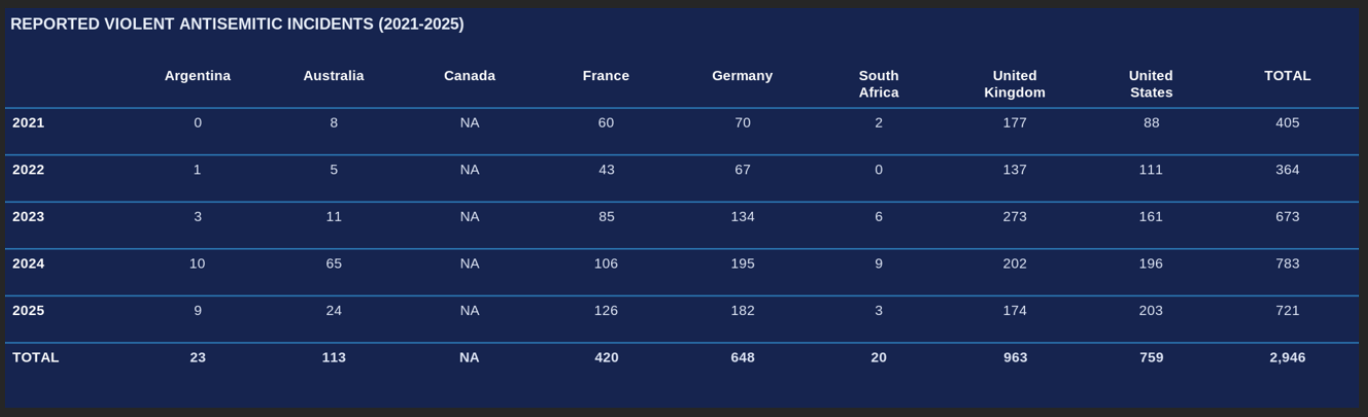
With all of this said, the real story of evolving antisemitism comes in a qualitative and not quantitative form. The J7 report highlights a number of convergent trends in 2025 that have affected all of them. These are normalisation of antisemitism in mainstream spaces; instrumentalisation of antizionism as a vehicle for antisemitic expression; campuses and educational institutions as acute flashpoints; the digital sphere becoming the primary arena of antisemitic expression; and growing Jewish concern for personal and communal safety.
We in South Africa have experienced normalisation of antisemitism in mainstream spaces in a less acute fashion. That said, the real impact on our community is what the SAJBD terms the “closure of spaces”, a subversive hostility toward Jews and Zionists that has led to a diminishment of Jewish participation in public spaces, such as at academic conferences or in professional organisations. Our efforts to counter this phenomenon have taken many forms, and we have countered every attempt at boycott, antagonism, or hostility towards our community in mainstream spaces.
We have also noticed a fundamental shift in the expression of hostility through the instrumentalisation of antizionism. In this respect we recently made a presentation to the South African Human Rights Commission (SAHRC) on antisemitism and the use of antizionism as a front to mask base Jew hatred. We were pleased to have been received so warmly by the commission, which even provided kosher food, and are certain our presentation will have an impact on its understanding of the issue going forward.
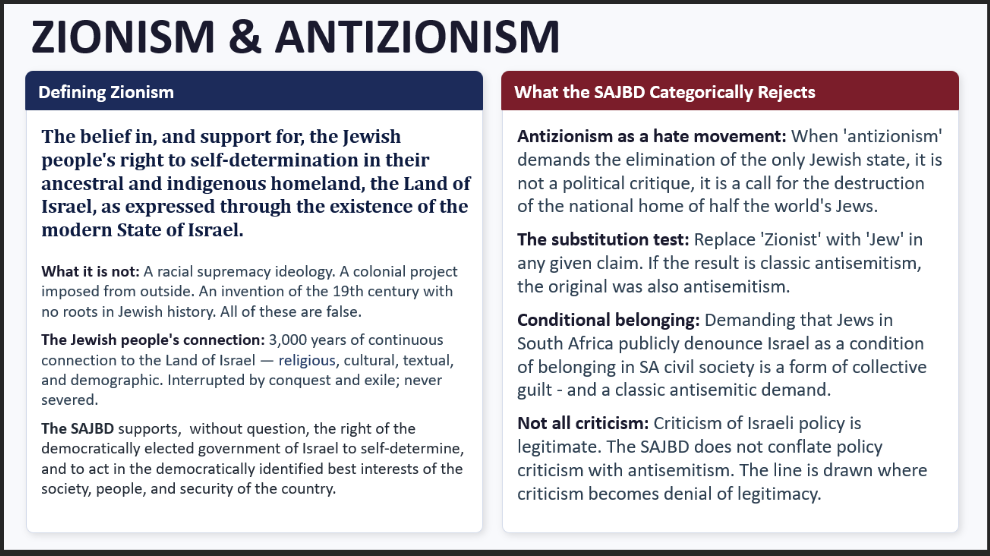
Slide from SAJBD Presentation to SAHRC
After years of committed work, South African campuses and educational institutions aren’t the flashpoints we witness overseas. In many cases, most notably at the University of Cape Town, the upper echelons of academia have attempted to introduce boycott resolutions and anti-Israel measures that may be seen as hostile. Nevertheless, the campuses are welcoming and safe environments for Jewish students, some of the most Jewish-friendly in the diaspora, and we are extremely proud of this fact.
Our community, in common with our overseas counterparts, has also witnessed a steep escalation in online hostility, which is often overtly antisemitic. We monitor this space closely, and over the past year have successfully taken a number of social media accounts to the SAHRC and courts on the grounds of hate speech.
Taken together we can see that, relative to our fellow communities, South Africa remains among the safest places to identify and practise as a Jew. This is in spite of a government that is openly hostile towards Israel and Zionists, and demonstrates the cleavages between official policy and ground-level attitudes.
That said, it has been shown that the government’s policy can serve as a legitimising permission structure for those who harbour antisemitic attitudes. This was most noticeable in the very public case of Roedean pupils’ refusal to play tennis against King David, citing that they were following the government’s policy.
Our low antisemitic statistics cannot be taken for granted and are a result of relentless and quiet work by our community organisations at multiple levels, to secure our community’s continued safety and viability. It falls on every one of us to continue to exercise this hard-won freedom, and to fight against the closure of spaces, antagonism, hostility, and blatant bigotry wherever it appears.
- Adam Charnas is a professional at the SAJBD, where he manages the antisemitism desk.