Israel News
Beit Shemesh blast hits too close to home

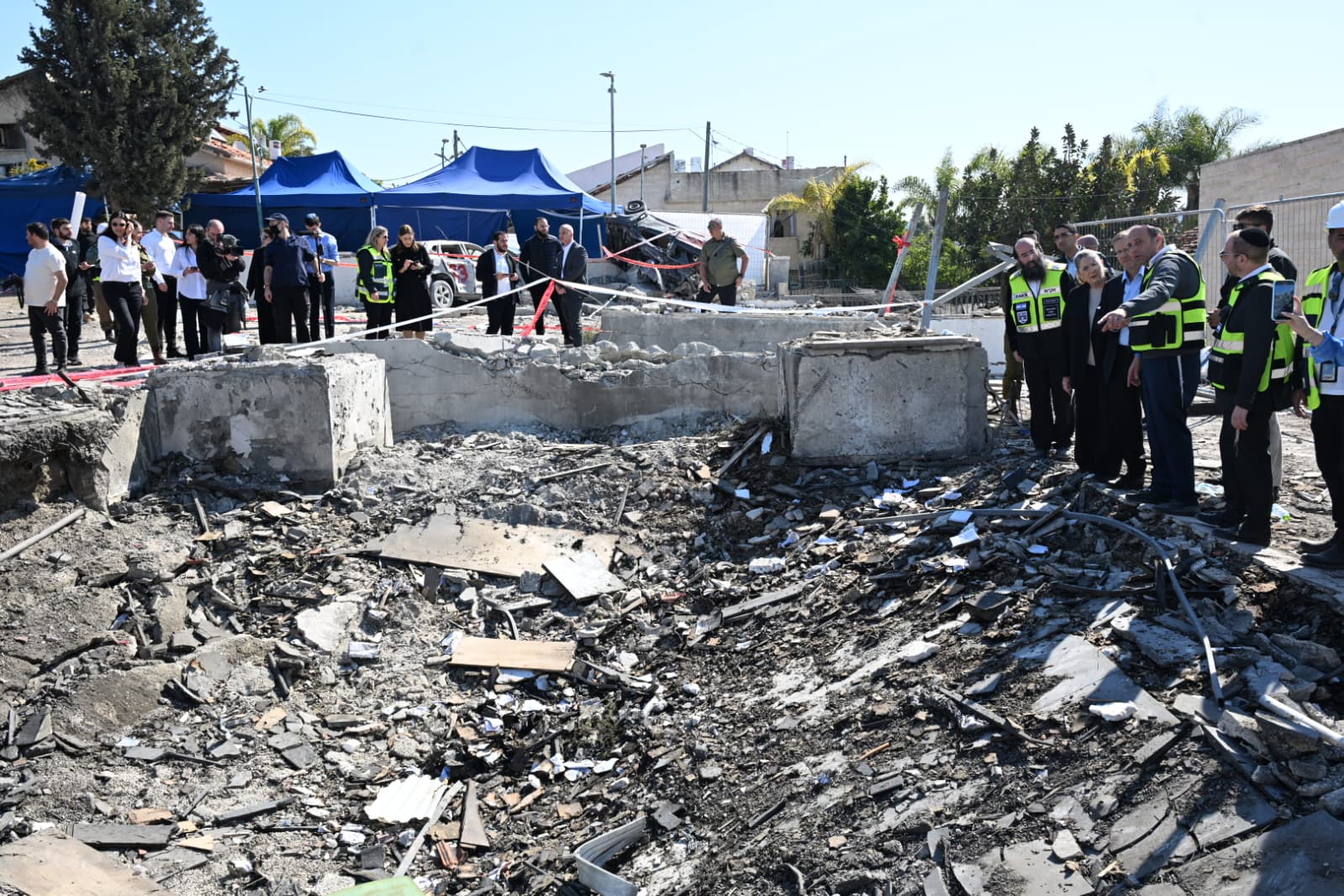
Three hundred South African families living in the city of Beit Shemesh narrowly escaped death and injury when a missile sent by the Islamic Republic of Iran struck a communal shelter on Sunday, killing nine people and injuring many more.
The name Beit Shemesh translates to “house of sun”, but this city near Jerusalem became a place of darkness in the war that broke out on 28 February, when Israel and the United States targeted Iran in pre-emptive strikes aimed at ending its regime once and for all.
South African expat Cliff Giesenow says “the force and speed of impact was indescribable” as the missile landed close to where he was sheltering on the roadside as sirens wailed. Never had he imagined this would be a scenario he would face so soon after making aliya from South Africa in December. Yet, he says, he is “grateful to have made aliya and to be here at this time, as intense as it is”.
Giesenow said he and his brother-in-law were on their way back to Beit Shemesh from Modi’in when the missile closed in. “We stopped on the side of the highway, close to where it hit, because sirens had gone off. We moved away from the car as protocol dictates, and heard a very loud and earth-shaking boom.”
Being in Israel right now, “I feel much more of a sense of a collective nationhood,” says Giesenow. “My heart breaks for those who were hurt, for the families whose worlds were turned upside down, and for both of our nations [Israel and Iran] and the wasteful loss of life.”
Giesenow chose Beit Shemesh as a “soft landing” and temporary home because his mother and sister live there, and he thought it would be a good central place to base himself. Except for when the missile hit, “I haven’t been scared [since the war started], trust the IDF [Israel Defense Forces], and I’m proud that the Lion of Zion is roaring.”
A longtime Beit Shemesh resident and South African oleh, David Fenster, says, “As the missile exploded, I saw a flash of light. But was it really from the missile? I think my brain went into overload and I imagined things in an intensified way. It was my instinct, finding a way of alerting me to move, fast. I heard the blast and felt the shockwaves. It was the first time I saw a child crying in the miklat [communal shelter] that I go to.
“I was scared, but that emotional energy then shifted to the broader picture – about what this meant for my neighbourhood,” says Fenster. “I’ve lived in Beit Shemesh for close to 35 years. We’ve remained in the older, smaller part, where everyone pretty much knows each other. So I thought I might know some of the victims. To quote Rav Doron Perez, father of fallen soldier Daniel Perez, ‘We are the smallest nation on earth. But we are the largest family on earth.’”
Fellow South African oleh and Beit Shemesh resident, Ariel Gluch, says this was brought home for him when he heard that one of the victims of the strike was the mother of a child in his daughter’s age group at elementary school. “It makes me realise how connected we all are.” He will now have to explain to his daughter that her friend’s mother is gone.
“It’s what it means to live here,” he reflects. “She is aware that this is part of the larger picture: that Israel is doing amazing things, and that we are shaping Jewish people’s future. This is not what we had 80 years ago. We are seeing miraculous success following the darkness of 7 October.”
Fenster emerged to see ambulances speeding past, sirens wailing. The missile landed about a 10-minute walk from where he lives.
Before 1 March, “hearing the booms was like a balloon burst next to you. You get a fright, but you know that there is nothing to be afraid of,” says Fenster. “But Sunday was different. As that boom resounded, I sensed ‘this is bad’.” It was at that moment that he “saw” a flash of light, his body instinctively knowing this was an emergency.
He had moved to Beit Shemesh when it was a small development town. “It has subsequently grown enormously, but a lot of that expansion is in the newer Ramat Beit Shemesh area,” he says. Living in the older part of town means one is more likely to head to a communal miklat than a private safe room.
“Practically, it’s far more difficult, and it’s really upsetting to see exhausted little children being brought down in their pyjamas at all hours of the night,” he says. “On the other hand, it’s nice to be together with your neighbours, giving each other support.”
Even South African olim living further away felt the effects of the blast. Colin Lotzof lives on Kibbutz Tzora, which sits in the valley below Beit Shemesh. It’s known as the “South African kibbutz” because it was partly founded by South African olim and has many South African residents.
“We felt the blast and heard the explosion, we were sure it was very close,” says Lotzof, who was in the mamad (safe room) at home when the missile hit Beit Shemesh. “Most people [on Tzora] go to the community bomb shelters. We are very organised on Tzora, and the shelters are way underground.”
His attitude remains calm and resolute. “What will it help to be nervous?” he asks. “As long as we stay disciplined and go into the shelters in time, we have every reason to stay safe.”
The chief executive of Telfed, Dorron Kline, lives about a kilometre from where the blast occurred. “We heard it and felt it,” he says. “Our whole building shook. It was a very loud boom.”
He says that Iran targeted the centre of Beit Shemesh, “which is only a civilian area”, while the Israeli Air Force is hitting military targets in Iran, not attacking civilians.
Telfed supports South African and Australian olim, and Kline says Telfed’s staff and volunteers contacted South African and Australian families in Beit Shemesh telephonically and by email to check on them after the blast.
“The South Africans mainly live in Ramat Beit Shemesh and in the newer Sheinfeld neighbourhood, so not in the older part of Beit Shemesh where the missile struck,” he says. However, the organisation reached out to them all.
“At times like this, phrases like ‘you are not alone’ or ‘we are here for you’ can sound hollow. Yet we say it because it’s true, and because it matters,” says Kline. “We direct olim to organisations that provide counselling, in English, for those who are experiencing trauma. Those who require any other kind of assistance, we direct to our social workers.”
He emphasises that “although the price that we in Israel are paying in this war is very high, it’s a price we’re paying so that future generations will be able to live in peace and tranquillity, in the State of Israel and the entire region”.