





OpEds
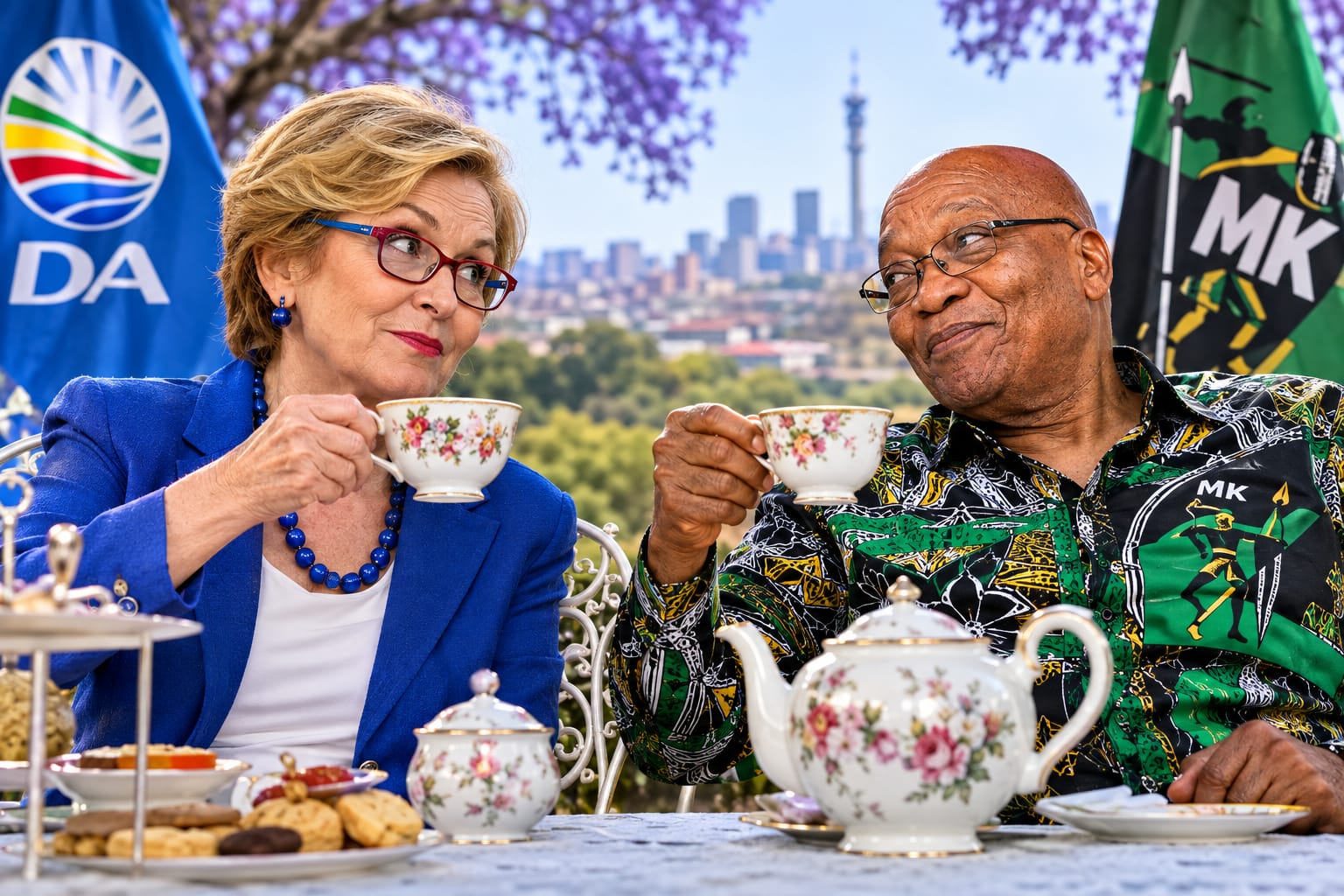
Time for Zille to sit down to tea with Zuma

After decades of one-party dominance, South Africa’s political map is rapidly being redrawn. But the latest poll numbers from the Social Research Foundation (SRF) should worry the Democratic Alliance almost as much as it they are publicly cheering it.
The SRF’s July polling puts the African National Congress at 34% nationally, down sharply from about 40% earlier this year. It’s been dragged down by the Phala Phala scandal, the daily revelations before the Madlanga Commission, and rising anger over illegal migration. The DA sits at 27%, steadily expanding its ground from the 21.81% it won in the 2024 national election.
Remarkably, Jacob Zuma’s uMkhonto weSizwe Party (MK), despite the instability within its ranks, is holding firm at 15%, while the Economic Freedom Fighters is down to 7%. That leaves a growing tail of smaller parties – the Inkatha Freedom Party (IFP), ActionSA, the Patriotic Alliance (PA), and Freedom Front Plus (FF Plus) among them.
The metros tell an even sharper story. In Johannesburg, the DA leads at 42% against an ANC crumbling to just 18%, but MK, at 13%, and ActionSA, at 10%, are both in the mix. In Tshwane, the DA is ahead at 43% to the ANC’s 32%. In Durban, MK now leads outright at 33%, with the DA at 23% and the ANC below 20%.
Read those numbers properly and the message isn’t “the DA is winning”. It is that South Africa is fragmenting. The ANC’s decline isn’t producing a new majority party. It is producing a scramble of smaller parties, none of which can govern alone.
That makes coalition-building the real contest of South African politics. And it is something local opposition politicians remain remarkably amateurish at.
Israel – and Prime Minister Benjamin Netanyahu in particular – really has something to teach them. Bibi is the grandmaster of coalition politics. For most of the past two decades, Likud has managed to retain power with only about a quarter of the seats in the Knesset. Netanyahu’s genius has not been winning outright majorities. It has been making sure that Likud is the indispensable anchor of a broader political bloc.
The strategic logic of building a broad centre-right bloc in South Africa is obvious. The obstacle isn’t ideology. It is personality. The DA’s Helen Zille, PA leader Gayton McKenzie, and ActionSA’s Herman Mashaba appear to dislike each other more than they distrust the ANC.
This plays into the ANC’s hands. We saw this clearly in the formation of the Government of National Unity. The ANC lost the election but won coalition negotiations by keeping the opposition divided and negotiating with them separately. That was when the opposition lost its leverage.
The simplest way to understand why is BATNA – the Best Alternative to a Negotiated Agreement – a central concept of Harvard’s legendary negotiation course. The party with the strongest credible alternative to a deal has the strongest hand at the table. While the ANC skilfully increased its possible paths to a majority, the DA ignored its former moonshot pact partners and put all its eggs in the ANC basket.
Mandy Wiener’s must-read book, The Deal, shows in remarkable detail, through extensive research and interviews, how that weakness played out through the negotiation process. There is a revealing anecdote about then DA leader John Steenhuisen arriving at the president’s residence with a bottle of red wine in a last-ditch effort to shift the tone and salvage the talks. Wiener’s broader account is of a DA that had been outmanoeuvred, with limited alternatives – and a terrible BATNA.
The municipal elections in November are about to recreate that same dynamic at metro level. If the SRF numbers hold, the DA could end up the largest party in Johannesburg and Tshwane without a majority to lead in either, while finding itself locked out of Durban altogether despite finishing second. However, a coalition with ActionSA, IFP, FF Plus, and the PA would probably give the DA a majority in most Gauteng metros, particularly Johannesburg and Tshwane.
But if Zille and Mashaba cannot get there, the DA needs to think harder about its alternatives, however uncomfortable they may be.
And this is where politics gets interesting.
An alliance with MK may actually be the most effective way for the DA to manufacture real leverage. Imagine a confidence-and-supply arrangement in which the DA supports a minority MK administration in Durban, while, in exchange, MK supports minority DA administrations in Johannesburg and Tshwane.
It would be startling.
It would also be politically toxic for many DA supporters. The MK represents much of what the DA has spent years campaigning against, and any such arrangement would carry enormous political risk.
But that is precisely the point of a BATNA. Your best alternative to a negotiated agreement doesn’t have to be your preferred outcome. It has to be a credible alternative to the deal on the table.
If an MK arrangement is genuinely available, suddenly the DA is no longer negotiating with the ANC from a position of necessity. It has another option. And that gives it leverage.
A disciplined minority government, propped up by a clear agreement, can be more stable than an unwieldy multi-party coalition that spends half its term threatening to collapse.
If Zille wants to be mayor of Johannesburg, it may require her to sit down to tea with Jacob Zuma. That can’t be more frightening than parasailing off a building.
It may sound like political heresy. But coalition politics, especially when you’ve alienated many of your natural partners, is not about talking to the people you like. The ANC understood that in 2024. The question is whether the DA will understand it before November.
If Zille can swallow her pride, sit down with Zuma, and build a credible alternative to the ANC, she may discover that the best way to get what she wants from the ANC is not with a bottle of wine but by proving she doesn’t need the party.
In coalition politics, the party with somewhere else to go is the party with the power.
Michael Kransdorff is an international tax specialist and Harvard Kennedy Schol graduate. He writes in his personal capacity.







CJB
August 14, 2026 at 12:05 am
When it comes to politics, Mr Kransdorff should stick to international tax.
Choosing Israel as a model is unfortunate. The totally unethical religious block and even more unethical Bibi, like Trump and JZ783, prioritizing staying out of jail before the interests of party or country, are exemplars of the opposite of what the DA has committed to: not going into a coalition with parties that don’t share its valued.
DA and MK could not be further apart on the Rule of Law or racism spectra nor on other deep-seated values that the Prog-DA membership have valued since 1959.
The DA is already in a coalition with the ANC at national level. Entering either a coalition or “confidence and supply” agreement with them in Gauteng’s metros is a Better Alternative to a Negotiated Agreement for the cities, would draw on the ANC’s institutional knowledge in each council and would hasten the split between the ANC moderates and its Lesufi/Mashatile faction, with consequences for the 2029 national and provincial elections.
Of course, while the DA has to play the cards it has been dealt not those it would like, as it did in 2024, the most favourable outcome is for the DA to get 50% + 1 of the council seats. That is why it is essential that every voter turns out on 4 November.
yitzchak
August 18, 2026 at 2:30 pm
Looks like the beautiful but hapless Helen of Troy(eville) has been captured by the Trojans.Poor old meenylouse has been given the Cock-a-snoot by the bully of Parys who ran off with our beautiful goddesszille. All the great warriors of Troy, Aghilies and patroclus will have their empty victory and no amount of surreptitious fighters carrying knobkerries in the Wooden Zebra will change the situation.
Agamemnon will be aghast on his return only to find his clytemnestra waiting to wipe him out. There will be no survivors in this battle as Odyseus wends his way back to ethekwini so neglected during his 20 year absence.The amakhosi of umkhalamba will have the last blow.(My knobkerrie is bigger than yours)
War has given way to romantic strife.Only the last tail wag of his dog Argus will greet all goodbye.
Meanwhile Iffigenia from Nkandla will be sacrificed to the gods of Gupta.
For the DA to consort with the MK devil can only bring a cyclops into being.The Xenophobia tells me all.
Likud is finished. The doubletalk,the corruption and the effacement of civil rights and reneging on agreements will end this Reign of Tyranny.(Good riddance)Remember Socrates was put to death for his silence.There isn’t enough hemlock for most of our politicians.
Gary Selikow
August 26, 2026 at 11:28 am
The growth of the MKP is refreshing to me. Especially since the DA stifle their own growth. If they had stuck with Maimane they would have won the 2024 elections. Duduzane Zuma who will take the helm of the MKP in time is well spoken and inteligent and would make an excellent president. Ths fear of the MKP by most White South Africans is misguided.