





Featured Item
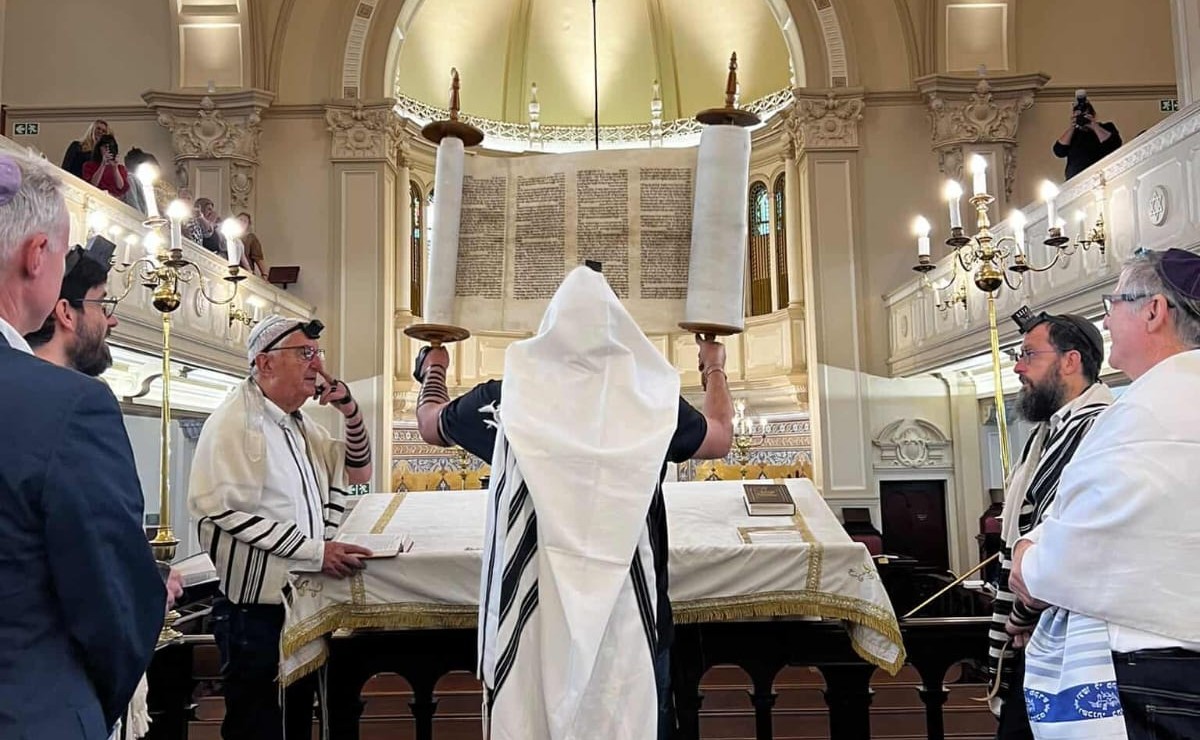
Globalise Hagbah a grassroots movement lifting Jewish pride

Being photographed doing something that is an honour gives the moment lifelong longevity. So, a new movement started at Marais Road Shul in Cape Town called Globalise Hagbah takes the honour of raising the Torah in shul to a new level.
Every Monday and Thursday morning, the Torah is lifted high in shul. This act of raising the Torah scroll after it has been read, known as hagbah, is one of the most visible and symbolic rituals in Jewish life. This ancient act has now taken on new life through the initiative born in the Marais Road morning minyan.
The initiative began informally. Two congregants, Hylton Arelisky and Morris Munitz, had for some time been taking photos of members during the ritual. One morning, another congregant, Rael Koping, was honoured with hagbah. Arelisky and Munitz photographed the moment, and sent it to him later that day.
Seeing himself holding the Torah, wrapped in his tallis and tefillin, surrounded by his community, stirred something profound in Koping. “It awakened a deep sense of connection with my Jewish heritage,” he says.
That reaction became the spark for what would become Globalise Hagbah. “We realised this simple moment captured something essential,” says Arelisky. “It showed Jewish identity in its purest form, a person physically connecting with Torah, visibly part of their community.”
The choice of hagbah as the centre of the initiative was deliberate. Though seemingly modest, the ritual carries immense symbolism. The Torah is physically lifted and displayed to the congregation; its scrolls open for all to see. The lifter embodies both strength and reverence, displaying the sacred text while standing before the community.
“It’s rich in the iconography of our identity,” says Munitz. “Wearing a tallis, holding up the Torah, surrounded by others, it gives one a feeling of deep connection with our Jewish heritage.” That imagery has become the heart of Globalise Hagbah. Each photograph captures a moment of engagement with faith and community. The pictures, taken respectfully and often anonymously, form a growing digital gallery of connection and pride.
As the movement gained momentum locally, the founders began to imagine a broader purpose. With antisemitism rising worldwide and many Jews feeling isolated or hesitant to express their identity publicly, Globalise Hagbah became more than a photographic project. It became a way to reclaim visibility and unity.
“In response to the growing isolation of diaspora Jewry and the rise in antisemitism, this project seeks to reconnect Jews worldwide with their roots through a symbolic and visually impactful act,” says Arelisky. “It transcends levels of religious observance.”
The project’s message is simple: wherever Jews gather, the Torah is lifted, and the community looks on. That act, repeated for generations, binds Jews across continents and traditions. Globalise Hagbah turns a shared ritual act into a visual movement, one that strengthens communal pride and reminds Jews everywhere that they are part of something enduring.
The initiative’s process is simple but meaningful. After a hagbah, the participant is photographed with the Torah. The photos are uploaded to a central collection and shared on a dedicated social media platform. To protect privacy, all images are anonymous, with no identifying details attached.
Social media management has been taken on by another member, Ariel Katzen. “Ariel has vast experience in this field,” says Munitz. “With his help, we hope to reach the broader Jewish community, locally and abroad.”
The online platform serves two purposes. It allows participants to see their contribution as part of a growing mosaic of global Jewish pride; and it creates a digital record of a unique moment in Jewish life. Each photograph becomes part of a collective story.
Looking ahead, the founders hope to expand participation far beyond Cape Town. “Our mission is to have every shul across the globe participate,” says Arelisky.
The goal isn’t only to create a vast archive of images, but to foster a sense of shared identity. “By doing so, we aim to build unity, pride, and connection across diverse Jewish communities,” says Munitz. “We would love to get Adam Sandler and Michael Rapaport to send us a picture of them doing hagbah. It would show that this really is a global Jewish moment.”
For Munitz, hagbah has taken on additional meaning in recent months. He is saying kaddish for his late mother, which has taken him to different shuls on Mondays and Thursdays. At each one, he encourages new participants to join in, inviting them to perform hagbah and become part of the growing project.
“It’s a beautiful way to honour her memory,” he says. “Each time I visit a different shul, I meet someone new, and they often say yes to doing hagbah. It connects people in the most natural, uplifting way.”
Already, interest has begun to spread. Congregations from other parts of South Africa have reached out to learn how to participate. Members abroad, too, have expressed enthusiasm about joining the project and sharing their own hagbah moments.
What makes Globalise Hagbah compelling is its blend of tradition and accessibility. Unlike many rituals that require specific learning or religious expertise, hagbah is a physical and communal act that speaks to anyone familiar with Jewish prayer. It requires presence, not scholarship.
For Munitz, who describes himself as more traditional than strictly observant, the experience resonated on a deeply personal level. Writing about it later, he described hagbah as “an ancient ritual that doesn’t require a knowledge of religious Hebrew to participate. It’s not a political statement or a strictly religious act. It’s easily accessible, yet profoundly connected to our thousands of years of heritage.”
That accessibility, he believes, makes it the perfect vehicle for reawakening connection among Jews who may feel distant from religious life. “It met my need to affirm and connect with my Jewish identity publicly and profoundly,” he wrote.
The founders also see Globalise Hagbah as a historical record. At a time when Jewish communities face increasing hostility, visibility and unity take on new importance.
The photographs aren’t simply personal mementoes, they are part of a collective archive documenting how Jews, in this moment in history, respond to challenges with affirmation rather than retreat. “Future generations will look back and see how our community met these times,” says Munitz. “This record is important for that reason.”
Although born in the Cape Town morning minyan, the idea behind Globalise Hagbah reaches far beyond one congregation. That message was underscored recently when Chief Rabbi Dr Warren Goldstein performed hagbah at Ohr Somayach as part of the initiative. His participation, say the founders, felt like a moment of validation for the project’s aim to unite Jews across South Africa and beyond through shared, visible pride in Torah.
