Featured Item
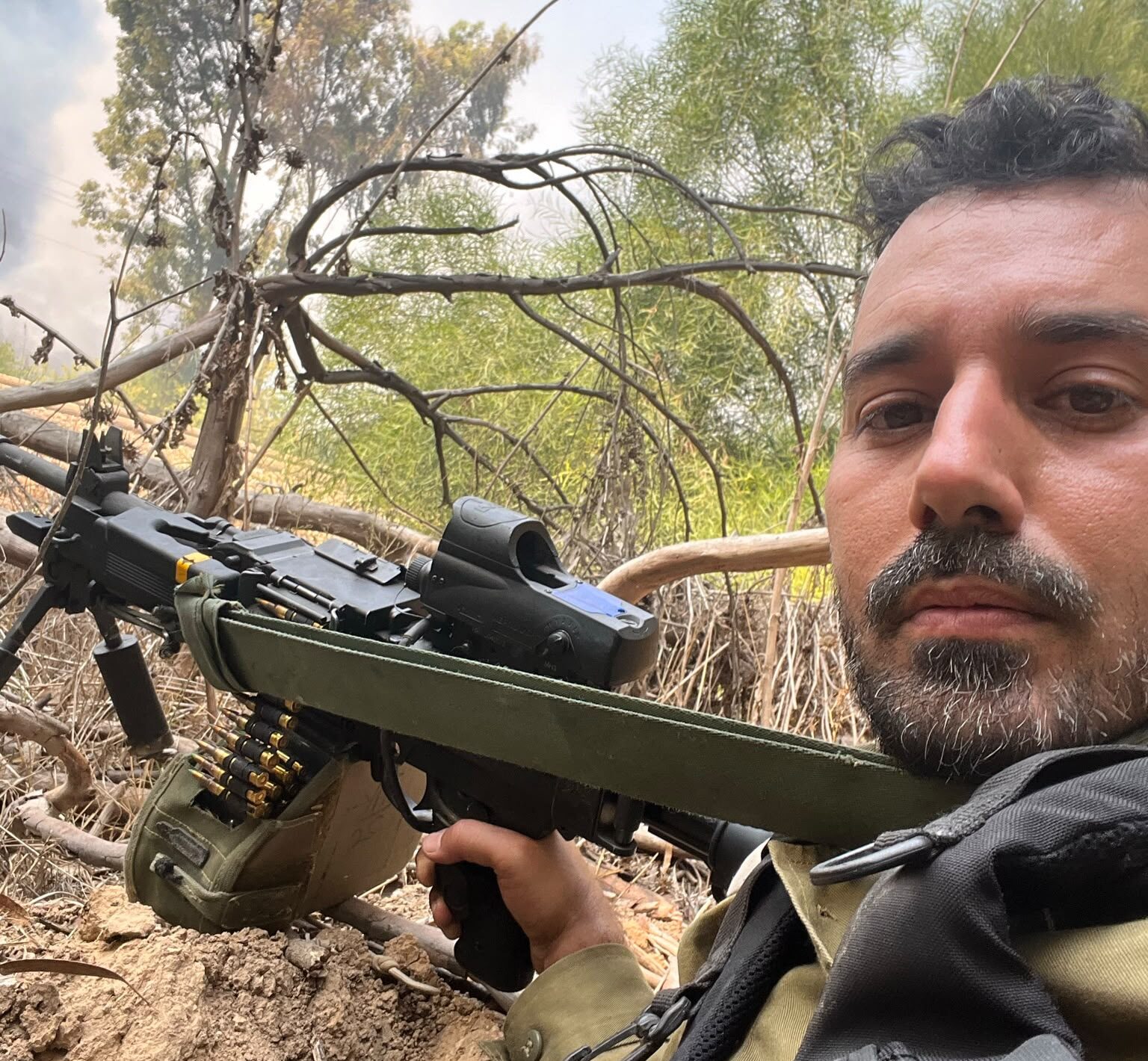
Machine gun in one hand, phone camera in the other

Israel Defense Forces reservist Major Nimrod Palmach defied orders from his commander on 7 October and drove south to save his ex-wife’s boyfriend and his children. “It could’ve been my own kids. It hit me hard,” Palmach explained when he was visiting South Africa recently and spoke at Rabbi Shmuel Moffson’s shul in Glenhazel.
“I knew that if I were in his shoes, I would want someone to act, to fight for my family,” Palmach said.
Palmach had been at home with his family when messages from his commander began appearing on his phone. “When my commander reaches out urgently, something’s wrong,” he recalled. He left without waking his family and in such a rush that he forgot to put on shoes.
He was initially instructed to report to Jerusalem, and while driving, began receiving videos and messages showing terrorists inside Israeli communities. “But it was the call from my ex-wife that changed everything.” Her boyfriend and his children were trapped in their safe room at Kibbutz Nir Oz after terrorists had entered their home.
Palmach called his commander and said he needed to go south, but was told to continue towards Jerusalem. “The system told me to wait, to sit quietly until the situation became clearer. But deep down, I knew I didn’t have that privilege,” he said. “I had this gut feeling telling me I should head south”.
As he drove down Highway 6, he contacted soldiers and others he knew, trying to gather people who could help. “If you have a gun, come here now; you’ll save lives. I said that to anyone who called or messaged.”
He was carrying his personal handgun and limited ammunition when, at about 10:00, he met Kiriel Shutko, another civilian with military experience who had headed south. By then, Palmach had begun to believe he wasn’t going to survive. “I never truly thought I’d make it through the day,” he recalled.
He stopped beneath a tree and recorded a short video for his children, Guni and Aluma. “I needed them to know how much I loved them, just in case. I thought that by the time they woke up, I’d be gone,” he said. “It was the hardest thing I’ve ever done.”
As Palmach and Shutko continued into the area under attack, he began recording on his phone what he was encountering. “I began filming, knowing that no one would believe the horror unfolding before my eyes,” he recalled.
They eventually reached Kibbutz Alumim, where hundreds of civilians were hiding as terrorists attempted to enter their establishment. “It was only when I got there that I realised how bad it was,” Palmach said.
He joined soldiers and others fighting at the kibbutz. “The team I fought with prevented 30 Hamas terrorists from entering Kibbutz Alumim,” he said. “They sought to replicate the massacre in Kibbutz Be’eri.”
When Palmach’s ammunition ran out, he grabbed the weapon of a soldier who’d been killed and continued fighting. During the battle, he was shot in the chest but didn’t realise the extent of the wound at the time. He later discovered that his sternum had been broken.
His phone remained with him as he moved through the area. “During the inferno, I asked myself who would believe me,” he said. “I realised that I had become an eyewitness to one of the worst atrocities perpetrated against humankind.”
Palmach later reached Kibbutz Be’eri, where more than 100 residents were murdered and others were abducted to Gaza. He continued recording. “Throughout the fighting on 7 October, I held with one hand a machine gun and with the other my iPhone, and I recorded; I documented what I saw,” he said. “Unfortunately, I saw everything.”
At one point in Be’eri, Palmach and those alongside him were pinned down during a hostage situation and couldn’t simply enter the building. It was during one of these pauses in the fighting that he began to process what he’d been seeing. “My emotions started to kick in, and I realised I wanted to share my story, but who would believe me?” he recalled.
He has spoken about seeing bodies on the roads and the destruction inside the communities, but also about the people he wasn’t able to reach. “The sights, the sounds, the stories of the survivors and the dead in Be’eri are etched into me to this day,” he wrote two years later. “The guilt over those I could not save will remain with me forever.”
Palmach fought for about 15 hours on 7 October. Fortunately, he survived the day and returned to his family.
He realised almost immediately that what he had experienced would affect him and contacted a psychologist the following morning.
Palmach’s work before 7 October had already centred on telling Israel’s story through personal encounters. He was chief executive of ISRAEL-is, a non-profit organisation that promotes Israel’s image abroad. After the attack, the question he’d asked himself while fighting, “Who would believe me?”, took on a new significance.
His testimony has since become part of Survived to Tell – Be the Witness, a virtual-reality project allowing audiences to hear survivors’ accounts while virtually experiencing the places in which they occurred.
For Palmach, documenting the attack began long before that project existed. It began while he was still fighting on 7 October. “I knew no one would believe what I had just witnessed,” he said.
Almost three years later, when he stood before a Johannesburg audience, it was this first-hand account he continued to share.
- Nimrod Palmach’s book out about his experience on 7 October, Rebel Heart, is available on Amazon.