SA
Ramaphosa demands Israeli ‘accountability’

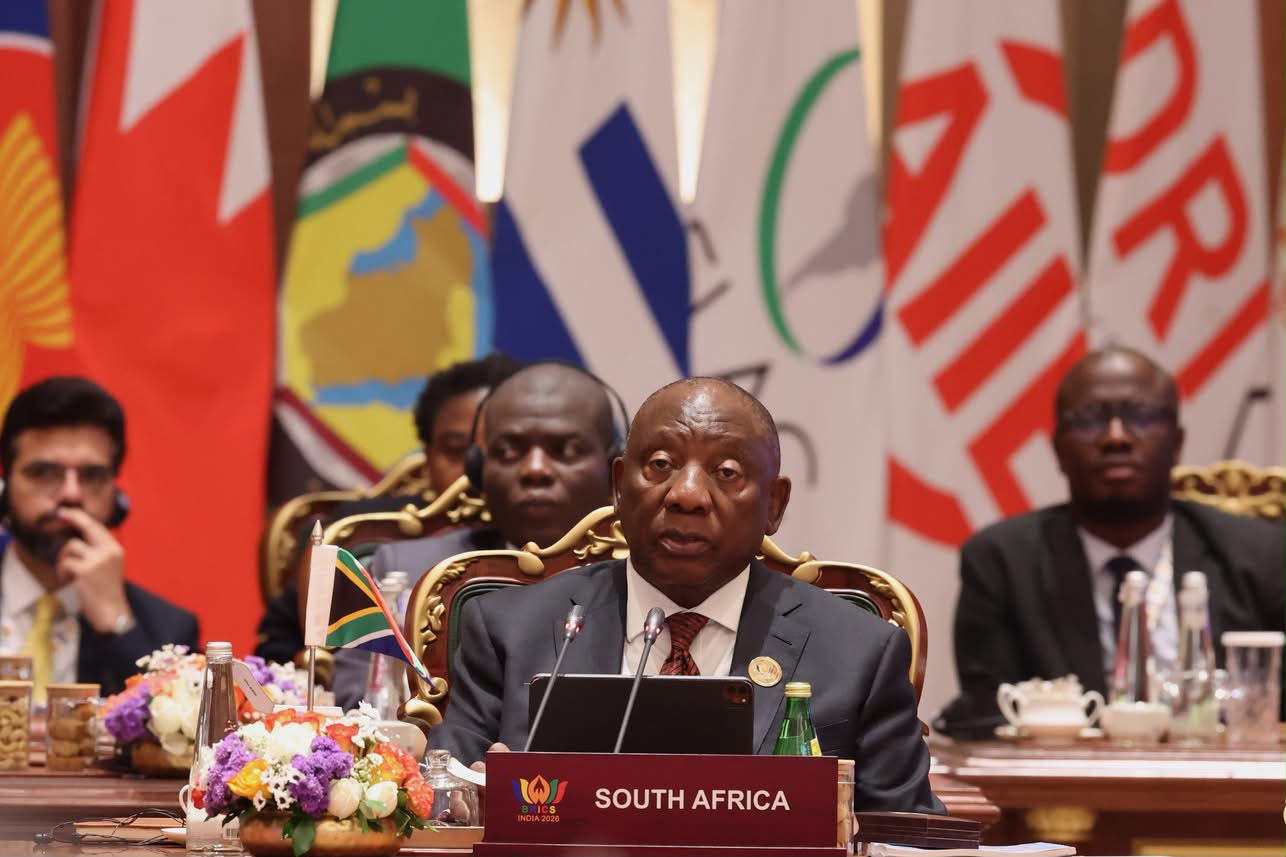
While Jews around the world were celebrating Rosh Hashanah last weekend, President Cyril Ramaphosa stood at the podium of a BRICS summit and said that “there must be accountability for the ongoing genocide against the Palestinians”.
Ramaphosa was delivering a speech at the 18th BRICS Leaders’ Summit in New Delhi, India on 12 September, in a session titled “Inclusive global governance and strengthening multilateralism”. He also said there must be accountability for “the crimes committed against the people of Sudan and for the illegal war against Iran”.
“We must exert pressure and expose violations whenever, and by whomever, they are committed,” said the president, who has rarely condemned Hamas violations of international law, or spoken up for Israel’s rights to safety and security. “International law cannot be applied selectively: the same principles must apply to all states and the same protections must apply to all peoples”.
It was for this reason that South Africa and other BRICS member states had turned to bodies like the International Court of Justice (ICJ) and the International Criminal Court (ICC) “to seek justice for the people of Palestine”, Ramaphosa explained.
The South African Zionist Federation national spokesperson, Rolene Marks, notes that at the same summit, Ramaphosa sat down with the president of Iran, “the regime that funds, arms, and trains the Hamas terror group that murdered 1 200 people in southern Israel on 7 October 2023 and dragged hostages into Gaza”. Iranian President Masoud Pezeshkian even invited him to Tehran.
“Ramaphosa then used the same summit to declare that international law cannot be applied selectively,” she says.
He said this in a room with Russian President Vladimir Putin, “who is wanted by the ICC for deporting Ukrainian children. South Africa is a state party to the Rome Statute. Ramaphosa also sought Putin out.”
Marks says Ramaphosa used the occasion “primarily to attack Israel, repeating the charge of ‘genocide’ as though a court had established it. None has, and South Africa knows exactly what its own application did and did not achieve.”
She points out that while Ramaphosa says international law cannot be applied selectively, South Africa has not taken Ukraine, Darfur, or Iran to the ICJ or ICC. “This is not principle but political alignment, dressed in the language of international law.”
Ramaphosa is correct that international law must be applied fairly and consistently, but “he might begin with the men whose hand he shook in Delhi”, says Marks.
In a statement called the BRICS New Delhi Declaration, released at the summit, the bloc of countries expressed concern “regarding arrangements that may prejudice the inalienable rights of the Palestinian people and legitimise or prolong occupation”.
The declaration condemned violations of international law, including “the use of starvation as a method of warfare, attacks targeting civilians and civilian objects – including healthcare facilities and other civilian infrastructure – as well as the unlawful obstruction of humanitarian access”.
BRICS reasserted its “steadfast” support for the UN Relief and Works Agency for Palestine Refugees in the Near East, better known as UNRWA.
The declaration rejected “any unilateral measures that seek to alter the legal and historical status of occupied Jerusalem” and welcomed the ceasefire in Lebanon. But it called on Israel to respect the terms agreed with the Lebanese government and to withdraw its “occupying forces” from all Lebanese territories in which it remains.
It expressed “serious concern over deliberate attacks on civilian infrastructure and peaceful nuclear facilities” and on the “continued violence in Gaza despite the ceasefire agreement of October 2025”.
The declaration said that “a just and lasting solution to the Israeli-Palestinian conflict depends on the fulfilment of the legitimate rights of the Palestinian people, including the rights to self-determination and return”, but also said it supports a two-state solution.
Local political analyst Daniel Silke says he doesn’t think Ramaphosa’s comments will have any impact on US-South Africa relations.
“South Africa is clearly adopting a two-tier strategy now, by maintaining its harsh criticism of Israel, but also attempting to find common ground with the US administration over trade, with the use, of course, of [ambassador] Roelf Meyer and other trade envoys,” says Silke
He says this “dual strategy” enables South Africa to continue its “vociferous rhetoric on Israel”.
He thinks Ramaphosa’s extreme position on the Middle East aligns with the broader African National Congress’s (ANC) position, and with that of many BRICS members. “It’s in line with the views of probably a large majority of United Nations members, and it also maintains the continuity of how the ANC sees its leadership position on the critique of Israel, emanating from the ICJ case.”
South Africa has “bought fully into the Palestinian view of the crisis” and “continues to avoid providing equal weight to the insecurities that Israel faces”. This is seen in Ramaphosa’s speech and the BRICS declaration, says Silke.
But much of what we’re seeing now is also about domestic politics, he says. “It’s local government election time and the ANC will be looking to find a point of differentiation between itself and perhaps the Democratic Alliance, and it cannot find that on service delivery, because the ANC’s service delivery has been so shocking.”
But the ANC can use the Middle East to try to regain support. “What it loses in terms of its domestic performance, it will attempt to make up in its foreign policy strategy, and it’s not going to let up on this issue,” says Silke.
Middle East expert Professor Glen Segell says Ramaphosa is “pandering to global opinion by justifiably stating that international law can’t be selectively applied, and calling for accountability for atrocities. He would have been applauded by America and Israel had he not chosen them selectively and incorrectly as examples of violators in Gaza and Iran.”
Segell says that at face value, Ramaphosa’s foreign policy gamble has failed.
“Foreign policy should serve the country, not overshadow the urgent challenges that define everyday life for its population. The prestige and symbolic influence generated by his foreign policy has not translated domestically into jobs, wage increases, or reduced poverty – or even resolved terrorist attacks by Hamas, attained Palestinian statehood, or stopped Iranian attacks on Gulf states.”
The director of the Middle East Africa Research Institute, Benji Shulman, says, “This is a useful distraction for Ramaphosa – he is talking at BRICS about international affairs while the ANC can’t even register election candidates back home.”
BRICS is also a place where South Africa “can legitimately interact with Iran without incurring too much wrath from the Americans or anybody else, so it gives them a free hand to network and to drive their policy agendas, which are anti-Israel measures and an anti-Western agenda under the guise of economic diplomacy”, says Shulman.
Journalist William Saunderson-Meyer, who has criticised South Africa’s stance on the Middle East and its alignment with anti-Western countries, says that the 11 BRICS member countries account for 49.5% of the world population, 40% of gross domestic product, and 26% of global trade, “to which one might add, and [they account for] only 1% of the world’s common sense”.
Statements like Ramaphosa’s speech and the BRICS declaration, “which are so obviously one-sided, are political theatre with no real immediate consequence, except for one thing”, says Saunderson-Meyer. “They help to raise the background level of anti-Israel hysteria at a critical time.”
Post-7 October, “Israel is facing an onslaught that has very successfully been internationalised”, he says. “One day sanity will return, but the challenge for Israel and those who care about her fate, will be to ride out the interregnum.”