


OpEds
Shifting the Israeli-Palestinian reality olive by olive

Olive growing is an ancient agricultural activity, going back thousands of years, that is common to many peoples across the Middle East. In the autumn, the trees sprout olives, which await curing for eating or crushing into olive oil. Lamentably, in the West Bank, Palestinian farmers living under Israeli occupation are facing increasingly violent attacks by emboldened extremist Jewish settlers, whose goal is to intimidate them, prevent them harvesting their olives, and, ultimately, drive them from their land.
Last week, I joined a group of Israeli and international volunteers whose goal was to deter such attacks through our physical presence during the harvest. “Protective presence” is an approach adopted in the strongest traditions of non-violent activism, and while many extremist settlers have no compunction in attacking Palestinians, fewer have been willing to do so when they risk hurting Israelis or foreigners. Such presence also helps document human rights violations and, more positively, demonstrates an active commitment to upholding the rights of these Palestinian families to their property, to harvest the olives from their land, and to earn a livelihood.
I felt a strong imperative to join in this important activity. Apart from being a proactive and constructive way to defend the fundamental rights of these families, it felt particularly important to stand up for the rule of law (both international and Israeli) and the most basic of universal and Jewish precepts – do not steal, do not assault.
It has of late become increasingly risky to join such groups of volunteers given the rise in the number of extremist settlers and the failure by the Israeli military to stop such attacks and prosecute the perpetrators. It was thus with some trepidation that I joined about 60 volunteers early in the morning, converging from Jerusalem and Tel Aviv on a beautiful valley south of Bethlehem at the invitation of a group of Palestinian families. The delegation I joined was led by Rabbis for Human Rights, an organisation of rabbis across denominations who seek to uphold the imperatives of Jewish tradition through defending human rights in Israel and the Occupied Palestinian Territories.
Upon arrival, we were shown several small outposts on surrounding hills where a few settlers had set up homes illegally. The Palestinian families told us that they were terrified to harvest their olives as a result of violence that could be unleashed on them at any moment and that our presence had made the harvest possible.
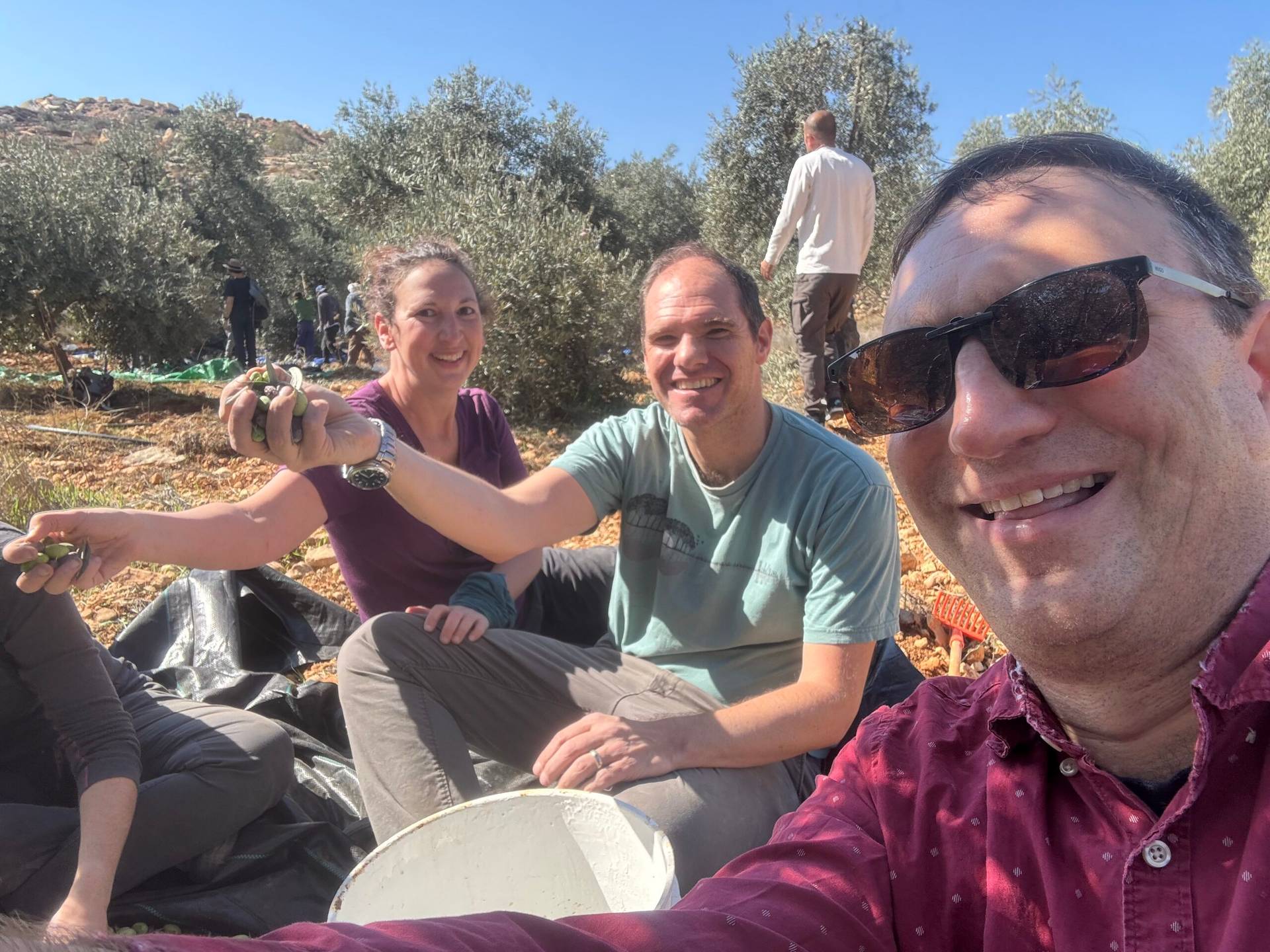
We went to work almost immediately. As a university professor, it is not exactly part of my skill set to harvest olives. Nevertheless, I soon learned to pick and then rake them. We also separated the olives according to the informal demarcations among the families as to who owns which trees.
There was a great sense of camaraderie among the mostly diaspora Jewish and Israeli volunteers. While there were some respectful disagreements, what united us was a conviction that the fear and violence Palestinian farmers were being subjected to was wrong, and that Israel, as the occupying power, has both a moral and legal obligation to stop it. In the absence of a commitment to do so, we needed to do something about it – even if that meant putting ourselves in harm’s way.
The picked olives were collated on a large piece of tarpaulin, and then scooped into buckets. Upon finishing, it was very satisfying to see that we had harvested tens of buckets of olives. After a moving farewell from the families, many of us breathed a sigh of relief that there had not been any violence.
Unfortunately, the following day, in Qusra, near Nablus, the harvest site was attacked by extremist settlers. Volunteers I had worked with the previous day told me that they had, similarly, been peacefully harvesting olives when a group of masked men had suddenly descended from a hilltop and started beating people in the fields with clubs. There is a video of one of these masked men beating and another kicking an elderly women. What kind of madness makes someone do such a thing?
Six people were injured that day. The elderly woman landed up in hospital with a head injury and bruised eye. The Israeli military and police were present – soldiers fired canisters of teargas at the settlers, which were ineffective in a vast open area and the attackers quickly regrouped. There appeared to be no effort, however, to arrest the attackers despite their being guilty of serious assault as well as theft of some olives.
This incident highlighted the current state of impunity for these extremist settlers. The outgoing far-right government, with extremist settlers among its senior ministers, has effectively enabled a major increase in illegal hilltop settlement activities and allowed the violence to continue.
One of the first actions of a new Israeli government must thus be to end settler violence. That is a necessary step to envisage an alternative future for these troubled lands in which both peoples finally break the cycle of violence and agree to live side by side in peace. Currently, that looks utopian, yet bringing it about also requires small acts by individuals that build trust, partnership, and collaboration. Perhaps, a glimmer of a different reality can be gleaned through Jews and Palestinians standing together and harvesting that emblematic and tangy fruit of the land, olive by olive.
- David Bilchitz is a professor of Fundamental Rights and Constitutional Law in the Faculty of Law at the University of Johannesburg and University of Reading. He writes in his personal capacity.