





Israel
SA Christians challenge government over Israel

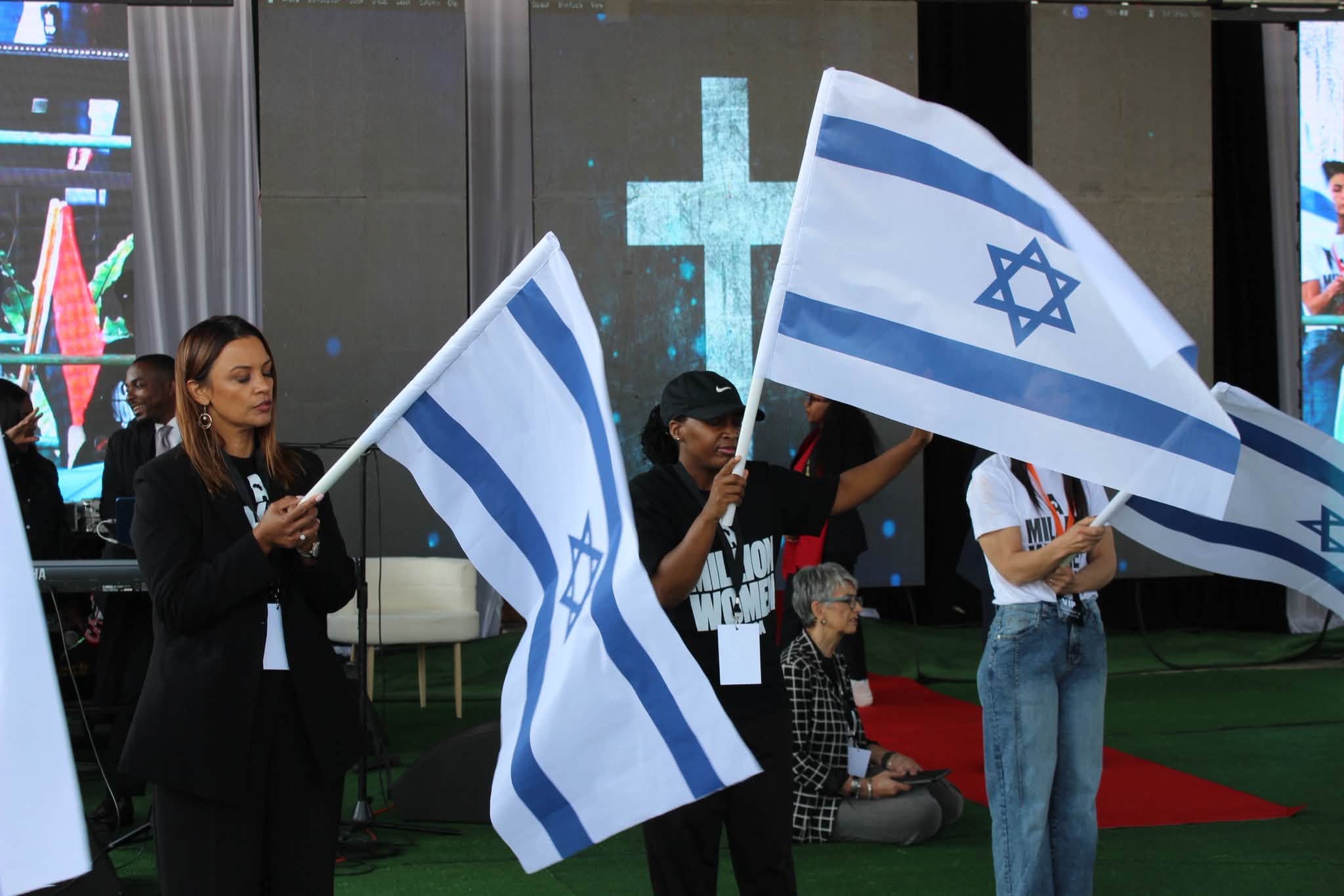
Thousands of Christians, gathered for the A Million Women National Solemn Assembly, have challenged the government’s position on Israel, making it clear that the country’s foreign policy does not represent all South Africans.
More than 5 500 Christians gathered at Beula Park conference centre in Johannesburg on 19 September to pray for Israel and the Jewish people.
The turnout demonstrated the growing Christian constituency that supports Israel despite the South African government’s strained relationship with the country, according to the South African Friends of Israel (SAFI).
Its national spokesperson, Bafana Modise, told the SA Jewish Report that the gathering highlighted a “serious disconnect” between South Africa’s political leadership and a silent majority. “This turnout demonstrates that sometimes the policy of a country doesn’t reflect the people of the country,” he said.
The assembly called Christians to fast, pray, and intercede for South Africa. It was open to women, men, families, churches, and believers across denominations. It was described as a call to unite in prayer during a time of national urgency.
Israel’s newly appointed Deputy Head of Mission, Hen Feder, was present at the gathering. For him, it was an opportunity to strengthen connections between Israel and South African Christians.
“The main importance is the connection,” he said. “Building the connection, or strengthening the connection more precisely, in the Christian community here in South Africa and in other countries.”
Feder said the gathering included international participants and reflected historical connections and shared values between Christians, Jews, and Israel. “There is obviously a very strong historical connection and shared values and beliefs between the two communities.”
He said the Israeli embassy wanted to strengthen people-to-people relationships. “It’s no secret that there are many differences between the Israeli government and South African government,” Feder said. “But at the same time, there are still many people here in South Africa who support Israel.”
The embassy wanted to build relationships not only with Christian communities, but with traditional leaders and other groups interested in maintaining positive relations with Israel. The gathering provided one example of how that engagement could take place, he said.
“In practice, what happened in that A Million Women event is a good example where we come to show support to people who support us,” Feder said. Future engagement could include shared events, projects, and meetings.
For Modise, however, the significance of the gathering went beyond religious solidarity. He argued that South Africa’s foreign policy on Israel was driven by political ideology rather than the interests of ordinary South Africans.
“I would love to see South Africa play more of a mediation role between the two people [Israelis and Palestinians],” Modise said. “It would be better for them to play a Mandela role, a reconciliation role. That’s what we are known for. We are known to be a country that was built on reconciliation, people coming together, looking beyond their differences.”
Feder said the embassy wasn’t seeking to dictate South African foreign policy, but wanted to find areas where it could engage constructively. “At the end of the day, the South African government is well aware of the differences in points of view regarding the geopolitical situation.”
He pointed specifically to South Africa’s support for Iran and the International Court of Justice (ICJ) case as issues that were “very problematic” for Israel.
“The decision to take Israel to the ICJ is something that has a huge impact on the way that Israel sees South Africa today,” Feder said. “Not only the government, but any Israeli you speak with will tell you that this is a major stain on the relationship.”
Despite those tensions, Feder said there were opportunities for cooperation in areas such as water, agriculture, and healthcare. However, the extent of that cooperation depended on the environment created by the South African government.
Modise also highlighted Israel’s potential contribution in areas including innovation, technology, and water solutions.
SAFI has sought to distinguish support for Israel from hostility towards Palestinians.
Modise said the organisation supported Israelis and Palestinians living alongside one another. “We see it from a point of cooperation, good neighbourliness, through that two-state solution, if that is the route that leaders of both countries will agree to,” he said. “But the idea is basically to see two people living side by side, far away from bloodshed, far away from indoctrination, and pursuing and safeguarding the future for their children’s children.”
Modise said one of the most significant moments of the event for him was when Pearl Kupe, a minister, lawyer, and Kingdom activist expressed solidarity with Israel by quoting from the Book of Ruth. “Your people will be our people and Your G-d will be our G-d,” Kupe said.
Modise said the words were particularly meaningful to him following the 7 October Hamas attacks and the subsequent war. “It warmed my heart to hear non-Jewish Christian voices declaring that.”
Feder said the event was personally significant because it was his first large Christian gathering since beginning his current role at the Israeli embassy. “I didn’t know what to expect and it exceeded my expectations,” he said. “It really moved me on a personal level.”
For SAFI, the gathering represents a broader call for Christians to become more publicly engaged with South Africa’s debate over Israel.
He also linked the issue to the country’s changing political landscape. “South Africa’s rules are changing, elections are coming up,” he said. “There is a certain wave of change that is coming to our nation. I’m hoping that with that wave of change will also be a new direction, a new better appreciation of Israel.” He hoped South Africa would develop stronger leadership focused on the country’s interests while working with Israel in areas that could benefit both countries.
The A Million Women movement’s stated purpose extends beyond Israel, with its organisers describing the assembly as a national call to prayer, fasting, worship, repentance, and intercession for South Africa. But the participation of SAFI and the Israeli embassy placed Israel firmly within the gathering’s public message.
For SAFI, the turnout was evidence that the government’s position doesn’t encompass the views of all South Africans. For Israel’s diplomatic mission, it demonstrated that people-to-people ties remain possible despite the deep political differences between the two governments. The question now is whether those relationships can translate into broader engagement between South Africans and Israelis while diplomatic tensions remain.






MR SIPHO P MALINGA
October 1, 2026 at 7:58 pm
Thanks a lot for the gathering that support Israel that is our wish to build a good relationship with nation of God Jehova the nation of Israel keep it So that Israel will understand That not supporting our government for being against Israel
Mark Alcock
October 2, 2026 at 1:49 pm
Nobody ever thought to ask , how would SA react after a terrorist attack in SA similar to th attack on the Kibbutz party on 7 October , 3 years ago, which was not only an attack on Israel and the nation of Israel but also irreverent and evil intent to kill on the high holy holidays of both Shabbat and Yom Tov , too?
John Langeveldt
October 2, 2026 at 2:53 pm
I am a Christian.I was born and bred in South Africa.I do not support the current policies of Israel and the people can’t claim they are speaking for all South African Christians. They must also explain why the Palestinians can’t enjoy the freedoms they are enjoying in South Africs
Pauline Holland
October 2, 2026 at 9:57 pm
Wonderful. The SA government were too quick to go to ICJ and the number of people that went must have cost us SA’S a great deal. The money should have been spent on the people,, water supply etc
Annie de Young
October 3, 2026 at 11:51 am
I am a Christian, born and raised in Cape Town, and I lived in Israel in 1996-1997.
I am encouraged by the strong and visible support of my fellow Christians for the Jewish State of Israel. I pray that this will become normalized again in our beautiful country. We continually pray for the Peace of Yerushalaim 🇿🇦❤️🇮🇱🤍✝️
Paul Kennedy
October 3, 2026 at 12:56 pm
The current government has popular support, so the research suggests, of less than 20%, so their utterances must be taken with a pinch of salt. Their views often do not share the support of the majority of the population especially given that over 66% of the population in the 2010 census ( the most reliable one as the kast one was a disaster – our family aasn’t even counted) expressed some fotm of Christian belief. Thus the verbal and ICC court case are not supported by the majority of South Africans.
mohammed Whasseef khan
October 3, 2026 at 5:16 pm
. Judaism does not accept Jesus as Messiah
Mainstream Jewish theology holds that Jesus was not the Jewish Messiah (Moshiach). Judaism expects the Messiah to accomplish things such as the redemption of Israel, establishment of an era of peace and justice, and—within traditional formulations—restoration of the Temple and resurrection of the dead. Since these things did not occur in Jesus’ lifetime, Judaism does not regard him as the Messiah. �
My Jewish Learning +1
This is probably the single biggest theological divide.
2. Judaism does not regard Jesus as God or God’s son
Judaism’s conception of God is strictly monotheistic. Therefore, the Christian claims that Jesus is divine, the Son of God in a unique divine sense, or part of the Trinity are rejected.
A contemporary Jewish explanation puts it plainly: Judaism does not consider Jesus a prophet, Messiah, or Son of God. �
My Jewish Learning
So from the Jewish theological perspective:
Jesus ≠ God
Jesus ≠ divine Son
Jesus ≠ Messiah
Jesus ≠ prophet
3. But Judaism generally recognizes that Jesus was Jewish
This is an important point that sometimes gets lost.
Jesus lived as a Jew in first-century Judea/Galilee. He participated in Jewish religious life and debated Jewish religious questions. Christianity as a separate religion did not yet exist during his lifetime. Jewish scholarship today commonly describes him as a Jewish teacher/preacher within the Jewish world of his time. �
My Jewish Learning
So Judaism isn’t saying:
“Jesus was an outsider who appeared from nowhere.”
Rather, the historical picture is closer to:
A Jewish man whose followers eventually developed a movement that became Christianity, while mainstream Judaism rejected his messianic claims.
4. What about the Talmud?
This is where things become much more interesting.
There are several passages in rabbinic literature referring to someone called Yeshu. Some Jewish authorities identify at least some of these references with Jesus of Nazareth, although the identification and historical details are debated. �
My Jewish Learning +1
The famous passage is Babylonian Talmud, Sanhedrin 43a.
It describes Yeshu as being executed around Passover and associates him with sorcery and leading Israel astray. The passage says he was “hung”—which in rabbinic terminology can refer to execution by crucifixion. �
My Jewish Learning
But there is a major historical caveat:
The Talmud was compiled centuries after Jesus’ lifetime, and some passages concerning Jesus were altered or censored in medieval manuscripts. Consequently, historians don’t simply treat every Talmudic statement about Yeshu as an eyewitness historical account. �
My Jewish Learning +1
5. Maimonides has a particularly interesting view
The medieval Jewish philosopher Moses Maimonides (Rambam) regarded Jesus as a failed messianic claimant.
But—and this is fascinating—Maimonides also argued that Christianity’s worldwide spread ultimately served a role in preparing humanity for a future recognition of God and the Messiah. His position is therefore considerably more sophisticated than simply “Jesus was evil.”
A Jewish summary of Maimonides explains that he regarded Jesus as a failed Messiah who changed Torah observance and led people toward what Maimonides regarded as incorrect theology. �
My Jewish Learning
6. There is also a medieval Jewish tradition called Toledot Yeshu
This is a collection of Jewish polemical stories about Jesus that developed in the medieval period.
Some versions portray Jesus extremely negatively, including accusations concerning illegitimate birth, magic and deception.
But Toledot Yeshu is not part of the Jewish Bible or authoritative Jewish theology. It is a later polemical tradition and shouldn’t be presented as “what Judaism officially teaches about Jesus.”