





OpEds
Israel-Somaliland – part of a geopolitical chess game

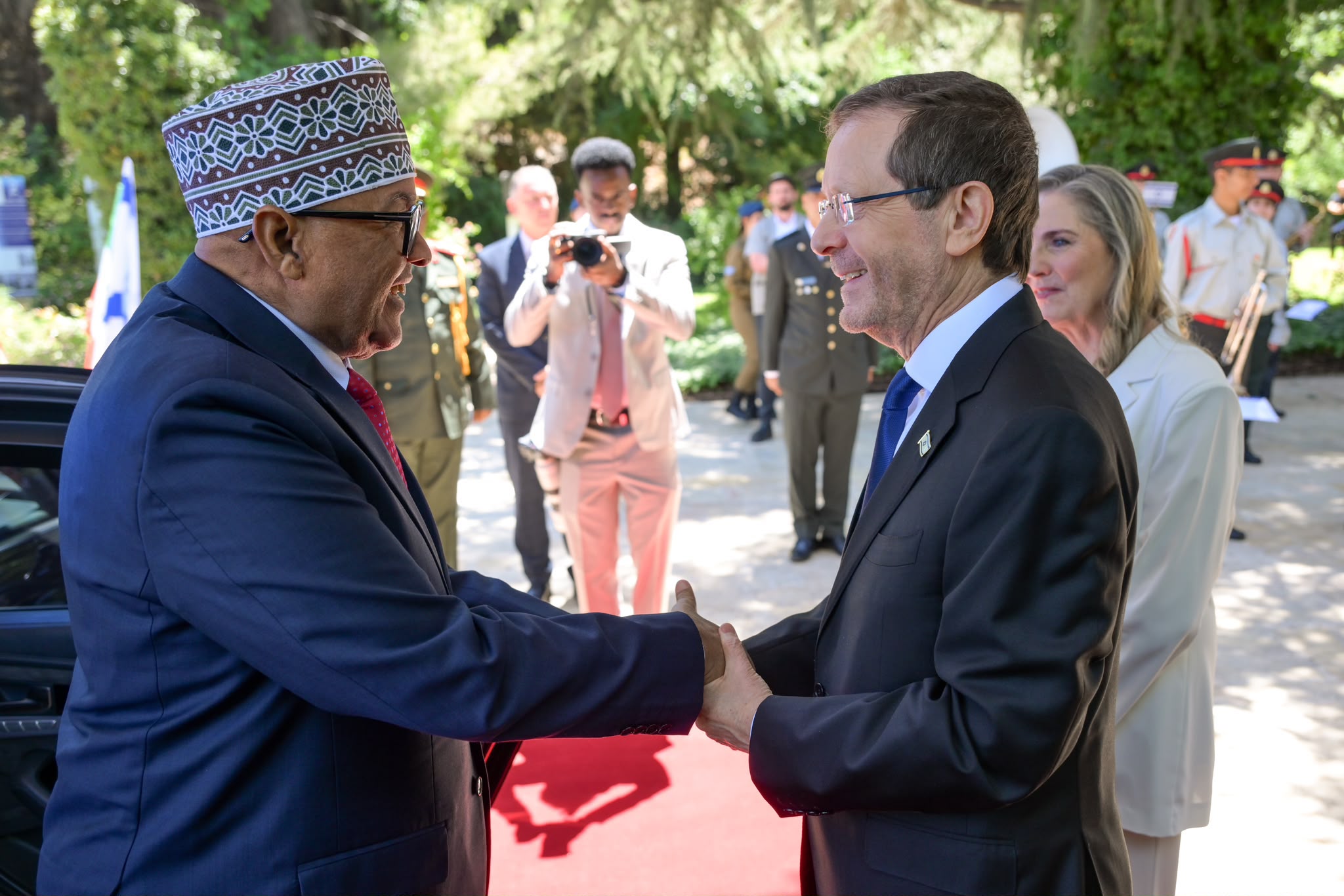
“We asked the world: Do you see us? Israel answered first.” So wrote Abdirahman Mohamed Abdullahi, president of a republic that has governed itself for 35 years without the world’s permission, on the morning he landed in Israel this week for the first state visit any leader of the Republic of Somaliland has ever made anywhere.
What followed was not the thin courtesy a small unrecognised territory might expect. It was a full state programme. President Isaac Herzog received Abdullahi at his residence in Jerusalem with an honour guard and a guest book, and stood outside to greet the motorcade himself. Foreign Minister Gideon Sa’ar opened Somaliland’s embassy beside him in the capital, the eighth foreign mission in Jerusalem, and Prime Minister Benjamin Netanyahu sat down with him. Speaker Amir Ohana welcomed Abdullahi into the Knesset and at the Friends of Zion Museum, Dr Mike Evans presented him with the institution’s award, handed before now to the likes of US presidents Donald Trump and George W Bush.
The question is why Israel ‒ at war, stretched, and watching its own alliances strain ‒ chose this moment to roll out the honour guard for a republic on the Gulf of Aden that most foreign ministries still pretend they cannot see. The mood at home offers little help in answering it. With Trump visibly desperate for a deal, and his public position flip-flopping by the week, the reading in Israel is that the Iranian regime’s leadership was struck but endured, and that the grinding “rounds of fighting” so familiar from Gaza will now simply be transposed onto Iran.
Israel and the United States assassinated Ayatollah Ali Khamenei on 28 February and destroyed much of the regime’s military and clerical leadership, but so far have not succeeded in toppling the regime. To endure is to triumph in the eyes of Iran and its proxies. A regime that thinks this way doesn’t emerge from a decapitation strike chastened and quiet. It emerges with a martyr, a harder leadership, and a story of defiance it can sell to its own people and to every proxy still holding a missile. This isn’t the silence after a victory. It’s the dangerous hour after a blow that didn’t land cleanly enough, or one that has been softened by capitulation and prowess in the diplomatic arena.
Look at the sea if you doubt it. Since February, Iran has effectively closed the Strait of Hormuz, the artery through which a quarter of the world’s seaborne oil once moved, by mining it, by boarding ships, by threat alone. That is the demonstrated capability. Now listen to what comes next. An adviser to Iranian leader Mojtaba Khamenei has promised that its allies can shut Bab el-Mandeb as Tehran has shut Hormuz. On 8 June the Houthis once again declared a total ban on Israeli navigation in the Red Sea. Two of the planet’s great chokepoints, threatened at once, by an enemy that believes it is winning or has won.
And there, on the African shore of that very threat, in the vicinity of Houthi launch sites, at the mouth of the strait they have sworn to close, sits Somaliland. Its port at Berbera, which was expanded in recent years by the United Arab Emirates (UAE), whose role we will return to.
Herzog, standing beside his guest, named the logic plainly: a shared exposure to radical extremism, a shared stake in the stability of the Horn of Africa, a shared interest in protecting maritime freedom. It wasn’t only a warning about a common enemy. It was a description of two states that each carry a burden the other needs to carry ‒ and that is a sturdier basis for partnership than fear alone.
What does each side draw from it? Strip away the speeches and the exchange is plain, and it is honest on both sides. Israel gains forward defence, a set of eyes and reach a few hundred kilometres from the missiles aimed at its ships, on the waterway its enemies have promised to strangle. It gains an additional moderate Sunni-Muslim partner in the Horn at the very moment its normalisation track has stalled.
Somaliland gains the one thing 35 years of quiet competence could not win it. Recognition. Israel was the first and only member state of the United Nations to grant it. For Hargeisa, recognition is not a courtesy but rather the whole game, the key to borrowing, to treaties, to guarantees, to existence itself in the eyes of the law. Around that key comes investment, security, the water and farming technology Israel sells better than anyone, and a friend in Jerusalem with a voice in Washington. A friend already at work: American senators now call for the United States to join Israel and Taiwan in recognising Somaliland. Hargeisa has already signalled its price and its direction ‒ a trade deal, mineral rights on its territory, and a declared willingness to join the Abraham Accords. The Accords line is more than ceremony even now that recognition has been granted: recognition is a bilateral fact between Jerusalem and Hargeisa, but accession to the Accords would fold Somaliland into a wider American-anchored framework alongside the Gulf states, converting a single relationship into membership of a bloc ‒ and handing Washington, which has not yet recognised Somaliland, a reason to follow Israel’s lead. This is not a flirtation. It is a country choosing a camp.
Taiwan. The word belongs in this story from the outset, because Somaliland’s visit is one expression of a wider pattern: an informal grouping of unrecognised or partially recognised democracies that happen to sit on strategically valuable ground, and that have begun to acknowledge one another precisely because the international system will not. Somaliland on the Gulf of Aden; Taiwan astride the first island chain. Each governs itself, holds elections, and controls territory the great powers care about; each is denied a name.
Somaliland and Taiwan already recognise each other in a quiet mutual acknowledgement between two states the world withholds the word from. China grasps the symmetry perfectly. It wants Berbera, it has dangled money for roads, and the one obstacle it cannot buy its way past is Somaliland’s hand clasped with Taipei’s. Beijing will not build up a port whose owner recognises the island it intends to swallow.
Here, then, is the whole contest in miniature. The same politics of recognition that decides whether a harbour on the Gulf of Aden tilts west or east is a working model of the question that hangs over the Pacific. And the audience is identical. Beijing studies every Western war in forensic detail, the sanctions, the timelines, whether the coalition finishes what it starts or slinks back into managed inaction. Israel’s recognition of Somaliland is a sentence Beijing is reading very carefully, against the day it tests how the West treats Taipei. Every position held is deterrence. Every position surrendered under pressure is an invitation.
And understand how Beijing prefers to work, because it is the opposite of a gunboat. China rarely arrives in the Horn with a fleet; it arrives with a loan, a road, a fibre-optic cable, a stadium, a scholarship, a port concession dressed as development. This is statecraft by infrastructure, and Djibouti, a short sail up the coast, is the cautionary text: courted, financed, and now host to China’s first overseas military base, built on the back of exactly this method. Somaliland is the rare seam where that method jams. Berbera would slot perfectly into the maritime-logistics lattice Beijing has been threading from the South China Sea to the eastern Mediterranean. But the price of admission is the abandonment of Taipei, and that is the one invoice Hargeisa has refused to pay. Israel did not engineer this refusal. It inherited it, and in recognising Somaliland it has quietly reinforced it. To keep one small democracy out of the Chinese lattice, on the strength of its loyalty to another, is a soft-power victory of a kind the West rarely manages and almost never plans.
None of this is to pretend the ground is empty or the road is smooth. Israel didn’t discover Berbera. The UAE built the platform Israel now hopes to stand on, namely a 30-year concession and the better part of hundreds of millions of dollars invested in the ports of the Gulf of Aden through DP World, the Dubai state-owned ports giant that runs terminals on every inhabited continent and moves something close to a tenth of the world’s container trade, military bases beside them, surveillance of the Houthis already running from their decks. That is the opportunity. It is also the fault line.
For the recognition that drew Somaliland to Jerusalem detonated the Emirati position elsewhere. In January, Mogadishu tore up every agreement it had with Abu Dhabi ‒ port operations, security, defence ‒ convinced, with reason, that the UAE had quietly midwifed Israel’s recognition of the breakaway it claims as its own. The trigger was immediate; the real cause was the same word that runs through this entire affair. Recognition. Somalia could not abide that its patron had helped hand statehood to its rebel province.
Watch closely what happened next, because it is the whole thesis rehearsed in a week. A word on the map first. Somalia is a federal state in name more than in fact: Mogadishu’s writ runs thinly, and several of its constituent regions behave as governments in their own right. Somaliland, in the northwest, has been effectively independent since 1991 and seeks nothing from the capital. Puntland, in the northeast, is a semi-autonomous state that has its own dealings with the Gulf and its own port at Bosaso. Jubaland, in the south, runs Kismayo, the regional capital and guards its autonomy jealously against Mogadishu. All three had reason to value the Emirati money the capital had just renounced on their behalf. So when Mogadishu issued its decree cancelling the UAE agreements, Somaliland, Puntland, and Jubaland simply refused it. DP World announced its Berbera operations would carry on as though nothing had been said. The federal government’s writ stopped precisely at the line of recognition, at the edge of the territories that had decided they were states, or near enough, whatever Mogadishu declared. The breakaway acknowledged by Jerusalem shrugged off the capital that claims it. That is the contest of this era in a single gesture: not who holds the title, but who has the power to ignore the one withholding it.
So the platform Israel means to stand on is real, pro-Israel in its alignment, and freshly cracked down the middle, with Saudi Arabia bankrolling Mogadishu to check Emirati reach and Turkey entrenched in the same capital. A foothold that rests on another power’s infrastructure is a real foothold, but it is not a sovereign one.
And that, in the end, is the logic of the whole exercise. Israel has watched its great patron fight beside it and then turn to bargaining over its head, on a clock set in Washington, a guarantor drifting towards broker. A state in that position doesn’t wait on the terms of someone else’s deal. It gathers ground of its own: relationships no settlement can sell, footholds no ally can withdraw, recognitions that need no permission.
A small nation doesn’t get to choose the century it is born into, only how it reads the one it has. Somaliland read its century early ‒ 35 years in the waiting room of the unrecognised, and it never once mistook patience for surrender. Israel is older at this game, and the harder question falls to it. It has just spent a year demonstrating that it can break an enemy. The Somaliland visit asks whether it has learned the rarer skill, the one that outlasts any single war: to build quietly, on ground it secures itself, before the need becomes an emergency.
The test is whether the months that follow turn a ceremony into an instrument: a working port, a standing presence on the Gulf of Aden, a partnership that holds when Mogadishu protests, Washington loses interest, and the cameras have long since moved on. Recognition was the gift Israel gave Somaliland. What Somaliland offers Israel in return is the chance to prove it knows how to plant something and wait for it to grow.
- Alon Sackstein is an adviser at the Geopolitics Laboratory, a geopolitical advisory firm, and a former strategic research team lead in the Research and Analysis Division of Israel Defense Intelligence. He holds an Executive MA in Diplomacy and Security from Tel Aviv University.
- Dr Roie Yellinek is co-director of the Geopolitics Laboratory. He has served as a geopolitical consultant to Israeli government bodies and as a researcher at the Begin-Sadat Center for Strategic Studies and the Middle East Institute in Washington, DC.




Ingrid
July 10, 2026 at 6:59 pm
Thank you for this interesting article, Ingrid