





World
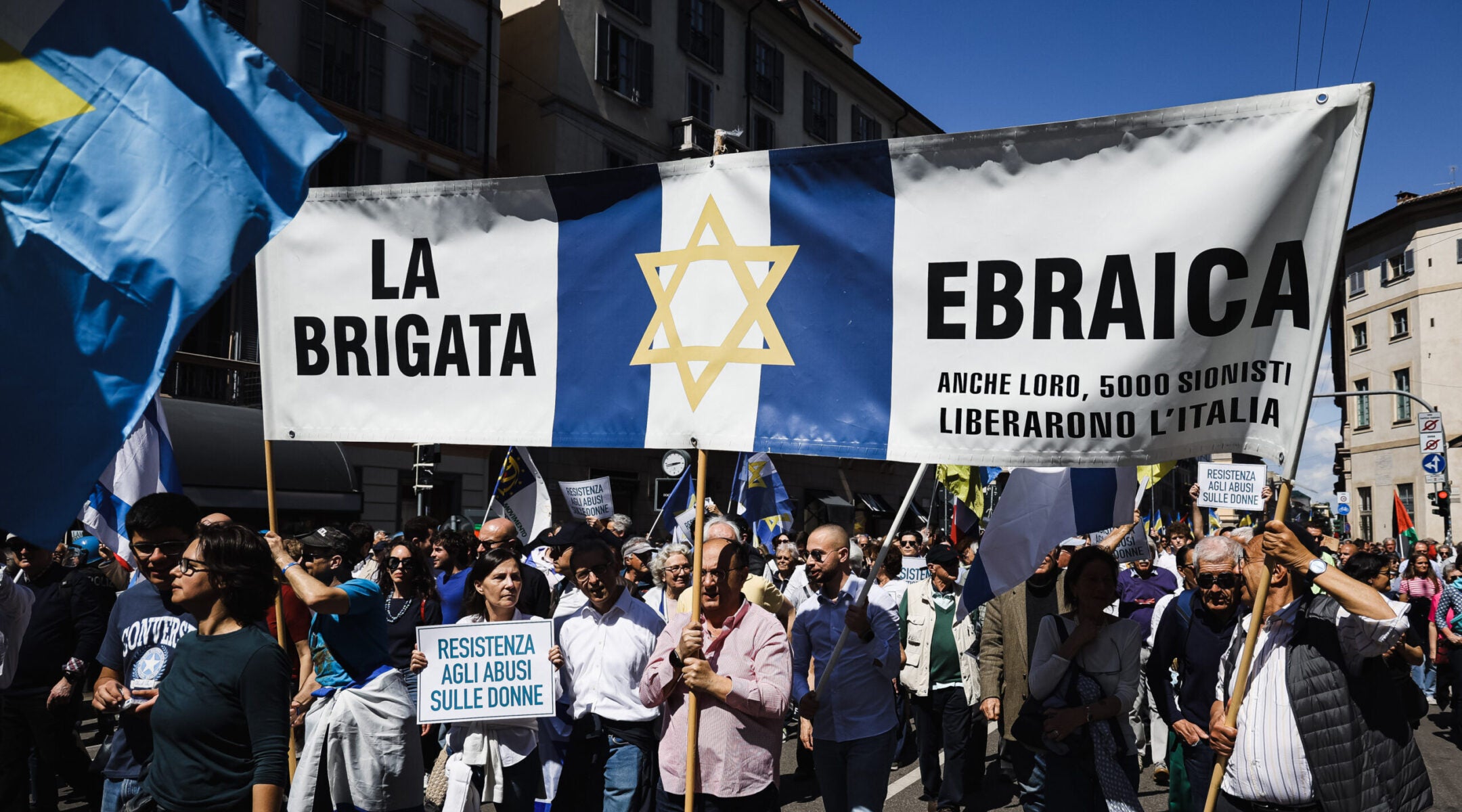
The Jewish Brigade fought fascism in Italy. Now its flags spark protests.

JTA – When the Jewish Brigade appears today in Italian public debate, it is rarely about the British Army unit ‒ formed largely by volunteers from Mandatory Palestine ‒ that was sent to fight in Italy in the final months of World War II.
The Jewish Brigade has become a screen onto which other conflicts are projected: Zionism and antizionism, antisemitism, Israel and Palestine, the meaning of antifascism, and the ownership of public memory.
This is why tensions in Milan and Rome during Italy’s Liberation Day commemorations this year were not simply disputes about flags or parades. They were symptoms of a deeper problem: the difficulty of allowing history to remain history, while also recognising that memory is always political.
On 25 April, Italy celebrates its liberation from Nazi occupation and fascist rule. It is the most important civil holiday of the Italian Republic, a foundational moment in its democratic identity. But precisely because it is so symbolic, it has always been a stage on which the political tensions of the present are acted out.
The Jewish Brigade occupies a peculiar place in this story. Militarily, its contribution to the Allied campaign in Italy was limited. The Brigade arrived late at the front, in early 1945, and fought for only a short time. Its soldiers were deployed in Romagna, north of Ravenna, along the Lamone, and later near Riolo Terme and the Senio river. About 50 of its soldiers died.
Yet to measure the Brigade only by military impact is to misunderstand its historical significance. Its importance was symbolic, political, and psychological. These were Jews in uniform, fighting under a flag marked by the Star of David, against the army of the regime that had attempted to annihilate European Jewry. For many of the volunteers, especially those who were committed Zionists, service in Italy represented more than participation in the Allied war effort. It was a form of Jewish self-assertion, and a claim to political dignity before the world.
This is one reason the Brigade mattered then. It also helps explain why it matters now.
After the war, the memory of the Jewish Brigade did not immediately become central to Italian public memory. For decades it remained relatively marginal, preserved above all within parts of the Jewish community and in the recollections of veterans. Its later rediscovery, especially from the 1990s and 2000s, coincided with new struggles over the meaning of 25 April. Some Italian Jewish communities began to bring the Brigade’s flag into Liberation Day commemorations to remind the public that Jews had not only been victims of fascism and Nazism. They had also been combatants, liberators, and political actors.
That reminder was, and remains, historically legitimate. Italian Jews belong fully to the history of the Resistance and to the history of the Republic that emerged from the defeat of fascism. The Jews of Mandatory Palestine who served in the Jewish Brigade also belong to the history of Italy’s liberation, however brief their time at the front. They fought in Italy, against German forces, alongside other Allied soldiers and alongside the reborn Italian army. To deny their place in that history is not a neutral act of historical correction. It is an exclusion.
At the same time, it is clear that the Brigade has become controversial, not only because of what it did in 1945, but because of what its flag is understood to mean today. The flag of the Jewish Brigade is virtually identical to the later flag of the State of Israel. For some, this makes it a proud symbol of Jewish resistance to Nazism and of the Jewish contribution to liberation. For others, especially in the context of the Israeli-Palestinian conflict, it is read primarily as a symbol of Israel and therefore as a political provocation.
This is the heart of the problem. The dispute is often presented as a debate about history, but it is, in fact, a debate about the present. People argue about the Brigade because they are really arguing about the legitimacy of Zionism, about whether antizionism can become antisemitism, about whether Israel should be understood as a national project or an imperial one, and about what antifascism should mean today. These questions generate fierce disagreements, and 25 April gives them a highly charged public stage.
There are two competing visions of Liberation Day. One sees 25 April primarily as a historically defined Italian commemoration: the day on which the country remembers those who fought between 1943 and 1945 to free Italy from Nazi-fascism. In this interpretation, the Jewish Brigade clearly has a place, because it took part in that struggle. Palestinian flags, by contrast, are harder to place within that specific historical frame, not because Palestinians were fascists, but because they were not participants in the liberation of Italy.
The other vision is more dynamic and internationalist. It sees 25 April not only as the commemoration of a past event, but as an annual reaffirmation of resistance to oppression in the present. In this interpretation, the presence of Palestinian flags, Ukrainian flags, Iranian dissidents, or other contemporary causes can be understood as part of a broader antifascist language. The date 25 April becomes not only the memory of Italy’s liberation, but a ritual of solidarity with those who resist domination elsewhere.
The Jewish Brigade forces us to confront this tension. It belongs to the historical 25 April because it helped liberate Italy. It also belongs to the broader moral history of antifascism because it embodied Jewish armed resistance to Nazism. But its memory is now inseparable from the unresolved political and psychological impact of the Israeli-Palestinian conflict on Italian, and indeed international, public life.
This does not mean that every criticism of Israel is antisemitic. It is not. Nor does it mean that Jewish history should be used to silence Palestinian suffering. It should not. But it does mean that excluding Jews from an antifascist march, insulting people carrying the symbols of the Jewish Brigade, or treating Jewish participation in Liberation Day as illegitimate is a profound historical and moral failure. Antifascism without Jews is not antifascism. A 25 April in which Jews are tolerated only if they hide the symbols they decide to choose is not a healthy democratic ritual.
The answer is not to turn the Jewish Brigade into a weapon in today’s political battles. Nor is it to erase it in the name of avoiding controversy. The answer is to recover the complexity of its history. The Brigade was a military unit, but also a symbol. Its soldiers were liberators in Italy, survivors or relatives of victims of European catastrophe, Zionists of different kinds, and human beings who often carried grief, hope, and a desire for revenge. Their story links the Holocaust, World War II, the end of empire, the birth of Israel, and the politics of memory in postwar Italy.
That is why the Jewish Brigade matters today. It reminds us that history cannot be reduced to slogans, that memory can both illuminate and distort, and that democratic societies must make room for complexity and uncomfortable truths.
- The views and opinions expressed in this article are those of the author and do not necessarily reflect the views of the SA Jewish Report, JTA, or its parent company, 70 Faces Media.





Rita
June 9, 2026 at 7:47 pm
Nazi links woth Arab “Palestinians” (even) after WW2 (1960s, 1980s, etc.)
PART I
Neo-Nazi Links with Arab Palestinians: persons, organizations.
Immediate links following in ex Mufti’s footsteps:
Ahmad Shukeiri, the Palestine Arab Delegation (PAD), and Issa Nakhleh
Ahmad Shukeiri and the Early PAD
The Palestine Arab Delegation (PAD) was described in The Wiener Library Bulletin (1968) as a creation of Haj Amin El-Husseini, the Grand Mufti of Jerusalem.
{The Wiener Library Bulletin (1968), p. 20.}
The PAD was initially managed by Ahmad Shukeiri (Shukairy).
Several sources associate Shukeiri with wartime and postwar propaganda activities. These include references as a supporter of Nazi propaganda and who, together with Jamal Husseini, sought to justify the Holocaust, aftermath:
{Farbstein, L. (1965, February 26). Remarks in the Congressional Record. Congressional Record, Vol. 111, p. 455,
Congressional Record
“Behind the British Conspiracy,” B’nai B’rith Messenger, July 12, 1946}
Praise for the Tacuara Movement.
On October 30, 1962, Ahmad Shukeiri, then serving as Saudi Arabia’s representative to the United Nations, became the subject of controversy after publicly praising and saluting the Tacuara Nationalist Movement, an Argentine nationalist organization, known antisemitic and neo-Nazi.
{“Recall of Arab Delegate from U.N. is Sought; ‘Saluted’ Tacuara,” December 3, 1962.
Recall of Arab Delegate from U.N. is Sought; ‘saluted’ Tacuara – Jewish Telegraphic Agency
Kathleen Teltsch, “Israeli Accuses Arabs of Nazism; U.N. Envoy Sees Link to Modern Fascist Groups,” New York Times, December 7, 1962;
Israel in the Third World, Michael Curtis and Susan Aurelia Gitelson, pp. 157–158,
Israel in the Third World
Israeli-Latin American Relations, Edy Kaufman, Yoram Shapira and Joel Barromi, p. 87}
Issa Nakhleh and the PAD.
Directed the PAD (1961+) and soon passed on Mufti’s “explaining” Nazis’ hatred
‘October 1961: The Palestine Arab Delegation sent to all U.N. delegations a formal statement of the Grand Mufti of Jerusalem declaring: “The enmity of Nazis to Jews…”‘
{“Nasser’s Anti-Jewish Propaganda.” Publication Date: July 8, 1965, CIA.
NASSER’S ANTI-JEWISH PROPAGANDA | CIA FOIA (foia.cia.gov)}.
The PAD was managed by Issa Nakhleh and Omar Azzouni.
{Facts, Vol. 17, Anti-Defamation League of B’nai B’rith (1966), “The Palestine Arab Delegation (PAD).”}
Association with the Arab Higher Committee
Issa Nakhleh served as a representative and adviser connected to the Arab Higher Committee for Palestine.
{Sabath, A. J. (1947, June 9). Congressional Record, 93, 2819–2821,
J. H. Richards, “The Mufti’s Henchmen,” Nation, Vol. 164 (1947), p. 561}
Activities in Britain (1930s).
As London correspondent for Falastin, Nakhleh defended the Arab propaganda center in Nazi Germany.
{The Palestine Post, January 14, 1938, p. 2.
The Palestine Post, July 13, 1939, p. 6}.
Activities in Argentina (1950s).
Nakhleh served as a representative of the Arab League in Argentina and edited America y Oriente.
A 1958 report described the publication as a vehicle for Arab nationalist propaganda and alleged anti-Jewish agitation, noting circulation among nationalist and Nazi-oriented circles in Argentina.
{Anti-Jewish Activities of the Arabs in Argentina (1958), Chapter V, “The Arab League in Argentina”;
Israel in the Third World, pp. 157–158;
“Attitudes Towards Jews in Argentina” (1975);
“Remapping the Cold War: Argentine-Arab World Transnationalism, 1946–1973”}
Sirhan Sirhan and the PAD (1968).
Following the assassination of Senator Robert F. Kennedy, reports stated that the Arab Higher Committee instructed its New York representatives to provide legal assistance to Sirhan Sirhan. The PAD representatives identified in the report were Issa Nakhleh and Omar Azzouni.
{“Justice Department Keeps Watch on Arab Students Group As Sirhan Probe Continues,” JTA, June 24, 1968}.
Holocaust Denial and Neo-Nazi Cooperation.
Multiple sources show Nakhleh’s Holocaust denial and document his participation in conferences and publications associated with Holocaust denial organizations, including the Institute for Historical Review (IHR).
{Patterns of Prejudice (1970), “Anti-Zionists and Antisemites.”
The American Spectator (1986), p. 20;
Gill Seidel, The Holocaust Denial: Antisemitism, Racism and the New Right (1986);
The Holocaust Denial
Kenneth S. Stern, Holocaust Denial (1993), pp. 170–171;
National Lampoon reference quoting Nakhleh’s outrageous statements regarding Holocaust victim numbers.
National Lampoon, 1972.l;
David Dalin, Icon of Evil (2017);
Nizkor archive entry}
Writings on Nazism, Zionism, and the Holocaust.
Several cited sources discuss Nakhleh’s writings that advanced conspiracy theories concerning World War II and against accounts of the Holocaust.
{Meir Litvak and Esther Webman, “Perceptions of the Holocaust in Palestinian Public Discourse,” Israel Studies (2003), p. 127;
Project MUSE — Verification required!
Eric Rozenman, “One Land, Two People, and Dozens of Errors” (2004),
‘One Land, Two People,’ and Dozens of Errors}
___
PART II
Neo-Nazi Links with Arab Palestinian Extremist Organizations.
François Genoud: Financier Linking Nazi and Palestinian Militant Networks.
François Genoud (1915–1996) was a Swiss Nazi sympathizer, financier, and political activist who served as an important intermediary between former Nazis, European far-right networks, and Palestinian militant organizations during the Cold War. Rather than acting as a militant himself, Genoud used financial, legal, and political connections to support causes he viewed as aligned with his anti-Zionist and anti-Israeli worldview (Aarons & Loftus, 1991; Lee, 1998).
Early Connections to Arab Nationalist and Pro-Nazi Networks.
Genoud’s involvement with Arab nationalist causes predated the emergence of modern Palestinian militant organizations. During and after the Second World War, he maintained ties to supporters of Amin al-Husseini, the former Grand Mufti of Jerusalem, who collaborated with Nazi Germany and maintained relationships with senior Nazi leaders, including Adolf Hitler. Historians have described Genoud as an admirer of al-Husseini and as part of postwar networks that connected former Nazis, Arab nationalists, and anti-Zionist activists (Herf, 2009; Küntzel, 2015).
Support for Arab Palestinian Organizations.
Genoud maintained close relationships with Palestinian nationalist and militant groups, including factions within the Palestine Liberation Organization (PLO) and the Popular Front for the Liberation of Palestine (PFLP). He reportedly assisted with fundraising, legal defense efforts, and financial transactions benefiting Palestinian militants during the 1960s–1980s (Aarons & Loftus, 1991; Lee, 1998).
He developed a close association with Ilich Ramírez Sánchez (“Carlos the Jackal”), financing aspects of his legal defense following his arrest and maintaining personal ties with networks connected to Palestinian militant organizations (Lee, 1998).
Genoud also maintained relationships with senior Palestinian figures, including George Habash, founder of the PFLP, and Ali Hassan Salameh, a founder of Black September. Near the end of his life, Genoud acknowledged to journalist Pierre Péan that he had personally delivered ransom communications during the hijacking of Lufthansa Flight 649, reinforcing longstanding allegations regarding his logistical support for Palestinian militant operations (Péan, 1994; Izzo, 2019).
Connections to Nazi Networks
A lifelong admirer of National Socialism, Genoud acquired literary rights associated with Adolf Hitler, Joseph Goebbels, and Martin Bormann, using portions of the resulting income to support far-right causes and legal defenses for former Nazis (Aarons & Loftus, 1991).
Researchers have also linked Genoud to postwar support networks that assisted Nazi fugitives and funded legal defenses for figures such as Adolf Eichmann and Klaus Barbie (Aarons & Loftus, 1991; Lee, 1998).
The “Euro-Arab” Connection.
According to historians, Genoud viewed Palestinian nationalism as a continuation of the struggle against Israel and Zionism that had previously animated Nazi ideology. Through financial and political networking, he helped facilitate contacts between European far-right activists and Palestinian militant organizations, contributing to what some scholars describe as a pragmatic Euro-Arab extremist alliance (Lee, 1998; Küntzel, 2015).
Ideological and Personnel Links Between Palestinian Militants and Former Nazis.
Historians have noted that cooperation between some Palestinian militant organizations and European neo-Nazis extended beyond financing and logistics into ideological and personnel relationships. Elements within Fatah and the PLO cultivated relationships with former Nazis and far-right activists during the Cold War period (Wistrich, 2010).
Mein Kampf circulated as recommended reading in some Fatah training camps, and several former Nazis were recruited as advisers, trainers, or operatives. Among those identified were Erich Altern, a former official connected to the Gestapo’s Jewish Affairs section, and Willy Berner, a former SS officer who served at the Mauthausen concentration camp (Wistrich, 2010).
Otto Albrecht (German neo-Nazi activist)
Karl van der Put (Belgian far-right figure)
Jean Tireault, secretary of the fascist publication La Nation Européenne
These relationships have been cited by historians as evidence that portions of the European far right and Palestinian militant movements were willing to cooperate despite substantial ideological differences, particularly when united by hostility toward Israel and Zionism (Wistrich, 2010; Herf, 2009).
References for Part II:
Aarons, M., & Loftus, J. (1991). Unholy Trinity: The Vatican, the Nazis, and the Swiss Banks. St. Martin’s Press.
[Bundeszentrale für politische Bildung (Wehrsportgruppe Hoffmann)](bpb.de)
Herf, J. (2009). Nazi Propaganda for the Arab World. Yale University Press.
Izzo, S. (2019, June 18). Karl-Heinz Hoffmann’s Secret History Links Neo-Nazis With Palestinian Terror. Tablet Magazine.
Küntzel, M. (2015). Nazis, Islamic Antisemitism and the Middle East: The 1948 Arab War Against Israel and the Aftershocks of World War II. Routledge.
Lee, M. A. (1998). The Beast Reawakens. Little, Brown and Company.
Latsch, G., & Wiegrefe, K. (2012a, June 17). Files Show Neo-Nazis Helped Palestinian Terrorists in Munich 1972 Massacre. Der Spiegel.
Latsch, G., & Wiegrefe, K. (2012b, June 17). München 1972: Deutsche Neonazis halfen Olympia-Attentätern. Der Spiegel.
Péan, P. (1994). Une jeunesse française: François Mitterrand, 1934–1947. Fayard.
Wistrich, R. S. (2010). A Lethal Obsession: Anti-Semitism from Antiquity to the Global Jihad. Random House. (Chapter 21, “The Liberation of Palestine”).