


World
US antisemitism envoy says SA’s ‘genocide’ claim fuelling Jew-hatred

WASHINGTON – The United States antisemitism envoy linked South Africa’s case against Israel at the International Court of Justice (ICJ) to deteriorating relations between Pretoria and Washington, while warning that accusations of “genocide” are being weaponised against Jews and Israel.
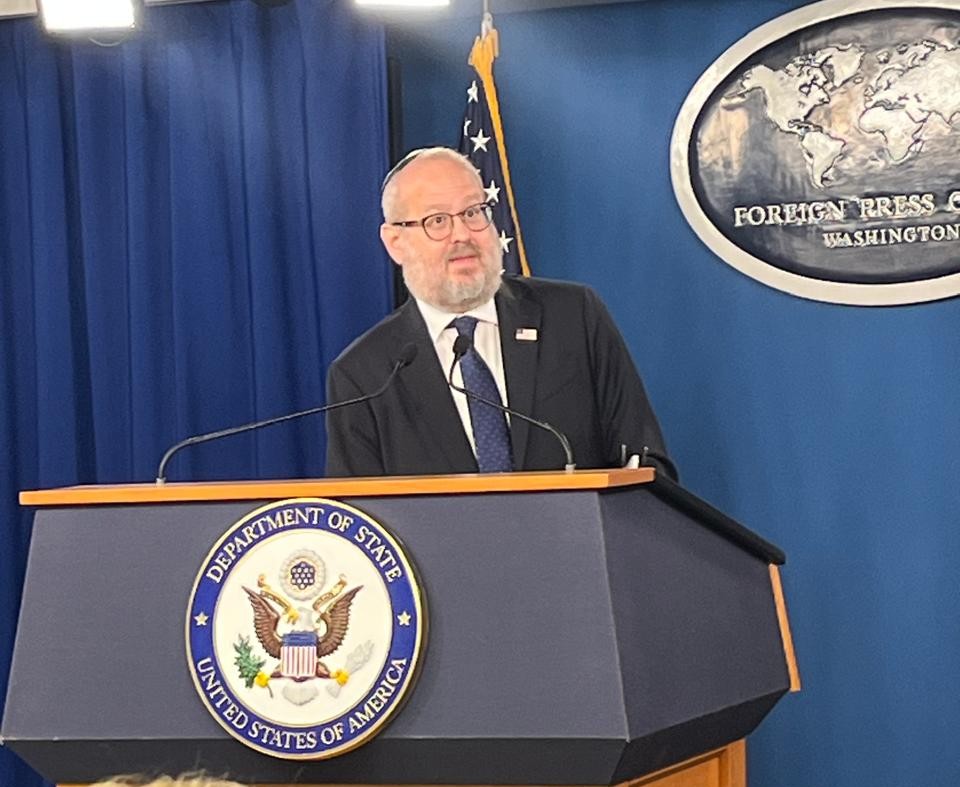
Ambassador Rabbi Yehuda Kaploun, the US Special Envoy to Monitor and Combat Antisemitism, made the comments in Washington on Monday, 5 October, during a Foreign Press Centre briefing on the Trump administration’s efforts to combat soaring global antisemitism.
Asked by the SA Jewish Report whether South Africa’s decision to make its ICJ case against Israel a centrepiece of its foreign policy had contributed to global antisemitism, and whether the case was connected to worsening US-South Africa relations, Kaploun was unequivocal.
“I do think that it is linked,” he said.
Kaploun then launched a forceful attack on the use of the word “genocide” against Israel, arguing that population figures undermined the allegation and that the term was increasingly being used to vilify Jews and the Jewish State.
He pointed to the fact that the global Jewish population, estimated at about 15.3 million in 1933 before the Holocaust, has only recently returned to roughly that level, while contrasting this with Gaza’s Palestinian population, which he said had grown from about 650 000 in 1948 to 2.5 million today. “So I don’t see how that is a genocide.
“The term ‘genocide’ is being thrown around here by a lot of uneducated people who are left-wing or right-wing radicals, [or] people who are literally antisemitic trying to tar and feather the Jewish community and Israel,” he said.
Kaploun questioned the consequences for Jewish children of repeatedly hearing the accusation directed at Israel.
“If someone would like to explain to me why a six-year-old child going to school anywhere in the United States is called a ‘baby killer’ or is being told ‘you’re responsible for a genocide’, I think people have to take a very strong look at how that term is being used.”
South Africa instituted proceedings against Israel at the ICJ in December 2023, alleging violations of the Genocide Convention in its military campaign against Hamas in Gaza. Israel has rejected the accusation of “genocide”, maintaining that it is acting in self-defence following Hamas’s 7 October attack and that it is bound by international humanitarian law.
Kaploun said the US government had made its opposition to the “genocide” allegations clear. He said the ICJ case “has no merit whatsoever”.
Kaploun also turned his sights on the legacy of the 2001 World Conference Against Racism in Durban, after being asked about a motion passed last week by the Green Party of England and Wales equating Zionism with racism.
He said Washington intended making representations over the issue.
“The fact that people are still equating Zionism with racism because of a Durban conference” was deeply troubling, he said, pointing to recent US efforts at the United Nations to persuade countries to distance themselves from the Durban process. Kaploun said dozens of countries had withdrawn from references to Durban following US diplomatic efforts.
He accused countries that singled Israel out of applying a double standard. “I think a lot of countries are being hypocritical in the sense that they will only focus on Israel; they will not focus on other countries,” he said.
Referring to the International Holocaust Remembrance Alliance definition of antisemitism, Kaploun said, “The same condemnation that you want to use about Israel has to be used across the board on every country, and I don’t think they’re living up to that standard.”
Kaploun’s comments came just a week after more than 40 countries, including the US, United Kingdom, Germany, Canada, Australia, and Israel boycotted a UN high-level meeting marking the 25th anniversary of the Durban Declaration.
The global briefing in Washington took place this week for international journalists participating in the Foreign Press Centre’s International Reporting Tour on Combating Global Antisemitism, taking place in Washington and Florida.
Setting out the administration’s broader approach, Kaploun described antisemitism as a global problem requiring active US diplomatic engagement.
“Antisemitism is all over the world. It’s virtually in every country,” he said.
He described his position as “a role that I wish did not exist, not just in America but in the world”, saying the State Department’s response went beyond the protection of American Jews to the defence of religious liberty internationally.
“As antisemitism surges globally, the president took unprecedented measures,” he said. Kaploun pointed to the executive action targeting antisemitism on university campuses, strengthened visa vetting, withdrawal from certain international bodies, hate-crime prosecutions, counterterrorism efforts, and work with foreign governments on education.
US President Donald Trump signed an executive order in January 2025 directing federal departments and agencies to identify civil and criminal mechanisms available to combat antisemitism, with particular emphasis on Jew-hatred at universities. The order also directed officials to examine immigration-law measures applicable to foreign students and staff engaged in unlawful conduct.
Kaploun said visa policy had become one of the administration’s tools, claiming more than 250 000 visas had been revoked. “We’ve implemented a rigorous visa vetting process.”
He said the envoy’s office was also focusing heavily on education and the role that school curriculums could play in either perpetuating or countering hatred.
He singled out Saudi Arabia, saying his office had worked with the Saudi government to remove antisemitic material from its curriculum.
“This office believes that most people who hate are ignorant, and if educated properly with respect and dignity for all of humanity, we can all reduce the levels of not just antisemitism but all levels of crime against all religions,” he said.
Kaploun stressed that his office’s work was not confined to attacks against Jews. It worked closely on wider religious-liberty issues and had raised concerns about “churches being burned, synagogues being burned, women being tortured, and women being raped across the globe”.
He also accused the international community of selective outrage, citing the deaths of Iranian citizens while, he said, much of the world remained silent.
His central message was that the US administration increasingly views antisemitism not simply as prejudice against individual Jews, but as an international diplomatic, educational, law-enforcement, and security challenge.