





SA
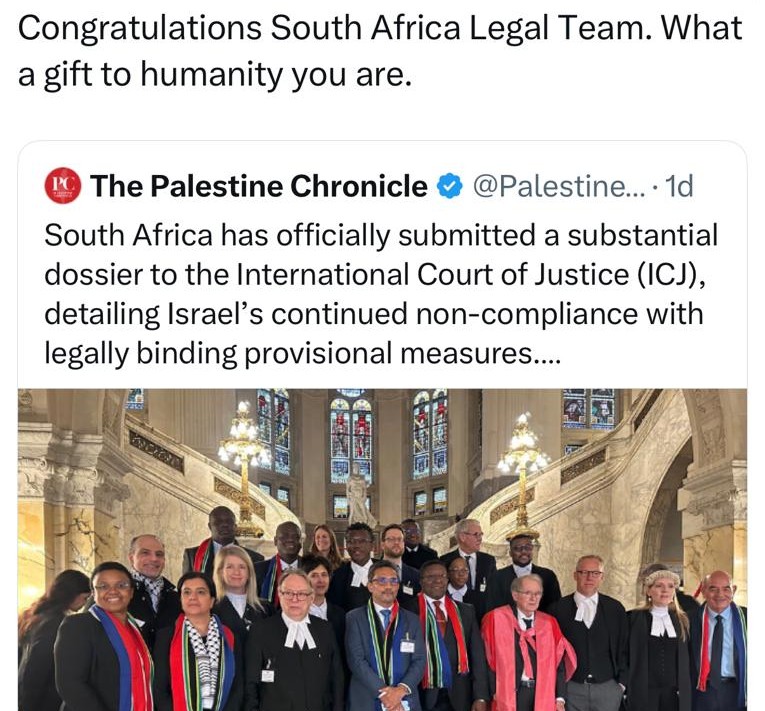
Government criticised over biased ICJ statement

The Department of International Relations and Cooperation (DIRCO) is facing fierce criticism over its “biased” statement accompanying South Africa’s latest submission to the International Court of Justice (ICJ).
It has accused Israel of killing journalists to conceal its “crimes”, torturing Palestinian detainees, and killing an average of one Palestinian child a day since the ceasefire. It makes no mention of Hamas.
DIRCO announced on 28 August that South Africa had submitted a “substantial dossier of information” to the ICJ. It said the dossier was intended to assist the committee of judges responsible for monitoring implementation of the court’s provisional measures.
The dossier itself has not been made public.
The DIRCO statement said, “Since the announcement of the so-called ‘ceasefire’, on average, one Palestinian child has been killed every day by the Israeli military.”
It said Palestinians were being “herded into an ever-shrinking sliver of territory and subjected to unbearable conditions of life”, and detainees have been “tortured, subjected to sexual and gender-based violence, and to cruel, inhuman, and degrading treatment”.
“To prevent any record of its crimes, Israel has killed local journalists, barred foreign journalists, and prevented UN-mandated investigative bodies from entering Gaza,” DIRCO said.
Yet Hamas isn’t mentioned even once in the statement. Neither are the Hamas-led atrocities of 7 October, the hostages abducted into Gaza, nor reported breaches of the ceasefire by Hamas and other Palestinian armed groups.
“This is not law. It is a government inventing a verdict, attaching the ICJ’s name to it, and hoping nobody reads the docket,” Rolene Marks, national spokesperson for the South African Zionist Federation, told the SA Jewish Report.
DIRCO states unequivocally, “Regrettably, Israel has not complied with the orders.”
Marks said it was presenting South Africa’s position as if it were a determination by the court.
“The dossier itself has not been made public, so we cannot comment on what it contains, and neither can anyone else quoting it,” she said. “We can, however, comment on the government’s announcement, which asserts Israeli non-compliance with the court’s provisional measures as established fact. It is nothing of the kind.”
“The ICJ has made no finding of genocide against Israel, and the committee established to monitor implementation has made no public determination on compliance. Yet DIRCO speaks as though its submission is already a judgment.”
David Benjamin, an Israel-based rabbi, international lawyer, and commentator on the law of war and Israeli legal affairs, said, “About two and a half years on, the South African government is still flogging a dead horse that was never alive to begin with. Concern for humanitarian conditions in Gaza is laudable, but the patently false accusation of ‘genocide’ is an afront to international law.”
Anne Herzberg, legal adviser at NGO Monitor, was equally critical. “The move by South Africa and its timing suggests that the government is, yet again, exploiting the court for purely political ends.”
She said the ICJ’s provisional measures were “largely displaced in November 2025 by Security Council resolution 2803, and the new international framework it established for Gaza”.
Herzberg also accused South Africa of ignoring developments that she believes undermine its case, including information about the number of combatants included in Gaza casualty figures.
“It is clear that the South African government is therefore trying to deflect from the reality that its fraudulent claims to the court have been exposed and eviscerated,” she said.
Herzberg questioned whether South Africa’s continued pursuit of the case was serving other interests. “Another question that the government continues to refuse to answer is whether it is also acting on behalf of Hamas and the Islamic Revolutionary Guard Corps at a moment when they are under severe international pressure and need these proceedings to assist their military campaigns.”
DIRCO said at least 73 407 Palestinians have been killed and 174 335 wounded in Gaza since 7 October 2023, describing this as more than 10% of the Palestinian population in Gaza. It doesn’t identify the source of those figures in its statement or distinguish between civilians and combatants.
Sara Gon, a fellow at the South African Institute of Race Relations, strongly challenged DIRCO’s numbers. “It is estimated that between 17 000 and 23 000 of the deaths were combatants, out of an estimated pre-war force of roughly 25 000 to 30 000 fighters.
“So, at worst 2.5% of the population killed was civilian. Military experts have estimated that the combatant-to-civilian ratio was 1:1.5 or 1:1. This is the lowest measure ever recorded in this type of urban warfare and this war was considered the most difficult urban warfare environments in which to conduct warfare.”
Gon was particularly critical of the exclusion of Hamas from DIRCO’s statement.
“So, not only are South Africa’s facts embarrassingly inaccurate but absolutely no mention is made of Hamas’s reported ceasefire breaches. None.
“South Africa’s self-righteousness and hypocrisy threaten to tarnish both DIRCO’s image and the image of the ANC government more broadly,” she said.
While DIRCO repeatedly uses 7 October as the starting point for its casualty figures, it doesn’t explain what occurred that day, when Hamas-led terrorists attacked southern Israel, killing about 1 200 people and abducting 251 hostages into Gaza.
DIRCO’s statement also makes no reference to reported attacks on Israeli forces since the ceasefire took effect. Israel has accused Hamas and other Palestinian armed groups of several breaches, including attacks on troops and efforts to rebuild military infrastructure. Hamas has, in turn, accused Israel of repeatedly violating the ceasefire.
Senior advocate Gavin Rome said an important distinction had to be drawn between South Africa’s legal submission to the ICJ and DIRCO’s public account of the conflict.
“The dossier is South Africa’s evidential and legal submission; whether it establishes non-compliance with the provisional measures is ultimately a matter for the ICJ,” he said.
Rome said Hamas isn’t the respondent in the ICJ proceedings and isn’t a state subject to the court’s orders in the way Israel is. Its omission therefore doesn’t, by itself, determine whether Israel has complied with the measures directed at it.
However, Rome said the position was different when considering DIRCO’s statement as an account presented to the public. “As a public account of the wider conflict, the statement is plainly selective. It advances grave allegations against Israel while making no reference to the 7 October atrocities, the hostages, Hamas’s continuing conduct, or reported ceasefire breaches.”
Rome stressed that these omissions don’t absolve Israel of its obligations under international law. “The essential distinction is between the court’s interim orders, South Africa’s allegations of non-compliance, and a final determination,” he said. “The genocide case has not yet been finally decided.”
The case remains years from resolution. South Africa has until November 2027 to file its next written pleading, while Israel has until May 2029 to respond, after which the ICJ is expected to determine the next procedural steps.
DIRCO had not responded to questions by the time of going to press.




HILTON BUTLION
September 3, 2026 at 1:11 pm
THE PEOPLE OF SOUTH AFRICA,NO LONGER REGARD THE INCUMBENTS OF THE SOUTH AFRICAN PARLIAMENT, AS THE LEGITIMATE
REPRESENTATIVES OF THE PEOPLE.