



Featured Item
Jewish identity deeply rooted in Kentridge’s art

On the surface, it may not seem that the art of William Kentridge is particularly Jewish; however, the more you delve into his artwork, the more you see that he was influenced by Jewish life in South Africa.
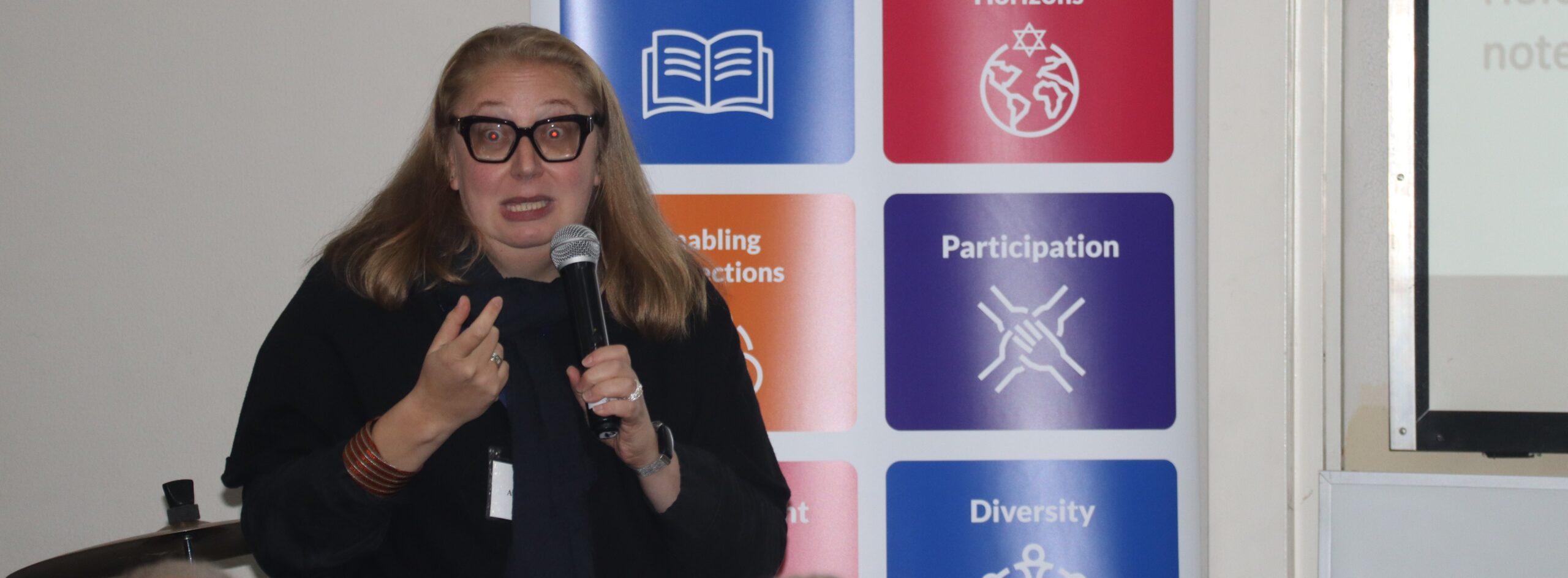
Aviva Dautch, the executive director of Jewish Renaissance magazine and the first ever scholar-in-residence for Oxford University’s Vera Fine Grodzinski Jewish Women’s Voices Programme, told Limmud Johannesburg on 18 August, “We can’t throw away his Jewishness because you don’t like his politics or because maybe he’s not part of the mainstream community.”
What Dautch has studied of Kentridge’s work and his statements shows her that there’s a Jewish consciousness that drives everything he does.
“I’m not saying that Kentridge is by any means religious,” she said. “When there are concepts of G-d, he’s often either using African proverbs or accidentally using Christian proverbs or Christian conceptions of G-d. But there’s a deep root of Jewish language that lies under what he does.”
Dautch said Kentridge’s political art often uses the inherently Jewish ideas of ambiguity, contradiction, and uncompleted gestures.
Judith Hecker, the co-curator of Kentridge’s exhibition at the Museum of Modern Art in New York in 2010, William Kentridge: Five Themes, said that in this exhibition, there were many themes, one of which was Jewishness. Hecker also alluded to the fact that Kentridge draws on the idea of the oppressor and the oppressed, and guessed that the Holocaust must have something to do with that.
Dautch disagrees with that idea, because if you look at Kentridge’s family background, his family immigrated to South Africa from Lithuania long before the Holocaust.
“You can’t be a 20th-century Jewish artist without the Holocaust looming somewhere in your mind, experience, work. But with Kentridge, is that what you would say is at the top of his mind? No,” she said. “This is a family who emigrated long before the Holocaust. If you were to talk about the oppressed and the oppressor in Kentridge’s work, where does that come from? Apartheid.”
Furthermore, Dautch argues that though Kentridge used his art as a form of resistance to apartheid, as he gets older, he has realised that all of his family’s activism is rooted in his grandfather’s experience with Jewish immigration.
“The older he gets, the more he sees his grandfather and his great-grandfather in his face,” she said. “He is more and more beginning to draw his face.”
Dautch then focused on Kentridge’s animation series, 9 Drawings for Projection, in which he depicts semi-autobiographical characters Soho Eckstein and artist Felix Teitlebaum. Dautch said that over the films, the characters slowly turn into Kentridge, and in turn, resemble his grandfather.
“He is portraying others, but he’s also portraying himself. And he’s portraying that kind of debate in the Jewish community about the artists, the businessmen, the privileged, and the workers,” she said.
In the film Tide Table, Soho Eckstein is depicted wearing a three-piece suit on the beach. Many in the audience said that this was a common experience growing up in South Africa.
“When he was starting his drawings for projection, the character of Eckstein shows how he deals with the fact that so many of the mine owners were Jewish, or the businessmen whom he felt were exploiting the black people were Jewish. At the same time, there were always prominent Jewish people in the anti-apartheid movement. And he tells bell hooks, a black feminist, a political figure in the United States, that a central irony exists for South African Jews.”
This is that our Passover ceremony commemorates the Jews as slaves in Egypt, yet Jews in South Africa have had immense privilege, and aren’t part of the most oppressed.
Said Dautch, “That remains an uncomfortable irony to live with. The ambiguity, the irony, and the discomfort are something he is living with.
“He’s coming out of a Jewish world,” said Dautch. “It’s a different kind of Jewish world, it’s an artistic Jewish world, but that childhood is a Jewish world many people in this room will relate to, and there is his grandfather, his father, and the grandchildren. It’s such a typical South African scene. So, an assimilated Jewish world, but that doesn’t mean it’s not a Jewish world.”
He describes the studio as a space where impulse is allowed to expand and find its place. A sound becomes a line; a line becomes a drawing; a drawing becomes a shadow; and a shadow gains the heft of a paperweight. At 70, Kentridge isn’t slowing down, eyes firmly fixed on what he cannot yet see.