





Featured Item
Stalled but strong – why Abraham Accords remain viable

The Abraham Accords are held up as the great hope for relations between Israel and surrounding Arab countries, but Rabbis Yakov Nagen and Aharon Ariel Lavi, both at the Ohr Torah Stones Blickle Institute of Interfaith Dialogue, warn that the agreements have been put under severe strain because of the Israel-Hamas war.
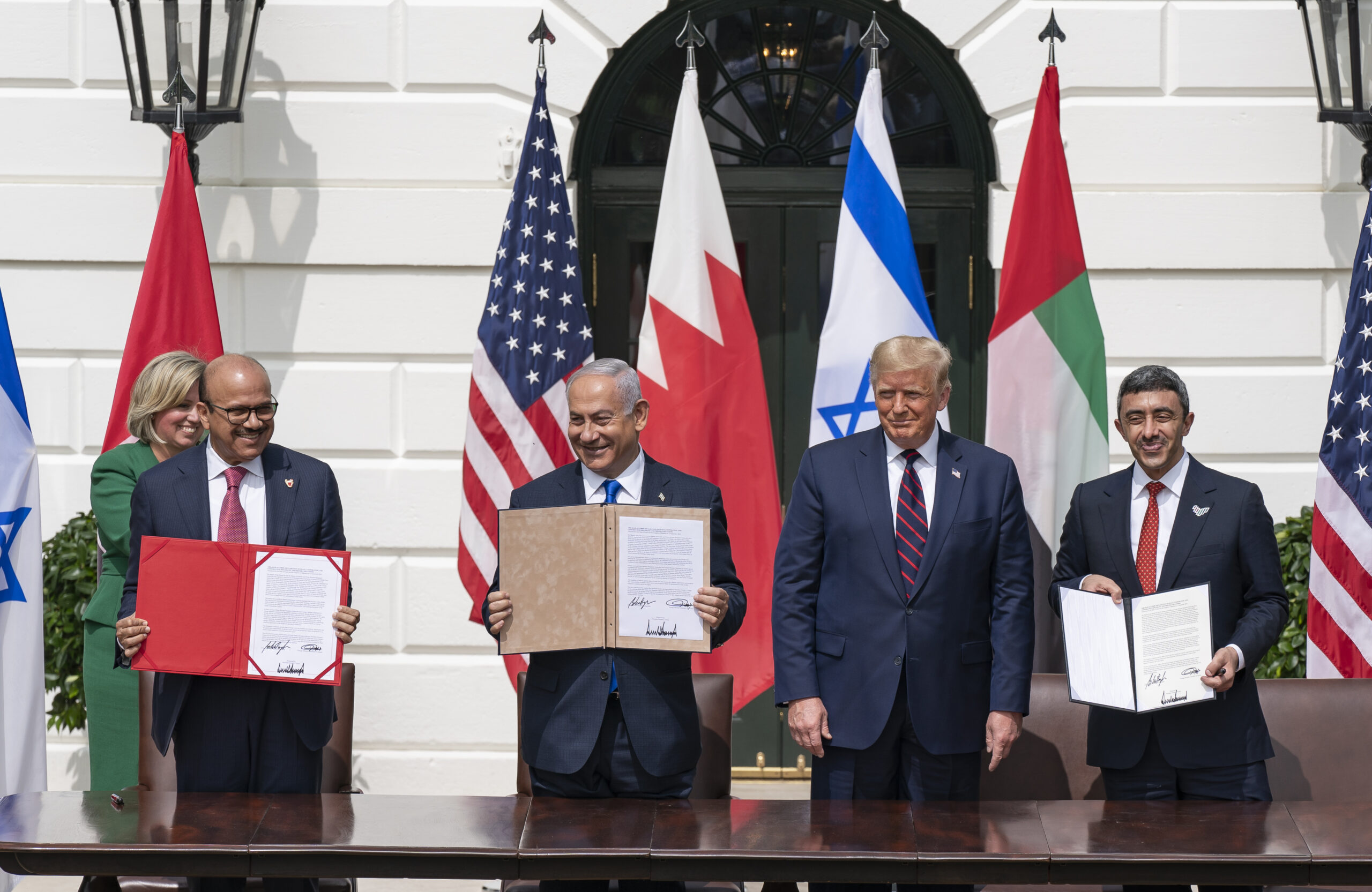
The Abraham Accords were signed in 2020 between Israel; the United Arab Emirates; and Bahrain, and were later joined by Morocco and Sudan. They represented a historic normalisation of relations between Arab states and Israel, breaking decades of hostility.
Despite the strain, Nagan, the institute’s director, is optimistic about their future. “Once there’s a ceasefire, you’ll see at least five, six more countries joining. It’s already in the making. They’re waiting for the opportunity,” he said.
But he pointed out that it didn’t look like there was going to be any new addition to the Accords at any point in the near future. He spoke at the recent Limmud South Africa after the two of them were delegates to the G20 Interfaith Summit in Cape Town.
Lavi, the institute’s managing director, implied that though the situation may not look good in the media, the Accords were still strong, but stagnating. “In Arabic, tawila, is a table. What you see on the table in the media in the Middle East isn’t exactly what happens under the table. Actually, Morocco is with us. There’s a signed $1.5 billion [R26.4 billion] security deal.”
“This distinction – between what happens in public and what happens behind closed doors – became a central theme [at the Abraham Accords],” Lavi said. “On the surface, the Accords look shaky. Bahrain hasn’t reappointed an ambassador to Israel. Sudan hasn’t formally entered the Accords. In Morocco, protests are reported every Friday in Rabat about the king, but he allows it to ventilate. Nothing more than that.”
Behind the scenes, however, they both say that there is deepening co-operation. “Saudi Arabia is in touch with us. Egypt just bought $35 billion [R616.2 billion] of gas from Israel. Even with Turkey, commerce is growing. These are the facts on the ground.”
Nagen said that the apparent conflict lay with public opinion and the role of regional media. “They have public opinion,” he told the audience at Limmud. “Al Jazeera is a huge force in the Middle East. Its boom was during the Arab Spring. It was the only media channel that attacked the rulers of other countries. That’s why it is so popular.”
Arab leaders face a paradox. “They need Israel for trade, technology, and access to the United States, but they also need to appease their audience, which Al Jazeera is brainwashing. So, they try to walk between the drops,” Nagen said.
Those involved in the Accords are worried about their own citizens’ opinions, not Israel. “Rulers in the Middle East are terrified. The main threat to them isn’t Israel or anyone else. It’s their own citizens. It’s an internal revolution,” Nagen said.
Said Lavi, “The Emiratis are okay. They’re not so afraid. But Egypt against its President Sisi [Abdel Fattah Saeed Hussein Khalil el-Sisi]; Saudi Arabia against MBS [Saudi Prime Minister Mohammed bin Salman]. That’s the threat. They need to balance their interests. They want a stable Middle East because oil isn’t going to run out. They need investors and tourism. Otherwise, there will be poverty and revolution. It’s not for the sake of their people. They need to stabilise their regimes.”
Their optimism countered the scepticism of the Limmud audience. They maintained that though the Accords look fragile when viewed through headlines and protests, the underlying trend is one of growing co-operation. Trade statistics, energy deals, and security agreements point to a reality that may be stronger than appearances suggest.
The Abraham Accords remain a complex and fragile experiment, the rabbis said. On the one hand, public protest, suspended ambassadors, and rising regional tension make them look tenuous. On the other, billion-dollar deals, quiet diplomacy, and shared security concerns show a foundation that’s not easily swept away.
Most of all, the rabbis underscored the dual nature of the Accords: they are at once political and economic, but also deeply about identity. As the opening statement reminded the audience, “Identity can divide us, but it can also unite us. It depends on whether we threaten it or respect it.”
The session didn’t end with trade figures or political analysis, but with faith, with Nagen drawing on the Quran and the Jewish mystical text, the Zohar, to remind participants that peace isn’t only possible but deeply rooted in both traditions.
Identities need not collide, Nagen said. The Quran and the Zohar alike speak of enemies becoming brothers. In a region often defined by division, the Abraham Accords may be less about erasing differences and more about proving that coexistence is possible.
His message was clear, “Yes, family relations are tense, but sometimes we could return to our fraternity and from enemies, and be turned to be siblings.”



